
Day and Night: A Spinning World
PicoBuddyUpper ElementaryInformational2 min read346 words
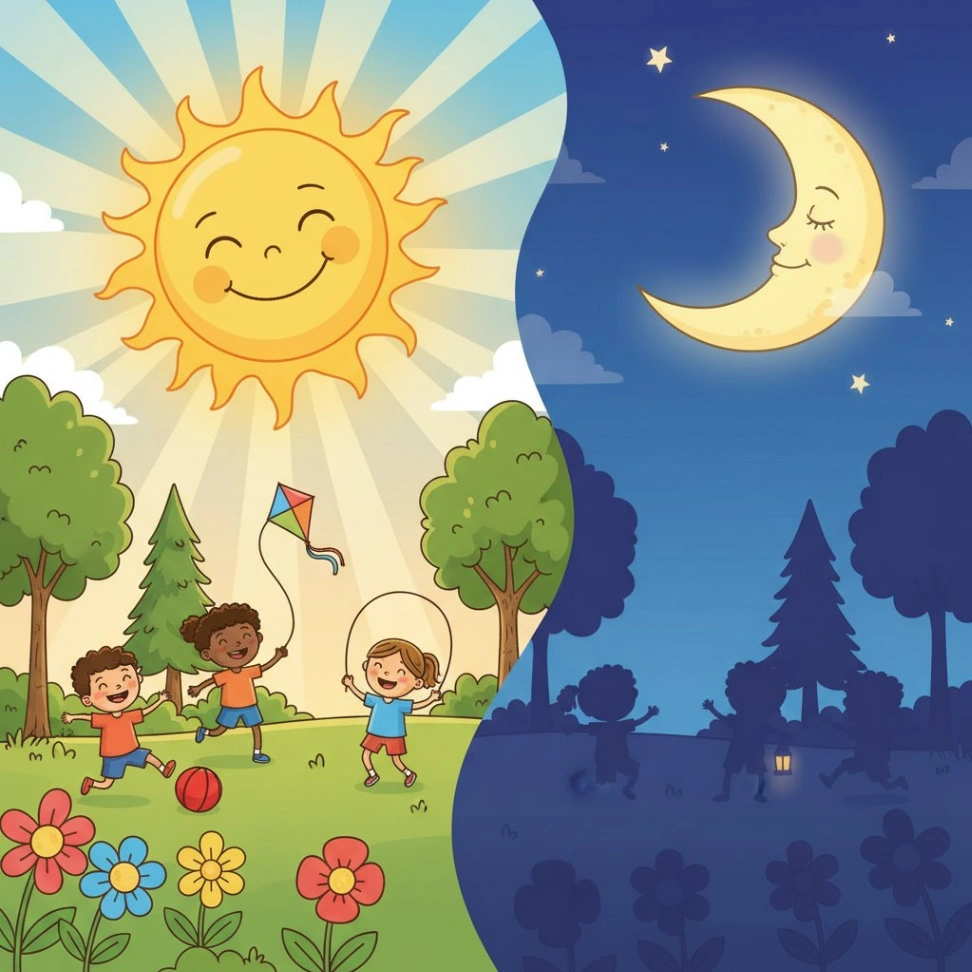
Day and Night: A Spinning World
Have you ever wondered why we have day and night? It's all thanks to our amazing planet, Earth, and its constant spinning! Let's explore how this works and how it affects different places around the world.
The Earth's Rotation
Imagine Earth as a giant ball spinning in space. This spinning is called rotation. It takes Earth about 24 hours to make one complete spin. That's why we have a day that is about 24 hours long! As Earth spins, different parts of the planet face the Sun. The part facing the Sun has daylight, while the part facing away from the Sun experiences night.
What Causes Day and Night?
Think of shining a flashlight on a ball in a dark room. Only the part of the ball that the flashlight shines on is lit up. The same thing happens with Earth and the Sun. As Earth rotates, the side facing the Sun is lit up, giving us day. The side facing away from the Sun is in darkness, giving us night.
Day and Night Around the World
Because Earth is round, not all places on Earth have day and night at the same time. When it's daytime in one place, it's nighttime in another! For example, when kids in the United States are waking up for school, kids in Australia are getting ready for bed. The world keeps spinning, and the Sun keeps shining.
Time Zones
To help keep track of time around the world, we use time zones. Time zones are areas that share the same time. Because of Earth's rotation, different time zones experience day and night at different times. This is why when you call someone in another country, you need to think about what time it is there!
In summary, day and night are caused by Earth's rotation. As our planet spins, different parts of the world are lit up by the Sun, giving us day, while other parts are in darkness, giving us night. Understanding this helps us appreciate how our world works!
- Rotation:
- The spinning of Earth on its axis.
- Time Zone:
- An area that shares the same time.
- Axis:
- An imaginary line that passes through Earth from the North Pole to the South Pole.
- constant:
- Happening all the time without stopping.
- daylight:
- Natural light that comes from the sun during the daytime.
- appreciate:
- To understand and value the importance of something.
You Might Also Like


About this informational passage for Upper Elementary
“Day and Night: A Spinning World” is a informational reading passage about Earth Science, written for Upper Elementary. It takes about 2 minutes to read (346 words) and comes with an interactive quiz and a printable worksheet with comprehension questions and an answer key.