
Marie Curie: A Pioneer of Science
PicoBuddyMiddle SchoolBiography3 min read463 words
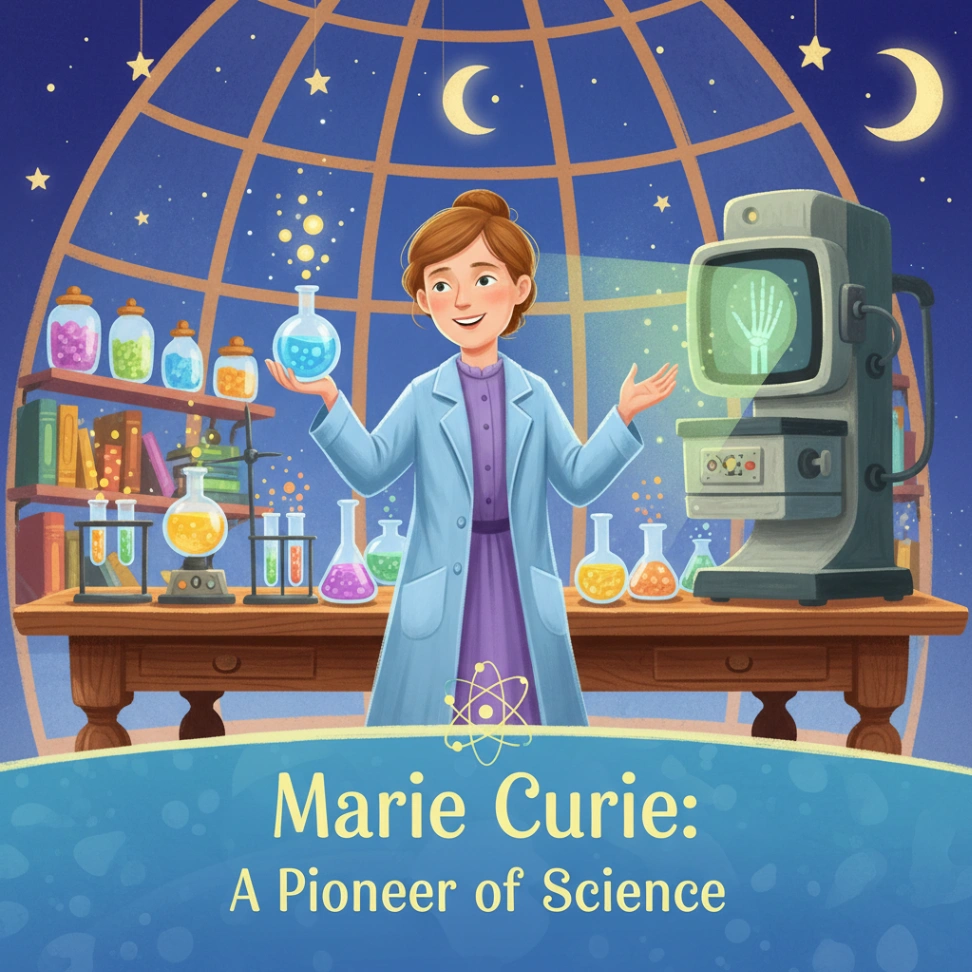
Marie Curie: A Pioneer of Science
Marie Skłodowska Curie, born Maria Skłodowska in Warsaw, Poland, on November 7, 1867, was a groundbreaking scientist whose work transformed our understanding of radioactivity and its applications. Her life was marked by relentless curiosity, dedication to scientific research, and a commitment to making a difference in the world.
Early Life and Education
Growing up in Poland under Russian rule, Maria faced significant obstacles to pursuing her education. Women were often excluded from higher learning. However, her parents valued education, and Maria excelled in her studies. To fund her sister Bronisława's medical studies in Paris, Maria worked as a governess. In return, Bronisława promised to support Maria's education later. This pact allowed Maria to move to Paris in 1891 and enroll at the Sorbonne, a prestigious university.
Groundbreaking Research
In Paris, Maria met Pierre Curie, a physicist who shared her passion for science. They married in 1895 and began working together to investigate the phenomenon of radioactivity, recently discovered by Henri Becquerel. Unlike Becquerel, who studied uranium, the Curies investigated other substances. They painstakingly processed tons of pitchblende, a uranium-rich ore, in a dilapidated shed to isolate the elements responsible for the intense radioactivity. In 1898, they announced the discovery of two new elements: polonium, named after Maria's native Poland, and radium, from the Latin word for "ray."
Nobel Prizes and Recognition
The Curies' work revolutionized physics and chemistry. In 1903, they were jointly awarded the Nobel Prize in Physics, along with Henri Becquerel, for their research on radioactivity. This made Marie Curie the first woman to win a Nobel Prize. After Pierre's tragic death in 1906, Marie continued their research and became the first woman professor at the Sorbonne. In 1911, she received the Nobel Prize in Chemistry for her discovery and isolation of radium, making her the first person to win Nobel Prizes in two different sciences.
Impact and Legacy
Marie Curie's discoveries had a profound impact on medicine, particularly in the development of X-rays and radiation therapy for cancer treatment. During World War I, she developed mobile X-ray units, known as "petites Curies," to help diagnose injuries on the front lines. Her work laid the foundation for nuclear physics and chemistry. Marie Curie died on July 4, 1934, from aplastic anemia, likely caused by prolonged exposure to radiation. Her legacy as a pioneering scientist, educator, and advocate for women in science continues to inspire generations.
Key Terms
- Radioactivity: The emission of ionizing radiation or particles caused by the spontaneous disintegration of atomic nuclei.
- Pitchblende: A uranium-rich ore that served as the source for the discovery of polonium and radium.
- Aplastic Anemia: A condition in which the body stops producing enough new blood cells, often caused by exposure to radiation or toxic chemicals.
- Radioactivity:
- The emission of ionizing radiation caused by the disintegration of atomic nuclei.
- Polonium:
- A radioactive element discovered by Marie and Pierre Curie, named after Poland.
- Radium:
- A highly radioactive element discovered by the Curies, used in radiation therapy.
- governess:
- A woman employed to teach and care for children in a private household.
- prestigious:
- Having a high reputation and being respected or admired.
- dilapidated:
- In very bad condition or falling apart because of old age or neglect.
- legacy:
- The lasting impact or achievements that a person leaves behind for future generations.
You Might Also Like


About this biography passage for Middle School
“Marie Curie: A Pioneer of Science” is a biography reading passage about Scientific Discovery, written for Middle School. It takes about 3 minutes to read (463 words) and comes with an interactive quiz and a printable worksheet with comprehension questions and an answer key.