
Listening Comprehension Passages: How to Help Students Understand What They Hear
Use listening comprehension passages to help students understand spoken language, build vocabulary, answer questions, and discuss what they hear.
Listening comprehension passages give students a focused way to practice understanding spoken language.
Before students can respond to a text, they need to understand the language they hear. They need to follow the topic, notice important details, understand vocabulary, remember the sequence, and think about meaning.
A listening comprehension passage gives students a short text to hear, discuss, and respond to.
This can support reading development, vocabulary growth, oral language, ESL and ELL practice, classroom discussion, and comprehension skills.
For some students, listening also reduces the pressure of decoding. But listening comprehension is not only a support for struggling readers.
It is a skill worth practicing on its own.

What are listening comprehension passages?
Listening comprehension passages are short texts students hear and respond to.
The passage may be read aloud by a teacher, parent, audiobook, text-to-speech tool, or online reading platform. Students may listen without seeing the text, or they may listen while following along with the written passage.
The goal is to understand spoken language.
Students listen for the topic, main idea, important details, vocabulary, sequence, character actions, or new information. After listening, they may answer questions, retell the passage, discuss one idea, draw a response, or reread part of the text.
A strong listening comprehension passage is not just audio in the background.
It gives students something meaningful to think about.
Why listening comprehension matters
Listening comprehension is an important part of language and reading development.
Students often understand spoken language before they can read the same level of text independently. They may be able to follow a story, understand a science topic, or explain an idea when they hear it aloud, even if the printed text is still difficult.
That matters because comprehension is not only built through silent reading.
Students also build comprehension through listening, speaking, vocabulary, discussion, and repeated exposure to language.
Listening comprehension passages can help students practice understanding language in a manageable way. They hear complete sentences, useful vocabulary, connected ideas, and different text structures. Then they respond to what they heard.
This can support later reading comprehension because students are practicing many of the same thinking skills they use when reading.
They are just accessing the language through listening first.
Listening comprehension vs reading comprehension
Listening comprehension and reading comprehension are connected, but they are not the same.
Listening comprehension means understanding spoken language.
Reading comprehension means understanding written language while also decoding print.
This difference is important. A student may understand the ideas in a passage when hearing it aloud, but struggle when reading the same passage independently. In that case, the language may not be the main barrier. The decoding load may be getting in the way.
The opposite can also happen. A student may read the words accurately but still struggle to explain the meaning. That tells us that decoding alone is not enough.
Listening comprehension practice can help teachers and parents notice what students understand when the decoding demand is lower.
When should students listen without reading?
Sometimes students should listen without seeing the text first.
This works well when the main goal is listening comprehension, oral language, vocabulary, or discussion. Students are practicing how to understand spoken language without relying on the printed words.
This can be useful for a short warm-up, ESL listening practice, vocabulary review, or a classroom discussion starter.
For example, students might listen to a short passage about penguins. After listening, they answer one main idea question and retell two facts they remember. They are practicing how to hold spoken information in memory and respond to it.
Listening without reading can help students focus on the sound, meaning, and structure of the language.
It is especially useful when you want to know what students understood from hearing the passage alone.
When should students listen and follow along?
At other times, students should listen while following along with the written text.
This works well when the goal is to connect spoken and written language. Students hear the words and see them at the same time. This can support vocabulary, pronunciation, fluency, and reading confidence.
Listening while following along can be especially helpful for students who are learning English, students who need support with fluency, or students who struggle to access the text independently.
For example, students may listen to a short passage about volcanoes while following the text on screen. Then they reread one paragraph and answer a few questions.
This routine keeps listening connected to reading.
Students hear the language, see the words, and then use the passage actively.
What questions work best after listening?
Listening comprehension questions should help students show what they understood from the passage.
The best questions are clear, focused, and connected to the goal of the activity. A short listening passage usually does not need a long worksheet. A few strong questions are often enough.
Good question types include:
- What was the passage mostly about?
- What happened first, next, or last?
- Which detail was most important?
- What does this word mean in the passage?
- Why did the character make that choice?
- What is one thing you learned?
- What question do you still have?

For younger students, oral answers may work better than written answers. For older students, a mix of multiple-choice, short-answer, and discussion questions can work well.
The goal is not to catch students out. The goal is to help them listen with purpose.
A simple listening comprehension routine
Listening comprehension practice works best when students know what to expect.
A simple routine could look like this:
- Preview the topic.
- Teach two or three important words.
- Listen to the passage once.
- Ask one quick retell question.
- Listen again or follow along with the text.
- Answer three to five comprehension questions.
- Discuss one important idea.
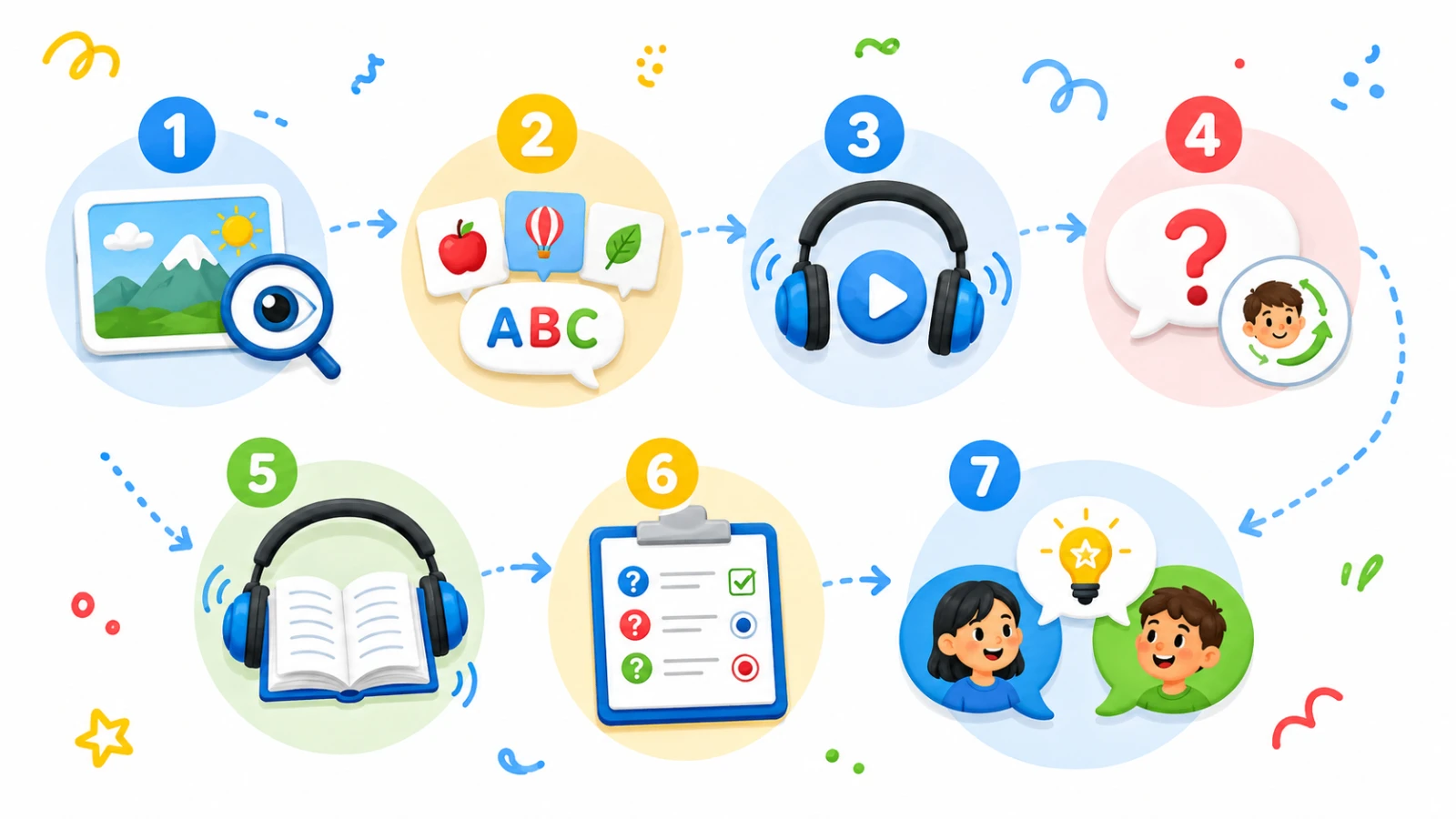
This routine can fit into a short classroom lesson, homeschool routine, tutoring session, or ESL activity.
The first listen helps students understand the general meaning. The second listen or follow along gives them a chance to notice details they missed. The questions and discussion help turn listening into active comprehension work.
Short passages work especially well because students can listen more than once without losing focus.
Best passages for listening comprehension practice
The best listening comprehension passages are short, clear, and interesting.
A passage should be long enough to give students something meaningful to understand, but not so long that they lose track of the main idea. For many elementary students, a short passage with one clear topic works best.
Good listening passages usually have a clear structure, useful vocabulary, and a small number of comprehension questions.
Topics matter too.
Students often listen more carefully when the passage connects to something they care about. Animals, sports, weather, space, mysteries, holidays, science facts, and real-world topics can all work well.
The passage should also match the goal.
If the goal is vocabulary, choose a passage with a few useful words in context. If the goal is sequence, choose a passage with clear events. If the goal is main idea, choose an informational passage with one focused topic.
The passage does not need to do everything.
It needs to support one clear listening goal well.
Listening comprehension for ESL and ELL students
Listening comprehension passages can be especially helpful for ESL and ELL students.
Students learning English are building vocabulary, pronunciation, sentence structure, listening stamina, and confidence at the same time. Hearing a passage aloud gives them a model for how English sounds in connected text.
This can help students notice rhythm, phrasing, word stress, and sentence patterns.
For English learners, it often helps to preview the topic before listening. A quick picture, short discussion, or simple vocabulary preview can make the passage easier to understand.
A helpful ESL routine might include a topic preview, a first listen, a vocabulary check, a second listen with the text, and a short speaking response.
This gives students more than one way to process the language.
They hear it, see it, think about it, and use it in conversation.
Listening comprehension for struggling readers
Listening comprehension passages can also support struggling readers.
Some students understand more than they can comfortably decode. When they hear the passage, they may be able to explain the main idea, answer questions, or join a discussion more successfully than when reading independently.
This does not mean reading instruction should stop.
Students still need opportunities to build decoding, fluency, and independent reading skills.
But listening comprehension practice can help students stay connected to meaningful language and ideas while those reading skills continue to develop.
It can also build confidence.
A student who struggles with printed text may still experience success when listening, discussing, and answering questions about a passage. That success can make reading-related tasks feel less overwhelming.
Common mistakes to avoid
Listening comprehension practice works best when it stays active and focused.
One common mistake is making the passage too long. Students may lose focus before they understand the main idea. Shorter passages often lead to better discussion and stronger answers.
Another mistake is treating listening as passive. Students should know what they are listening for. A simple purpose, question, or vocabulary focus can make the activity much stronger.
It also helps not to ask too many questions. A short passage does not need ten questions. Three to five focused questions are usually enough.
Finally, do not use every listening passage the same way. Sometimes students should listen only. Sometimes they should listen and follow along. Sometimes they should listen, reread, and answer questions.
The routine should match the goal.
Can PicoBuddy help with listening comprehension passages?
PicoBuddy helps teachers, parents, homeschool families, and intervention teams create short passages that can be used for listening comprehension practice.
This is useful because listening passages work best when they match the student’s level, topic, vocabulary needs, and learning goal.
With PicoBuddy, you can create passages by grade, topic, text type, and reading focus. You can also use comprehension questions so students have a clear reason to listen.
For example, you might create a short science passage for a listen and discuss activity, an animal passage with vocabulary questions, or an ESL-friendly passage with simple language and clear structure.
You can also use the same passage for different routines.
One group may listen and answer questions. Another group may listen, follow along, and reread. A third group may use the passage for vocabulary or discussion.
Need a listening comprehension passage for your next lesson? Browse PicoBuddy’s free reading passages or create a custom passage by grade, topic, and reading goal.
Final thoughts
Listening comprehension passages help students practice understanding what they hear.
They can support vocabulary, oral language, background knowledge, ESL and ELL instruction, classroom discussion, and reading comprehension skills.
They can also help struggling readers access meaning when decoding takes too much effort. But the main goal is not passive listening. The goal is active understanding.
When students listen with a purpose, respond to questions, discuss ideas, and connect spoken language to meaning, listening becomes real comprehension practice.

Frequently Asked Questions
Related Articles
Helping kids read better, together.
Like this article? Join 500+ educators using PicoBuddy to generate high-quality reading materials in seconds.