
25 Ways to Use Halloween for Reading, Writing & ELA
Halloween can be more than a seasonal worksheet. Use one story or topic to practice prediction, vocabulary, comprehension, fluency, Reader’s Theater, writing and more with these 25 practical ELA ideas for Grades 1–8.
Halloween is one of those classroom themes that almost plans itself. Students are already curious about ghosts, mysteries, costumes, strange creatures and spooky stories. The problem is that Halloween content can also become very worksheet-heavy, very quickly. A better starting point is to ask: what do I actually want students to practice?
One Halloween story can become a vocabulary lesson, a comprehension lesson, a fluency activity, a Reader’s Theater performance, a writing prompt and even homework. You do not need six unrelated activities when one good text can do six jobs.
That is the idea behind this guide: 25 ways to use Halloween as the context for real reading and ELA instruction across Grades 1–8.
PicoBuddy’s Halloween theme already brings together seasonal passages, vocabulary activities, printable worksheets, word games, comics and writing resources. Use those as your materials; use the ideas below to decide what students will actually do with them.
Start With the Goal, Not the Halloween Worksheet
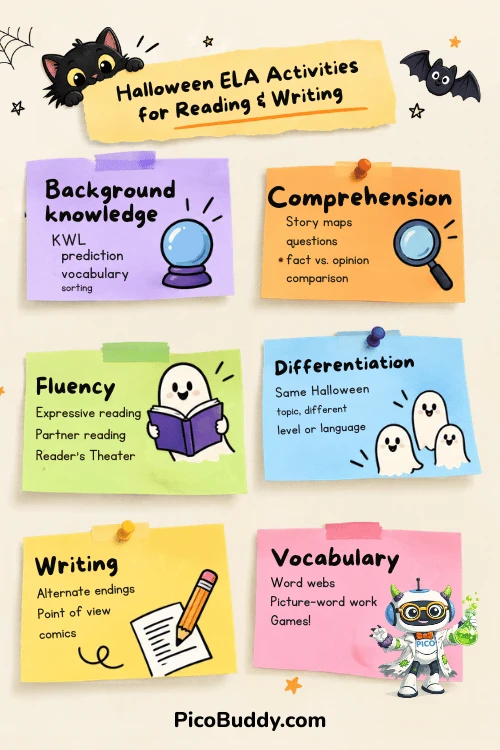
If you are short on planning time, this is the quickest way to use the list:
- Background knowledge: KWL, prediction, vocabulary sorting
- Comprehension: story maps, questions, fact vs. opinion, comparison
- Fluency: expressive reading, partner reading, Reader’s Theater
- Writing: alternate endings, point of view, comics
- Vocabulary: word webs, picture-word work, games
- Differentiation: same Halloween topic, different level or language You do not need all 25 ideas. A strong lesson may only use three. For example: KWL → read → timeline or: predict → read → character traits → Reader’s Theater or: vocabulary sort → leveled text → comic strip That is already a complete literacy lesson.
Before Reading: Give Students Something to Look For
1. Start With a Halloween KWL Chart
KWL works particularly well when students think they already know the topic. Halloween is full of assumptions: where traditions came from, why certain animals are associated with the holiday, or which customs are actually old and which are modern.
Before reading, ask students what they know and what they want to know. Afterward, return to the final column and compare their original ideas with what the text actually said.
Try pairing the Halloween KWL chart with The Ancient Origins of Halloween: The Story of Samhain. It gives the KWL chart a real purpose: students are not filling boxes because it is October; they are testing what they thought they knew.
2. Predict From the Title and Illustration
For fiction, reveal the title and illustration before the text. Ask students:
- What kind of story do you think this will be?
- What might happen?
- Which detail gives you that idea? The third question matters most. Prediction becomes much more useful when students must explain the clue behind it.
Stories such as Halloween Night in Willow Creek and The Secret Under the Stairs work well because the titles already create questions.
3. Make a Word Web
Put one Halloween word in the center: ghost, mystery, costume, night, fear.
Students add what they already associate with it. After reading, they return and add new vocabulary from the text. That small second step is what makes a word web stronger than a brainstorm. Students can literally see their vocabulary grow.
4. Use Picture-Word Matching Before the Text
For Lower Elementary and ESL/ELL learners, a few minutes of vocabulary support before reading can make a large difference.
Use PicoBuddy’s Halloween Picture-Word Match to introduce concrete words such as pumpkin, bat, ghost, costume or candy. Then ask students to say a sentence using two of the words. The matching is the warm-up. The spoken sentence is the language practice.
5. Sort the Vocabulary
Take those same words and sort them into categories. You can start with obvious groups such as characters, objects, places and actions, then make the categories harder.
Could dark be a description and a feeling? Where would nervous go? What about creepy? The discussion around the sort is often more valuable than the finished worksheet.
During Reading: Turn “I Read It” Into “I Understood It”

6. Pause and Predict Again
Prediction should not disappear once the text begins. Stop at one or two places where the story could reasonably go in different directions. Ask: What do you think will happen next, and what in the text makes you think that?
Students can revise earlier predictions as they gather more evidence. That is a much more realistic model of comprehension than being “right” on the first guess.
7. Use a Story Map as a Thinking Tool
A story map can be basic: characters, setting, problem, events, solution. But it becomes more interesting when you add one question: Which event changed the story most?
Now students have to decide what is important rather than just copy information. For younger students, complete the map together. For Upper Elementary, let pairs compare maps and defend differences.
8. Hunt for Character Traits
Halloween is perfect for character work because appearances are often misleading. A ghost can be shy. A monster can be kind. A vampire can be terrified of something ridiculous.
Ask students to use the sequence: trait → evidence → explanation For example: Bartholomew is frustrated because…
This prevents character traits from becoming a list of random adjectives. And if you plan to move into Reader’s Theater later, keep these notes. They become acting directions.
9. Let Students Write the Questions
PicoBuddy’s Thin & Thick Questions worksheet gives you an easy way to shift some of the thinking from teacher to student.
A thin question usually has one clear answer. A thick question needs explanation, inference or discussion. After reading, ask students to write one of each. Then exchange questions with another pair.
Students quickly discover that writing a genuinely good question is harder than answering one.
10. Separate Fact From Opinion
Halloween history and Halloween animals make this especially easy. Students might sort statements such as:
- Halloween has roots in older traditions.
- Bats are scary.
- Bats play an important ecological role.
- Costumes are the best part of Halloween. Then make the activity harder: ask students to explain what evidence would be needed to prove a statement is factual.
11. Compare Two Things
Comparison gives you a lot of mileage from one theme. Students can compare:
- Samhain and modern Halloween
- two characters
- two spooky stories
- myth and scientific evidence
- two different endings
PicoBuddy’s Compare Two Things worksheet works here, but the important part is the prompt. Ask students to compare something meaningful, not simply fill both sides of a Venn diagram.
12. Build a Timeline
For Halloween history, a timeline is a natural next step. Students can sequence traditions, changes or events from an informational passage. Then ask: Which change had the biggest effect on what Halloween looks like today?
That turns chronology into interpretation.
Fluency: Give Students a Reason to Read It Again
Repeated reading can be useful. It can also become painfully obvious to students that they are doing the exact same thing again.
Halloween solves that problem nicely because you can change the performance purpose without changing the text.
13. Read the Same Line in Four Different Ways
Take one sentence and read it:
- like a nervous vampire
- like a tired zombie
- like an excited ghost
- like a dramatic witch Suddenly phrasing, pace, expression and volume are concrete. You can even ask which version fits the character best and why. Now fluency connects back to comprehension.
14. Use Partner Reading With One Coaching Goal
Do not ask the listening partner to monitor everything. Give them one job:
- listen for expression
- listen for smooth phrasing
- listen for accurate reading Then switch.
A useful coaching sentence is: Read that line again and make it sound like the character really means it. That is usually more actionable than “read with more expression.”
15. Make the Final Read a Performance
If students know the third read ends in a performance, the repetition has a reason. The audience can be tiny: a partner, a table group or another pair.
The point is not a polished show. The point is that each rereading has a goal. For ready-made dialogue, PicoBuddy also has Reader’s Theater passages.
16. Turn a Halloween Story Into Reader’s Theater
This is one of the strongest ways to combine comprehension and fluency. Before students can perform a role well, they need to understand what is happening in the scene, what the character wants and how the character feels.
That means repeated reading is no longer “practice the same paragraph again.” It becomes:
- understand the scene
- understand the character
- decide how the line should sound
- rehearse
- perform
You can start with an existing Reader’s Theater text such as The Magic of the Whispering Spire. But you can also go one step further.
17. Create the Characters First, Then Write the Play
This is the Halloween activity I would give the most classroom time. Instead of handing students a finished script, let each student invent one Halloween character first.
Ask:
- Who are you?
- What are three character traits?
- What do you want?
- What are you afraid of?
- How do you speak?
You might get a forgetful mummy, an overly polite vampire, a zombie who is scared of germs and a ghost who is afraid of the dark. Now combine several characters into one group.
The group needs a simple situation: they are lost, they all want the same object, they are preparing for a party, or something has disappeared. From there, students create a short script. The learning sequence becomes:
create a character → identify traits → combine characters → create a problem → write dialogue → rehearse → perform
There is a lot happening here: character analysis, speaking, writing, perspective-taking, fluency and collaboration. And because students helped build the characters, they usually have a much stronger idea of how the lines should sound. You can even send each role home for one night of rehearsal before the performance.
After Reading: Make Students Do Something With the Text
18. Retell Without Retelling Everything
Go back to the Story Map, but add a limit.
Students have to explain the story using only the most important events. Ask: If you remove this event, can someone still understand the story? That turns retelling into summarizing.
19. Let Students Make the Quiz
Instead of another teacher-made question sheet, let students create the check. PicoBuddy’s Halloween Quiz Maker includes room for multiple-choice, true-or-false and short-answer questions.
Pairs can create three questions, exchange them and then challenge each other. The hidden comprehension task is deciding what is important enough to ask about.
20. Rewrite the Ending
Alternate endings are much better when they have rules. Tell students: You may change the ending, but you may not change who the characters are or what the main problem was.
Now they have to understand the original story before they can change it.
This is a good place to use PicoBuddy’s Halloween writing resources or the Haunted Attic Micro-Story.
21. Change the Point of View
Retell one scene from another character’s perspective. The ghost tells what happened. The monster explains why everyone misunderstood them. A side character writes a diary entry.
This is especially useful for older students because point of view forces them to infer what a character knows and does not know.
22. Turn the Story Into a Comic
A comic is not just a “fun extra.” It is a very efficient summarizing task. Students cannot include every sentence, so they have to decide:
- which moments matter
- which lines deserve dialogue
- what the image can show instead of the words
- what can be removed
That is sequencing, summarizing and writing in one activity.
Vocabulary and Extension: Keep Reusing What Students Already Know
23. Use Games After the Vocabulary Work
Word searches, scrambles, crosswords and memory games are useful, but they work better as retrieval practice than as the first encounter with the words.
So teach the vocabulary through reading, pictures, sorting or discussion first. Then use the Halloween games for review, centers or early finishers. That way the game reinforces language students have already met.
24. Keep the Topic the Same, Change the Reading Level
This is one of the easiest ways to make a Halloween lesson work in a mixed-level class. You do not need three completely different topics for three reading groups.
Keep the shared topic, story world or discussion question. Adjust the text.
With PicoBuddy Remix, you can adapt a passage to another reading level or language. Students can then read accessible versions while still joining the same whole-class conversation afterward. That is particularly useful for:
- intervention groups
- ESL/ELL students
- mixed-level classrooms
- siblings or homeschool groups at different levels The shared topic matters. It gives students something to discuss together even when their texts are not identical.
25. Send the Familiar Part Home
Homework does not have to be new work. Send home something students already understand:
- a passage they have read once
- Reader’s Theater script
- a vocabulary review
- a short quiz
- one fluency target A student can rehearse the role at home and return ready to perform. That is much more connected to the classroom lesson than a random extra worksheet.
What Would This Look Like in One Real Lesson?
If 25 ideas feel like too many, here is one simple Upper Elementary sequence:
- Before reading: Predict from the title and complete the first two columns of a KWL chart.
- Read: Use a Halloween history or mystery passage.
- During reading: Pause once for prediction and write one thick question.
- After reading: Complete a short story map or timeline.
- Next step: Turn one scene into Reader’s Theater or a comic.
- Homework: Rehearse the role or reread one short section for expression. That is one text used across several reading goals without constantly introducing new materials.
For Middle School, the same structure can become more analytical: mythology, Halloween animals, suspense, point of view, evidence and argument.
For Lower Elementary or ESL/ELL, make it more visual and oral: picture vocabulary, prediction, partner reading, retelling and drawing.
Ready to Build Your Halloween Lesson?
PicoBuddy’s Halloween theme brings the seasonal materials together, including reading passages, vocabulary activities, worksheets, comics and other ELA resources.
If you want to begin with the text itself, browse the Halloween reading passages. And if fluency or performance is your main goal, explore the Reader’s Theater passages.
The simplest planning rule is still the best one: Choose the skill first. Then choose the Halloween resource that helps students practice it.
Frequently Asked Questions
Related Articles

Helping kids read better, together.
Like this article? Join 500+ educators using PicoBuddy to generate high-quality reading materials in seconds.