
How Many Questions Should a Reading Comprehension Passage Have?
Most reading comprehension passages work best with 4 to 8 questions, depending on grade level, passage length, and lesson goal. Learn how many questions to use and what types to include.
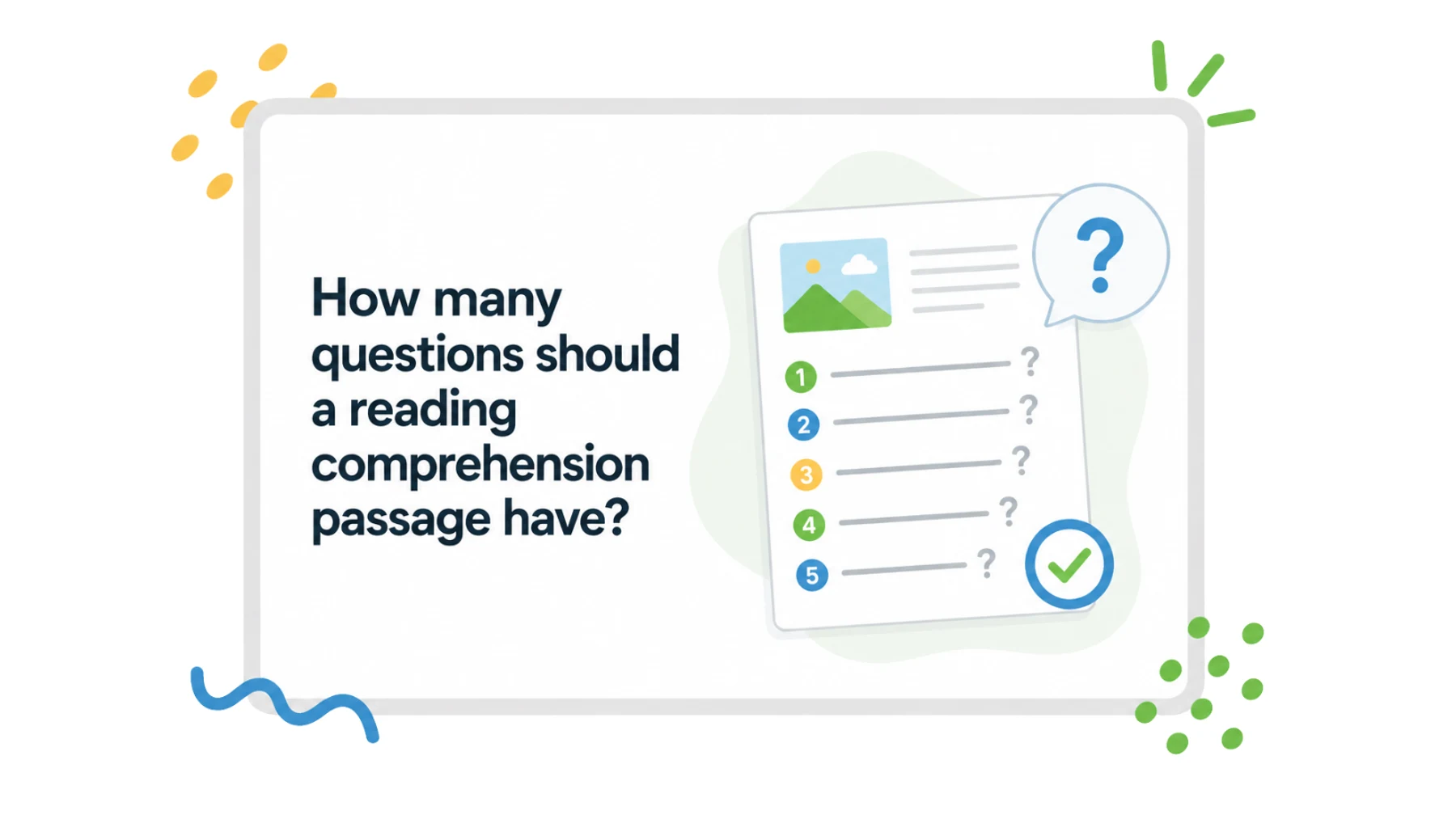
There is no single required number of questions for a reading comprehension passage. 4 to 8 questions can be a practical starting point for a short lesson, but one well-chosen question may be enough for a focused task. The ranges below are planning examples, not research-based requirements.
The best number depends on the passage length, grade level, reading goal, and student ability.
More questions are not always better. A short set of well-chosen questions can teach more than a long worksheet full of repetitive questions. The goal is not to ask as many questions as possible. The goal is to help students understand the text, think about what they read, and practice the right reading skill.
How many questions should a reading comprehension passage have?
For a short comprehension lesson, you might start with 4 to 8 questions, then adjust the set to your goal and available time.
For example, you might choose 3 to 5 questions for a short passage, 5 to 8 for a broader elementary lesson, or 8 to 10 for a longer task. These are options, not targets every student should complete.
Possible starting ranges:
| Passage type | Suggested number of questions |
|---|---|
| Short beginner passage | 3 to 5 questions |
| Standard elementary passage | 5 to 8 questions |
| Longer upper elementary passage | 6 to 10 questions |
| Middle school passage | 8 to 10 questions |
| Full lesson or assessment passage | 8 to 12 questions |
The number should always match the purpose of the activity. A quick fluency check may only need 2 or 3 questions. A full reading comprehension lesson may need 8 or more.
Example question counts by grade level
Use this table as a planning example, not a developmental standard. Students in any grade can discuss meaning, make inferences, and use text details with suitable support. Adjust the number for question complexity, response format, language demands, and the learner.
| Grade level | Suggested number of questions | Why |
|---|---|---|
| Grade 1 | 3 to 4 questions | Keep it short, clear, and concrete |
| Grade 2 | 4 to 5 questions | Focus on story events, details, and simple vocabulary |
| Grade 3 | 5 to 6 questions | Add main idea and simple inference |
| Grade 4 | 6 to 8 questions | Include text evidence, vocabulary, and deeper thinking |
| Grade 5 | 6 to 8 questions | Add theme, author’s purpose, cause and effect |
| Grades 6 to 8 | 8 to 10 questions | Use more analysis and evidence-based questions |
For example, a Grade 1 passage about a pet may only need three simple questions:
- Who is the passage about?
- What did the pet do?
- How did the character feel?
A Grade 5 passage about space exploration may need more questions because students can practice main idea, vocabulary, cause and effect, inference, and text evidence.
The best question mix for a reading passage
The number of questions matters, but the type of questions matters even more.
A passage with 5 strong questions is usually better than a passage with 12 weak questions. A strong question set checks different parts of understanding.

A good reading comprehension passage often includes:
-
A literal question
This checks whether students understood something directly stated in the passage.
-
A main idea question
This asks students to identify what the passage is mostly about.
-
A detail question
This asks students to find important information in the text.
-
A vocabulary question
This helps students understand words in context.
-
An inference question
This asks students to use clues from the passage to figure something out.
-
A text evidence question
This asks students to support an answer with information from the passage.
-
An extension or opinion question
This is optional, but useful for discussion, writing, or deeper thinking.
A simple 5-question set might look like this:
- What is the passage mostly about?
- Which detail from the passage supports the main idea?
- What does the word “curious” mean in the passage?
- What can you infer about the character?
- Which sentence from the passage supports your answer?
This gives students a balanced comprehension check without making the activity too long.
Example question sets by passage length
The right number of questions also depends on how long the passage is.
Short passage: 100 to 200 words
For a short passage, 3 to 5 questions is one possible starting set. A focused activity may need fewer.
This works well for:
- Grade 1 and Grade 2
- ESL beginners
- Quick reading practice
- Morning work
- Fluency practice
- Short homework tasks
A good question mix for a short passage could be:
- Who or what is the passage about?
- What happened first?
- What is one important detail?
- What does one key word mean?
- How did the character feel?
Medium passage: 250 to 500 words
For a medium-length passage, you might choose 5 to 8 questions if they serve the lesson goal.
This is common for:
- Grade 3 to Grade 5
- Small group reading
- Independent practice
- Homework
- Standard reading comprehension lessons
A good question mix might be:
- What is the main idea?
- Which detail supports the main idea?
- What can you infer from the passage?
- What does this word mean in the passage?
- What happened because of this event?
- Which sentence gives evidence for your answer?
- What lesson, message, or important idea can you take from the passage?
This gives students enough practice without turning the passage into a long test.
Longer passage: 600+ words
A longer passage can use 8 to 12 questions, especially for older students.
This works well for:
- Grades 6 to 8
- Deeper analysis
- Test preparation
- Multi-skill practice
- Written response activities
A longer passage might include questions about:
- Main idea
- Author’s purpose
- Vocabulary
- Inference
- Text evidence
- Cause and effect
- Compare and contrast
- Theme or central message
- Text structure
- Written response
Even with longer passages, every question should have a purpose. Avoid adding extra questions just to make the worksheet look longer.

When fewer questions are better
Sometimes fewer questions are the better choice.
Use fewer questions when:
- The passage is short
- The student is young
- The goal is fluency
- The activity is a warm-up
- The student is an ESL or ELL learner
- You are focusing on one reading skill
- Students will discuss the passage orally
- The passage is used for homework and should feel manageable
For example, if the goal is to practice oral reading fluency, you may not need 8 comprehension questions. You may only need 2 or 3 quick questions to check whether the student understood the passage.
If the goal is to teach main idea, you may only need one main idea question, one supporting detail question, and one discussion question.
In focused reading practice, 3 strong questions can be better than 10 weak ones.
When more questions are useful
More questions can be useful when the passage is longer or the lesson has a bigger goal.
Use more questions when:
- Students are preparing for a test
- The passage is part of a full lesson
- You want to assess several skills
- Students need written practice
- Older students are analyzing a more complex text
- The passage includes multiple sections or ideas
- You want to include both multiple-choice and open-ended questions
For example, a middle school passage about climate change might include questions about vocabulary, main idea, cause and effect, author’s purpose, evidence, and written response.
That kind of passage can support more questions because the text has more depth.
But question overload is still a risk. If students spend more energy getting through the worksheet than thinking about the passage, there may be too many questions.
Multiple-choice vs open-ended questions
Reading comprehension passages can include multiple-choice questions, open-ended questions, or a mix of both.
Multiple-choice questions are useful for:
- Quick checks
- Online quizzes
- Independent practice
- Younger students
- Test preparation
- Easy grading
Open-ended questions are useful for:
- Discussion
- Writing practice
- Deeper thinking
- Explaining evidence
- Small group lessons
- Teacher-led instruction
For many elementary passages, a balanced set works best. For example:
- 4 multiple-choice questions
- 1 vocabulary question
- 1 short written response
This gives students a mix of quick comprehension practice and deeper thinking.

How many questions should an ESL or ELL passage have?
For a short ESL or ELL task, 3 to 5 clearly worded questions can be a starting point. English proficiency alone does not determine a student's thinking ability or the number of questions they need.
The questions should use simple wording and avoid unnecessary confusion. For English language learners, the goal is not to trick the student. The goal is to help them understand the text, build vocabulary, and gain confidence.
A good ESL or ELL question set might include:
- One who, what, or where question
- One sequence or detail question
- One vocabulary question
- One simple inference question
- One personal connection or discussion question
For example, after a short passage about food, the questions could be:
- What food is the passage about?
- Where does the character eat lunch?
- What does the word “favorite” mean?
- Why do you think the character smiled?
- What is your favorite food?
As students become stronger readers, you can add more challenging questions about evidence, cause and effect, or author’s purpose.
Quick planning examples
These ranges are optional starting points, not minimums or grade requirements:
Use this simple guide:
- 3 to 5 questions for short or beginner passages
- 5 to 8 questions for most elementary reading passages
- 8 to 10 questions for longer or more advanced passages
- 8 to 12 questions for full lessons or assessments
But remember: the best number is the number that supports the reading goal.
A passage does not need a long list of questions to be useful. It needs the right questions.
To plan the rest of the activity around those questions, explore teaching reading comprehension in elementary school, from choosing a passage to discussing what students understood.

Can PicoBuddy create reading passages with questions?
Yes. Teachers and parents do not always have time to write both a passage and comprehension questions from scratch.
With PicoBuddy, you can browse free reading passages or create a custom reading passage by choosing a grade level, topic, and text type. You can use passages for classroom lessons, homeschool reading, ESL practice, independent reading, or online quizzes.
For example, you can create:
- A Grade 3 fiction passage with 5 comprehension questions
- A Grade 4 informational passage with vocabulary questions
- A Grade 5 sports passage with inference questions
- A beginner ESL passage with simple multiple-choice questions
- A middle school passage with text evidence questions
Need a passage with the right number of questions? Browse PicoBuddy’s free reading passages or create your own passage and quiz in minutes.

Frequently Asked Questions
Related Articles
Helping kids read better, together.
Like this article? Join 500+ educators using PicoBuddy to generate high-quality reading materials in seconds.