
How Reading Comprehension Develops from Grade 1 to Grade 5
Reading comprehension develops step by step from Grade 1 to Grade 5. Learn which skills students practice at each grade level and how to choose the right reading passages.
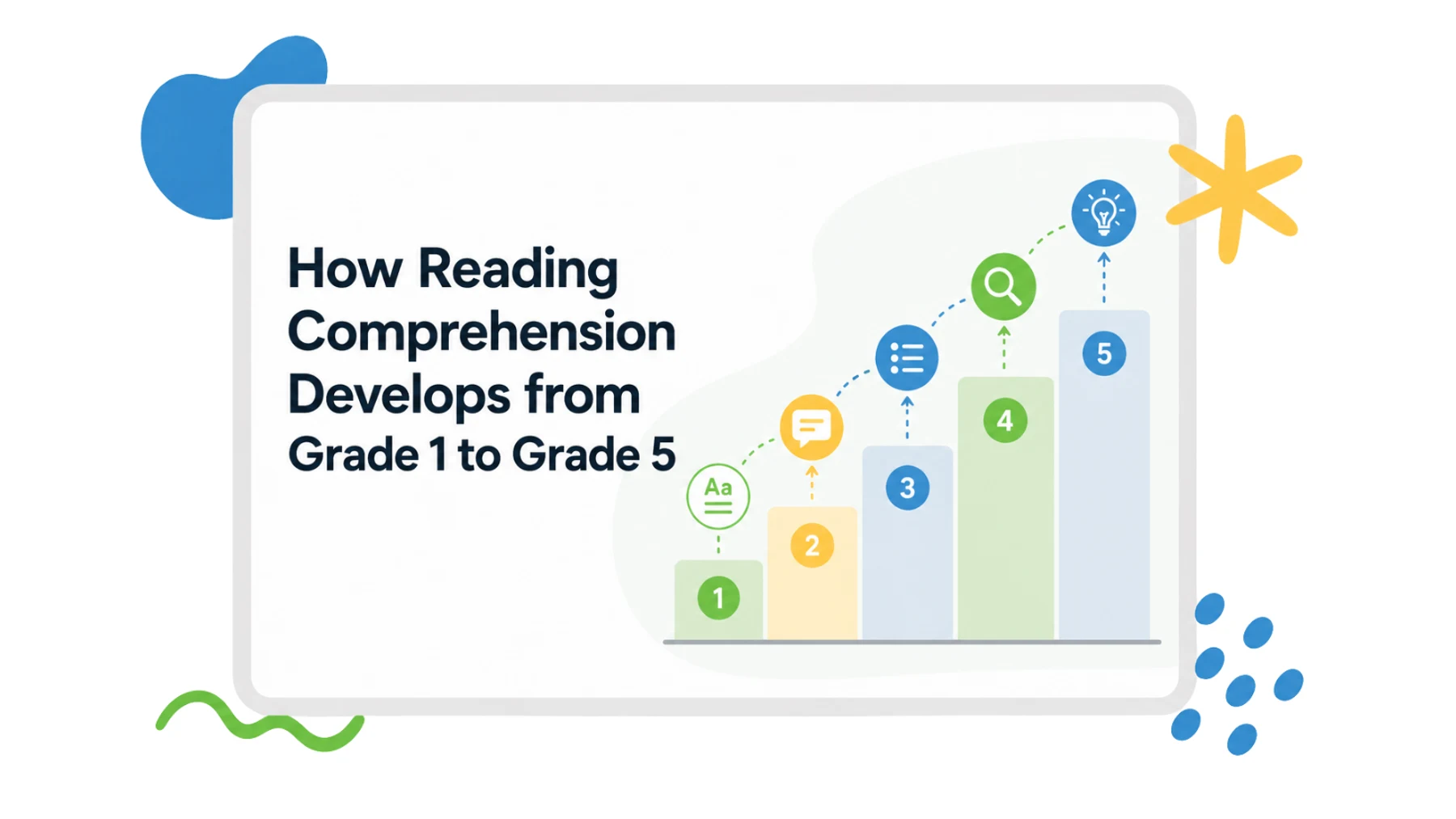
Reading comprehension develops step by step throughout elementary school. A Grade 1 student and a Grade 5 student are both learning to understand what they read, but the type of thinking expected from them is very different.
In Grade 1, students often focus on simple understanding: who is in the story, what happened, and where the story takes place. By Grade 5, students are usually expected to explain theme, compare ideas, understand author’s purpose, and support answers with evidence from the text.
This is why choosing the right reading passage matters. A good passage should match the student’s grade level, reading ability, interests, and lesson goal.
How does reading comprehension develop in elementary school?
Reading comprehension is not one single skill. It is a group of skills that grow over time.
In the early grades, students learn to understand simple stories and short texts. They answer concrete questions, retell events, and connect words with meaning.
As students move through elementary school, they begin to think more deeply. They learn to identify the main idea, use context clues, make inferences, compare information, explain text evidence, and understand the author’s purpose.
The following are connected areas of comprehension practice, not a fixed sequence that every child follows:
- Understanding simple events
- Retelling what happened
- Identifying characters, setting, and key details
- Finding the main idea
- Using context clues
- Making simple inferences
- Explaining answers with text evidence
- Comparing ideas
- Understanding theme and author’s purpose
- Reading longer fiction and nonfiction texts
Students do not simply read “harder texts” each year. They also learn to think about texts in more complex ways.

Quick overview: reading comprehension by grade level
This table gives examples of lesson emphases, not developmental milestones or limits on what children can discuss. Younger students can make inferences and explain text clues with support; older students may still need help with foundational skills. Text complexity, vocabulary, background knowledge, decoding, and instructional support all affect the task.
| Grade | Main comprehension focus | Typical passage type | Question style |
|---|---|---|---|
| Grade 1 | Basic understanding, characters, events | Short fiction, simple nonfiction | Who, what, where |
| Grade 2 | Sequence, details, simple vocabulary | Short stories, simple informational texts | What happened first, why, how |
| Grade 3 | Main idea, details, simple inference | Fiction and nonfiction | Main idea, detail, vocabulary |
| Grade 4 | Inference, text evidence, cause and effect | Longer fiction and nonfiction | Explain, support, infer |
| Grade 5 | Theme, author’s purpose, compare and contrast | More complex nonfiction and fiction | Analyze, compare, justify |
Grade 1 reading comprehension: building basic understanding
Grade 1 students are often still building decoding, fluency, vocabulary, and confidence. At this stage, reading comprehension is usually very concrete.
Students are learning to understand what is happening in a short text. They may still need support from pictures, repeated reading, simple questions, and familiar topics.
Grade 1 students often practice:
- Understanding who or what the text is about
- Identifying characters
- Naming the setting
- Remembering what happened
- Answering simple who, what, and where questions
- Retelling a short story
- Connecting pictures and text
- Understanding simple facts
Good Grade 1 reading passages are usually short, clear, and focused. They often have one main event or idea. The questions should be simple and direct.
Example Grade 1 questions:
- Who is in the story?
- Where does the story happen?
- What did the character do?
- What happened at the end?
- How did the character feel?
For 1st grade, keep the text and response demands manageable. Students can also explain a character's feelings or make a simple inference through supported discussion.
Grade 2 reading comprehension: following events and details
By Grade 2, many students become more comfortable reading short texts. They can often follow a story from beginning to end and answer questions with more detail.
Grade 2 reading comprehension usually focuses on sequence, details, character feelings, and simple problem and solution.
Grade 2 students often practice:
- Retelling the beginning, middle, and end
- Understanding sequence of events
- Identifying key details
- Explaining a simple problem and solution
- Understanding character feelings
- Recognizing simple cause and effect
- Learning new vocabulary from context
- Answering short comprehension questions
Good Grade 2 passages can be slightly longer than Grade 1 passages, but they should still be clear and manageable. Stories with familiar problems work well. Simple informational texts also become more useful at this stage.
Example Grade 2 questions:
- What happened first?
- What happened after the character opened the box?
- Why did the character feel happy?
- What problem did the character have?
- Which detail tells you where the story takes place?
Grade 2 is a good time to help students move from simply answering “what happened?” to explaining “why did it happen?”

Grade 3 reading comprehension: moving into main idea and inference
Grade 3 is an important transition year. Students are often expected to move beyond basic understanding and begin explaining what a passage is mostly about.
They can extend their use of text clues to explain inferences in more demanding passages. Inference can be practiced earlier too, through a suitable text and guided discussion.
Grade 3 students often practice:
- Finding the main idea
- Identifying supporting details
- Understanding vocabulary in context
- Making simple inferences
- Summarizing short texts
- Comparing simple ideas
- Understanding fiction and nonfiction
- Explaining answers more clearly
Good Grade 3 passages often include a clear topic, more developed paragraphs, and a mix of fiction and informational text. The questions can become more varied.
Example Grade 3 questions:
- What is the main idea of the passage?
- Which detail supports the main idea?
- What does this word mean in the passage?
- What can you infer about the character?
- What is a good summary of the passage?
Grade 3 is often where reading comprehension starts to feel more academic. Students are still reading stories, but they are also expected to handle more nonfiction and skill-based questions.
Grade 4 reading comprehension: using evidence and deeper thinking
By Grade 4, students usually read longer passages and answer questions that require more reasoning.
They are expected to explain their thinking, not just choose an answer. They may need to support answers with details from the text. This is where text evidence becomes more important.
Grade 4 students often practice:
- Making inferences
- Using text evidence
- Understanding cause and effect
- Comparing characters or ideas
- Understanding author’s purpose
- Reading longer nonfiction passages
- Identifying theme in simpler stories
- Explaining answers in more detail
Good Grade 4 passages often include longer paragraphs, richer vocabulary, and questions that ask “why” and “how.” Students may read more science, history, biography, and informational text.
Example Grade 4 questions:
- Which sentence supports your answer?
- What can you infer from this detail?
- Why did the event happen?
- What was the author’s purpose?
- How did the character change during the passage?
Continue teaching students to return to the text: “I think this because the passage says…” This habit can begin in earlier grades and develop with increasingly complex texts.

Grade 5 reading comprehension: analyzing complex ideas
Grade 5 students are usually preparing for middle school reading. They need to understand longer texts, compare ideas, and explain their thinking with more independence.
Reading comprehension in Grade 5 often includes deeper analysis. Students may read fiction, nonfiction, biographies, argumentative texts, and passages connected to science or social studies.
Grade 5 students often practice:
- Identifying theme
- Understanding author’s purpose
- Comparing and contrasting texts
- Analyzing characters
- Identifying text structure
- Using evidence to support answers
- Understanding figurative language
- Interpreting more complex nonfiction
- Drawing conclusions
- Writing short responses about reading
Good Grade 5 passages often include richer vocabulary, multiple paragraphs, deeper questions, and real-world topics. Students should be asked to explain how they know an answer, not just what the answer is.
Example Grade 5 questions:
- What is the theme of the passage?
- How does the author support the main idea?
- How are these two ideas alike and different?
- Which evidence best supports your answer?
- What conclusion can you draw from the passage?
Grade 5 reading comprehension should help students become more independent, thoughtful readers.
Fiction and nonfiction development from Grade 1 to Grade 5
Students should read both fiction and nonfiction throughout elementary school. The balance may change over time, but both text types are important.
Fiction helps students understand characters, events, feelings, plot, and theme. Nonfiction helps students build knowledge, vocabulary, main idea skills, and academic reading confidence.
| Grade | Fiction role | Nonfiction role |
|---|---|---|
| Grade 1 | Builds story understanding | Introduces simple facts |
| Grade 2 | Strengthens sequence and character understanding | Builds topic vocabulary |
| Grade 3 | Supports main idea and inference | Becomes more important for learning |
| Grade 4 | Develops theme and deeper inference | Builds evidence and content knowledge |
| Grade 5 | Supports analysis and theme | Prepares students for academic reading |
Use both fiction and nonfiction from the early grades. Choose the first text by its fit with the lesson, the learner's interests and knowledge, and the language demands, rather than assuming stories are always easier.
By Grades 3 to 5, nonfiction becomes increasingly important because students need to read to learn. They are no longer only practicing reading. They are using reading to understand science, history, people, places, and ideas.
If you are deciding where to start, see Should students read fiction or nonfiction first?

How comprehension questions change by grade
Reading comprehension questions should become more complex as students grow.
A Grade 1 student may answer a simple question about what happened. A Grade 5 student may need to explain how the author supports an idea.
| Grade | Good question example |
|---|---|
| Grade 1 | Who is in the story? |
| Grade 2 | What happened after the character opened the door? |
| Grade 3 | What is the main idea of the passage? |
| Grade 4 | Which detail supports your inference? |
| Grade 5 | How does the author support the central idea? |
This progression matters because question quality shapes reading practice.
If questions are too simple, older students may not grow. If questions are too difficult, younger students may feel frustrated.
A good question should match the student’s level, the passage, and the reading goal.
For more guidance on question quality, see What makes a good reading comprehension question?
How to choose the right passage for each grade
A good reading passage should fit the student and the purpose of the lesson.
When choosing a reading passage, consider:
- Grade level
- Reading ability
- Topic interest
- Text type
- Lesson goal
- Question difficulty
- Vocabulary level
- Passage length
- Student confidence
- Need for support or challenge
Grade level is a helpful starting point, but it is not the only thing that matters.
For example, a Grade 4 student who struggles with reading may benefit from a shorter Grade 3 passage on a high-interest topic. A strong Grade 3 reader may enjoy a Grade 4 informational passage if the topic is motivating.
The right passage should feel challenging but possible.

What if a student is reading below or above grade level?
Students do not always fit neatly into one grade level. Some need easier texts to build confidence. Others need harder texts to stay engaged.
For students reading below grade level, use:
- Shorter passages
- Familiar topics
- Fewer questions
- Clear vocabulary support
- More oral discussion
- Repeated reading
- Simple fiction and nonfiction
- Confidence-building tasks
The goal is to reduce frustration while still building skill.
For students reading above grade level, use:
- Longer passages
- More complex vocabulary
- Deeper questions
- Nonfiction and biography passages
- Text evidence tasks
- Written responses
- Compare and contrast activities
- Higher-level themes and ideas
The goal is to keep the student challenged and interested.
This is also important for ELL students and mixed-level classrooms. One class may include students who can discuss the same topic, but need different reading levels. In that case, it can help to use passages on the same topic at different levels.
Can PicoBuddy help with grade-level reading comprehension?
Yes. PicoBuddy helps teachers, parents, and homeschool families find or create reading passages that match a student’s grade level and reading goal.
You can use PicoBuddy to:
- Browse ready-made passages by grade
- Choose fiction or informational texts
- Pick topics students enjoy
- Create custom passages for a specific grade
- Make passages easier or more challenging
- Generate comprehension questions
- Support classroom, homeschool, ESL, or extra reading practice
For example, you might need:
- A Grade 1 fiction passage with simple who and what questions
- A Grade 2 passage about animals with sequence questions
- A Grade 3 nonfiction passage with main idea questions
- A Grade 4 passage with inference and text evidence questions
- A Grade 5 passage about sports with author’s purpose questions
Need reading passages for a specific grade? Browse PicoBuddy’s free grade-level passages or create your own custom passage in minutes.

Final thoughts
Reading comprehension develops gradually from Grade 1 to Grade 5.
Across these grades, students revisit details, sequence, main idea, inference, theme, and evidence with increasingly demanding texts and greater independence. The grade examples above help with planning; they do not set a fixed starting age for a skill or replace attention to individual needs.
The best reading practice is matched to the student’s level and supported with clear, useful questions.
For help turning these grade-level examples into a lesson, explore teaching reading comprehension in elementary school, including passage selection, question types, and a daily reading routine.
Browse PicoBuddy’s free reading passages by grade or create a custom passage for the exact topic, level, and reading goal you need.

Frequently Asked Questions
Related Articles
Helping kids read better, together.
Like this article? Join 500+ educators using PicoBuddy to generate high-quality reading materials in seconds.