
The Complete Guide to Teaching Reading Comprehension in Elementary School
Learn how to teach reading comprehension in elementary school with grade-level skills, fiction and nonfiction passages, question types, daily routines, and practical lesson ideas.
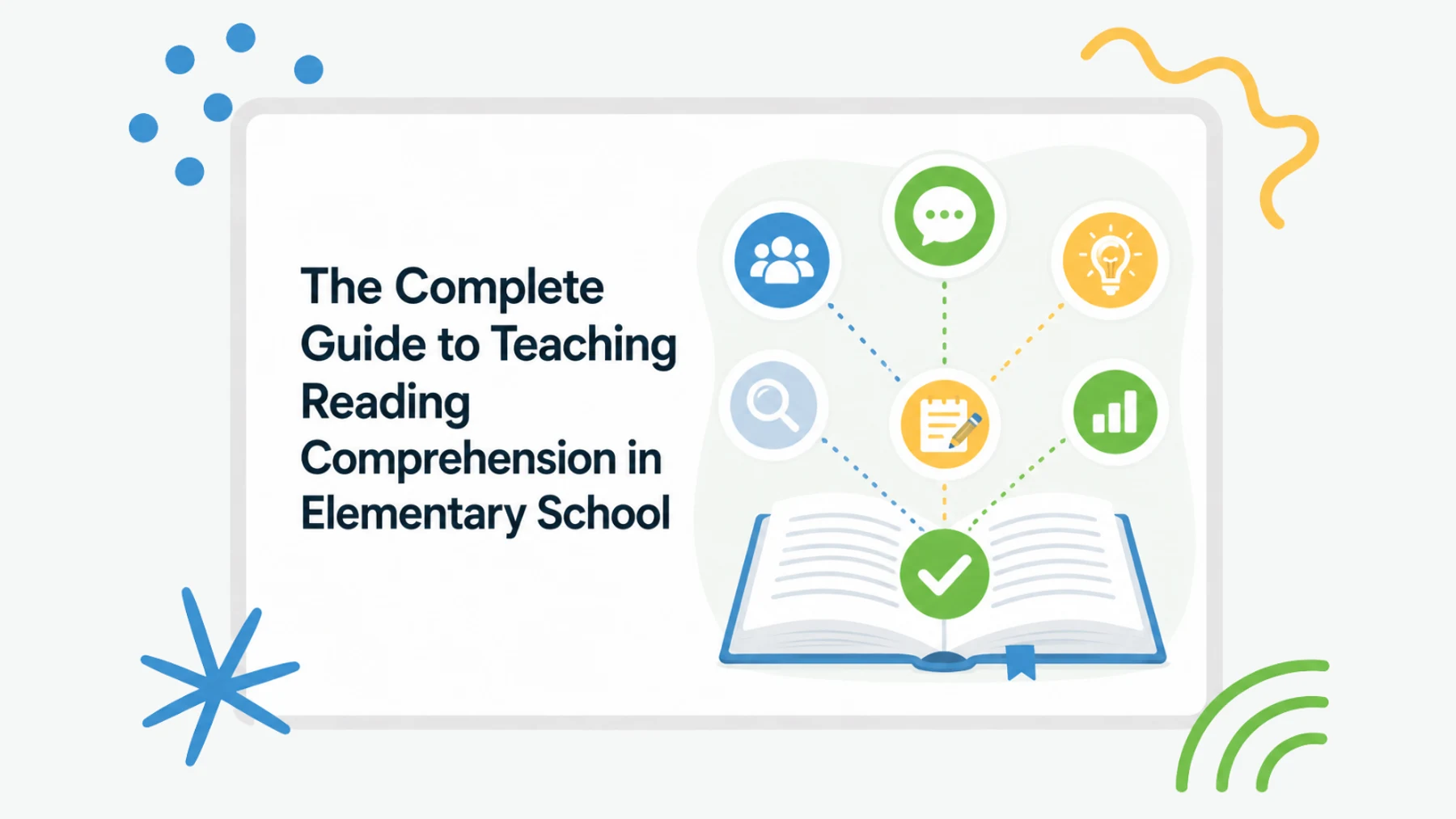
Teaching reading comprehension in elementary school can feel simple at first. Give students a text, ask a few questions, and check their answers.
But in practice, reading comprehension is much bigger than that.
Some students can read the words but struggle to explain what the passage means. Some understand stories but find nonfiction difficult. Some answer simple questions easily but get stuck on inference, main idea, text evidence, or author’s purpose.
Reading comprehension is not one single skill. It is a set of connected skills that develop gradually across elementary school.
In this guide, we will look at what reading comprehension means, how it develops by grade level, which skills students need, how to choose the right passages, how to use fiction and nonfiction, how to create better questions, and how to build simple daily reading routines.
What is reading comprehension?
Reading comprehension is the ability to understand, think about, and respond to a text.
It includes understanding the words, following the ideas, remembering key details, making inferences, and explaining meaning. A student with strong reading comprehension does not only read the text. They can also talk about it, answer questions, connect ideas, and support their thinking.
Reading comprehension includes skills such as:
- Understanding what a passage is about
- Identifying important details
- Understanding vocabulary in context
- Making reasonable inferences
- Comparing ideas
- Using evidence from the text
- Discussing meaning
- Connecting the text to a larger idea
- Understanding the author’s purpose
- Explaining a theme, lesson, or central message
It is important to remember that comprehension is more than answering questions. Questions are a tool. The real goal is understanding.
A student may answer a multiple-choice question correctly but still not fully understand the passage. Another student may explain the meaning well in a discussion, even if writing the answer is still difficult.
Good reading comprehension instruction helps students understand the text first, then gives them tools to explain their thinking.
To better understand the role of texts in reading practice, see what is a reading passage?

Why reading comprehension matters in elementary school
Reading comprehension affects almost every school subject.
Students need comprehension when they read stories, science texts, social studies passages, math word problems, instructions, test questions, online information, and everyday texts.
Strong reading comprehension helps students:
- Understand what they read
- Learn from nonfiction
- Enjoy stories
- Build vocabulary
- Follow instructions
- Answer questions with evidence
- Discuss ideas
- Become more independent learners
- Build confidence
- Prepare for harder texts in later grades
Elementary school is where students move from learning to read toward reading to learn.
In the early grades, students spend a lot of energy decoding words and understanding simple texts. As they grow, they are expected to use reading to learn new ideas. That means comprehension becomes more important every year.
A Grade 1 student may need to understand what happened in a short story. A Grade 5 student may need to compare two ideas, explain author’s purpose, and support an answer with text evidence.
This development does not happen automatically. Students need regular, focused practice with the right texts and the right questions.
How reading comprehension develops from Grade 1 to Grade 5
Reading comprehension develops step by step.
In the early grades, comprehension is usually concrete. Students answer who, what, where, and what happened questions. By upper elementary, students begin to analyze ideas, compare texts, explain evidence, and understand author’s purpose.
| Grade | Main focus | Example question |
|---|---|---|
| Grade 1 | Basic understanding, characters, events | Who is in the story? |
| Grade 2 | Sequence, details, simple why questions | What happened first? |
| Grade 3 | Main idea, details, simple inference | What is the main idea? |
| Grade 4 | Inference, evidence, cause and effect | Which detail supports your answer? |
| Grade 5 | Theme, author’s purpose, compare and contrast | How does the author support the idea? |
In Grade 1, students often focus on short texts, simple events, familiar vocabulary, and basic understanding.
In Grade 2, they begin to follow a sequence of events, explain simple problems, and understand more details.
In Grade 3, they move toward main idea, supporting details, vocabulary in context, and simple inference.
In Grade 4, they begin using text evidence, explaining answers, and reading longer nonfiction.
In Grade 5, they work with theme, author’s purpose, compare and contrast, text structure, and deeper analysis.
The passage should grow with the student. But the thinking should grow too.
Students do not simply need longer texts each year. They need better questions, richer vocabulary, more varied text types, and more opportunities to explain their thinking.
For a deeper, grade-by-grade breakdown of how these skills develop, see how reading comprehension develops from Grade 1 to Grade 5?

Core reading comprehension skills elementary students need
Elementary students need a mix of basic and deeper comprehension skills.
Some skills help students understand what is directly stated. Other skills help them think beyond the words on the page.
| Skill | What students practice | Good passage type |
|---|---|---|
| Literal understanding | Remembering what is directly stated | Fiction or nonfiction |
| Main idea | Understanding the big idea | Informational text |
| Supporting details | Finding important information | Fiction or nonfiction |
| Vocabulary in context | Understanding words from clues | Nonfiction, ESL texts |
| Inference | Reading between the lines | Fiction |
| Sequence | Understanding order of events | Fiction, biography |
| Cause and effect | Understanding why things happen | Fiction or nonfiction |
| Compare and contrast | Finding similarities and differences | Paired texts |
| Text evidence | Supporting answers from the passage | Upper elementary |
| Theme | Understanding the lesson or message | Fiction |
| Author’s purpose | Understanding why the author wrote the text | Nonfiction, argumentative |
These skills often overlap.
For example, a student reading a nonfiction passage about sea turtles may need to find the main idea, understand vocabulary, identify details, and explain cause and effect. A student reading a fiction passage about a lost dog may need to understand sequence, character feelings, inference, and theme.
The best lessons usually focus on one or two skills at a time.
Trying to teach every skill in one passage can make the lesson feel scattered. A more focused approach helps students understand what they are practicing and why it matters.
Fiction vs nonfiction reading comprehension
Fiction and nonfiction both build reading comprehension, but they build different parts of it.
Fiction helps students understand stories, characters, feelings, plot, conflict, theme, and point of view.
Nonfiction helps students understand facts, vocabulary, main idea, details, evidence, author’s purpose, and real-world topics.
| Text type | Best for |
|---|---|
| Fiction | Story structure, characters, inference, theme |
| Nonfiction | Main idea, facts, vocabulary, evidence |
| Both | Fluency, comprehension, discussion, writing |
A fiction passage might ask students to understand how a character feels or why a character makes a choice.
A nonfiction passage might ask students to identify what the passage is explaining and which details support the main idea.
For example, a fiction passage about a child moving to a new school can help students think about character feelings, friendship, and change. A nonfiction passage about schools around the world can help students build background knowledge, compare ideas, and learn new vocabulary.
Students need both.
Using only fiction can limit students’ experience with informational reading. Using only nonfiction can limit their practice with story structure, character, and theme.
A balanced reading routine includes stories and informational texts across the week.
For a deeper comparison, see Fiction vs Nonfiction Reading Comprehension.

How to choose the right reading passage
Choosing the right reading passage is one of the most important parts of teaching reading comprehension.
A passage should match:
- Lesson goal
- Grade level
- Reading ability
- Topic interest
- Text type
- Vocabulary level
- Passage length
- Question difficulty
- Lesson format
- Student confidence
A Grade 4 passage is not automatically right for every Grade 4 student. Some students may need a shorter passage to build confidence. Others may need a more challenging nonfiction text to stay engaged.
Start with the lesson goal.
Use fiction when you want to teach character feelings, plot, theme, or inference.
Use nonfiction when you want to teach main idea, vocabulary, facts, author’s purpose, or text evidence.
Use short passages when you want daily practice, fluency, warm-ups, or focused skill work.
Use paired fiction and nonfiction when you want students to compare text types or learn a topic more deeply.
Student interest also matters. A reluctant reader may work harder on a passage about sports, animals, space, friendship, or a place they know. The right topic can make reading feel more approachable.
For a step-by-step approach, see How to Choose the Right Reading Passage for Your Lesson?
How to use short reading passages in daily lessons
Reading comprehension practice does not always need a long text.
Short reading passages can be used for warm-ups, small groups, homework, fluency practice, vocabulary practice, ESL support, homeschool lessons, and quick checks.
They work well because they are focused and manageable. A short passage lets students practice one skill without getting lost in a long text.
A simple 10-minute routine can look like this:
- Introduce the topic.
- Students read the passage.
- Students reread or partner-read.
- Students answer 3 to 5 questions.
- Discuss one answer or vocabulary word.
Short passages can also be used across the week.
| Day | Passage type | Skill |
|---|---|---|
| Monday | Fiction | Character and setting |
| Tuesday | Nonfiction | Main idea and details |
| Wednesday | Fiction | Inference |
| Thursday | Nonfiction | Vocabulary |
| Friday | Paired passage | Compare and discuss |
This routine gives students repeated practice without making every lesson feel heavy.
Short passages are also useful for fluency. Students can read the same passage more than once, improve expression, and still answer a few questions to check understanding.
They are especially helpful for students who need confidence. A short, clear text can feel achievable, while a long text may feel overwhelming.
For more classroom ideas, see How to Use Short Reading Passages in Daily Lessons?

How to create good reading comprehension questions
The passage is important, but the questions matter just as much.
Good reading comprehension questions should be:
- Clear
- Text-based
- Grade-appropriate
- Connected to the reading skill
- Supported by the passage
- Not too easy
- Not too confusing
- Useful for the lesson goal
A strong question set usually includes a mix of question types.
| Question type | Example |
|---|---|
| Literal | Who is the main character? |
| Main idea | What is the passage mostly about? |
| Detail | Which detail supports the main idea? |
| Vocabulary | What does this word mean in the passage? |
| Inference | Why do you think the character stayed quiet? |
| Text evidence | Which sentence supports your answer? |
| Author’s purpose | Why did the author write this passage? |
| Discussion | What would you have done? |
A Grade 1 passage may only need who, what, and where questions. A Grade 5 passage may need inference, text evidence, author’s purpose, and written response.
Good questions should make students return to the text. They should not be so vague that students can answer without reading.
For example, “Did you like the story?” may be useful for discussion, but it is not enough to check comprehension.
A stronger question would be:
Which part of the story shows that the character changed?
That question is clear, text-based, and connected to a reading skill.
For more examples and question types, see How to Create Questions for a Reading Passage?

How many questions should a reading passage have?
Most elementary reading passages work well with 4 to 8 questions.
A short beginner passage may only need 3 to 5 questions. A longer upper elementary or middle school passage may use 8 to 10 questions.
| Passage type | Suggested number of questions |
|---|---|
| Short beginner passage | 3 to 5 questions |
| Standard elementary passage | 5 to 8 questions |
| Longer upper elementary passage | 6 to 10 questions |
| Middle school passage | 8 to 10 questions |
More questions are not always better.
A short set of strong questions is usually better than a long list of weak questions. If the passage is short, too many questions can make the activity feel heavier than the reading itself.
A balanced 6-question set might include:
- One literal question
- One main idea or detail question
- One vocabulary question
- One inference question
- One text evidence question
- One discussion or writing question
The number should match the passage, grade level, and lesson goal.
For a deeper breakdown, see How Many Questions Should a Reading Comprehension Passage Have?
How to teach reading comprehension by grade level
Reading comprehension instruction should change as students grow.
Each grade level needs different types of passages, questions, and support.
Grade 1 reading comprehension
Grade 1 students usually focus on basic understanding.
They practice:
- Who, what, and where questions
- Simple events
- Characters and setting
- Retelling
- Picture support
- Basic facts
- Simple story structure
Good Grade 1 passages are usually short, concrete, and familiar.
Best passage types:
- Short fiction
- Simple nonfiction
- Familiar topics
- Texts with clear events
- Passages with simple questions
Grade 2 reading comprehension
Grade 2 students begin to follow events with more detail.
They practice:
- Sequence
- Beginning, middle, and end
- Details
- Character feelings
- Simple problem and solution
- Simple vocabulary
- Basic cause and effect
Good Grade 2 passages often include short stories, simple informational texts, and 4 to 5 questions.
Best passage types:
- Short fiction
- Simple nonfiction
- Familiar topics
- Stories with clear problems
- Informational texts with simple details
Grade 3 reading comprehension
Grade 3 is often a transition year.
Students begin moving from basic understanding toward main idea, supporting details, vocabulary in context, and simple inference.
They practice:
- Main idea
- Supporting details
- Vocabulary in context
- Simple inference
- Summary
- Fiction and nonfiction comprehension
- Comparing simple ideas
Good Grade 3 passages often include clear paragraphs, a mix of fiction and nonfiction, and 5 to 6 questions.
Best passage types:
- Fiction with clear character clues
- Informational texts with clear main idea
- Short nonfiction
- Topic-based passages
- Passages with vocabulary questions
Grade 4 reading comprehension
Grade 4 students usually need more evidence-based reading practice.
They practice:
- Inference
- Text evidence
- Cause and effect
- Author’s purpose
- Richer nonfiction
- Character change
- Main idea and supporting evidence
- Explaining answers
Good Grade 4 passages often include longer paragraphs, more vocabulary, and questions that ask students to support answers.
Best passage types:
- Longer fiction
- Informational texts
- Biographies
- Science and social studies passages
- Passages with evidence questions
Grade 5 reading comprehension
Grade 5 students are preparing for more complex reading in middle school.
They practice:
- Theme
- Author’s purpose
- Compare and contrast
- Text structure
- Evidence
- Deeper analysis
- Figurative language
- Written responses
- More complex nonfiction
Good Grade 5 passages often include richer vocabulary, multiple paragraphs, deeper questions, and real-world topics.
Best passage types:
- More complex fiction
- Informational text
- Biography
- Argumentative text
- Paired texts
- Passages with written response opportunities
Teaching reading comprehension to struggling readers
Students who struggle with reading comprehension often need support before they can handle harder questions.
Some students struggle because decoding takes too much effort. Others can read the words but do not understand the meaning. Some students lack vocabulary or background knowledge. Others need more practice explaining their thinking.
Helpful strategies include:
- Use shorter passages
- Choose familiar topics
- Pre-teach key vocabulary
- Ask fewer questions
- Start with literal understanding
- Reread the passage
- Discuss answers before writing
- Build confidence first
- Increase difficulty gradually
- Use topics students care about
For example, a struggling Grade 4 reader may benefit from a shorter Grade 3 passage about a topic they enjoy. Once they understand the passage and feel successful, you can gradually increase the difficulty.
The goal is not to make reading too easy forever. The goal is to create a path where students can build skill without feeling defeated.
Short, high-interest passages can be especially useful. They give students enough text to practice comprehension, but not so much that they lose focus.
For practical classroom routines, see How to Use Short Reading Passages in Daily Lessons
Teaching reading comprehension to ESL and ELL students
ESL and ELL students may need extra support with language, vocabulary, background knowledge, and question wording.
A passage may be at the right grade level for native speakers, but still too difficult for an English learner because of idioms, sentence structure, unfamiliar cultural references, or abstract vocabulary.
ELL students may need support with:
- Vocabulary
- Background knowledge
- Sentence structure
- Idioms and figurative language
- Question wording
- Confidence speaking about text
- Academic language
- Written responses
Helpful strategies include:
- Use short, clear passages
- Choose familiar topics
- Preview vocabulary
- Read aloud first
- Use visuals where possible
- Ask literal questions before inference
- Pair fiction and nonfiction on the same topic
- Let students discuss before writing
- Use repeated reading
- Adjust the passage level when needed
For example, if the topic is food, students might first read a short nonfiction passage about healthy lunches. Then they might read a fiction story about a child packing lunch for school. The shared topic helps students hear the same vocabulary in different contexts.
For ELL students, it is often helpful to keep the topic familiar while adjusting the language level.
Daily reading comprehension routine for elementary students
Consistent practice matters.
A daily reading routine does not need to be long. Even 10 minutes can help when the passage is focused and the questions are purposeful.
Option 1: 10-minute daily routine
- Read a short passage.
- Reread one important paragraph.
- Answer 3 to 5 questions.
- Discuss one answer.
- Write one sentence about the passage.
This works well for classrooms, tutoring, homeschool lessons, and extra practice at home.
Option 2: Weekly fiction and nonfiction routine
| Day | Passage type | Skill |
|---|---|---|
| Monday | Fiction | Character and setting |
| Tuesday | Nonfiction | Main idea and details |
| Wednesday | Fiction | Inference |
| Thursday | Nonfiction | Vocabulary |
| Friday | Paired passage | Compare and discuss |
This type of routine helps students practice both story comprehension and informational reading.
It also gives teachers and parents a simple structure. You do not need to create a completely new approach every day. You can rotate passage types and skills while keeping the routine familiar.
For more ideas on daily routines, see How to Use Short Reading Passages in Daily Lessons.
To better understand how fiction and nonfiction work together, see Fiction vs Nonfiction Reading Comprehension.
Common mistakes when teaching reading comprehension
Reading comprehension instruction works best when the passage, questions, and goal are aligned.
Here are common mistakes and simple fixes.
Mistake 1: Choosing passages that are too hard
If students are overwhelmed by the text, they may not be able to practice the target skill.
Fix: Choose a shorter or more familiar passage. Build confidence first, then increase difficulty.
Mistake 2: Asking too many questions
A long list of questions can make reading feel like a test.
Fix: Use 4 to 8 purposeful questions that match the lesson goal.
Mistake 3: Only asking literal questions
Literal questions are useful, but students also need deeper thinking.
Fix: Add main idea, vocabulary, inference, text evidence, or discussion questions when appropriate.
Mistake 4: Using random passages without a skill goal
A passage may be interesting, but the lesson can feel scattered if there is no focus.
Fix: Choose one or two skills before selecting the passage.
Mistake 5: Ignoring student interest
Students may disengage if the topic feels boring or disconnected.
Fix: Use topics students care about, especially for reluctant readers.
Mistake 6: Skipping vocabulary support
Students may misunderstand the passage if key words are unfamiliar.
Fix: Preview 3 to 5 important words before reading.
Mistake 7: Treating every passage like a test
Reading comprehension should include discussion, thinking, and confidence-building, not only checking answers.
Fix: Discuss one or two answers together and ask students to explain their thinking.
Mistake 8: Using only fiction or only nonfiction
Students need both story comprehension and informational reading.
Fix: Build a weekly routine that includes fiction and nonfiction.
Mistake 9: Expecting written responses too soon
Some students can explain an answer orally before they can write it clearly.
Fix: Let students discuss first, then write.

How PicoBuddy can support reading comprehension lessons
PicoBuddy helps teachers, parents, tutors, and homeschool families find and create reading passages for different grades, topics, text types, and reading goals.
You can use PicoBuddy to:
- Browse free reading passages
- Find passages by grade
- Choose fiction or informational text
- Search by topic
- Use passages with questions
- Create custom passages
- Generate grade-appropriate quizzes
- Make easier or harder versions
- Support ELL students
- Create passages based on student interests
For example, you can create:
- A Grade 3 nonfiction passage about space with main idea questions
- A Grade 4 fiction passage about friendship with inference questions
- A Grade 5 sports passage with author’s purpose questions
- A beginner ESL passage about food
- The same topic at multiple reading levels
This is useful because real reading lessons often need a specific fit. You may need a passage for a certain grade, topic, skill, text type, or student level.
Instead of searching for a passage that almost works, you can find or create one that matches the lesson.
Need reading passages for your next lesson? Browse PicoBuddy’s free reading passages or create a custom passage by grade, topic, and text type.
Final thoughts
Teaching reading comprehension in elementary school is about helping students understand, think about, and respond to texts.
Strong reading comprehension instruction combines the right passage, the right skill focus, useful questions, and consistent practice.
The most important ideas are:
- Reading comprehension develops gradually by grade.
- Students need both fiction and nonfiction.
- Good questions matter.
- Short passages can support daily practice.
- The right topic can improve motivation.
- Passages should match the student, not just the grade.
- Struggling readers and ELL students may need shorter, clearer texts.
- The best lessons focus on one or two skills at a time.
When students get regular practice with clear passages and purposeful questions, they become more confident and flexible readers.
Browse PicoBuddy’s free elementary reading passages or create your own custom passage for the exact grade, topic, and skill you want to teach.

Frequently Asked Questions
Related Articles
Helping kids read better, together.
Like this article? Join 500+ educators using PicoBuddy to generate high-quality reading materials in seconds.