
How to Use Short Reading Passages in Daily Lessons
Short reading passages are useful for daily reading practice, warm-ups, fluency, vocabulary, and comprehension. Learn how to use them in simple classroom and homeschool routines.
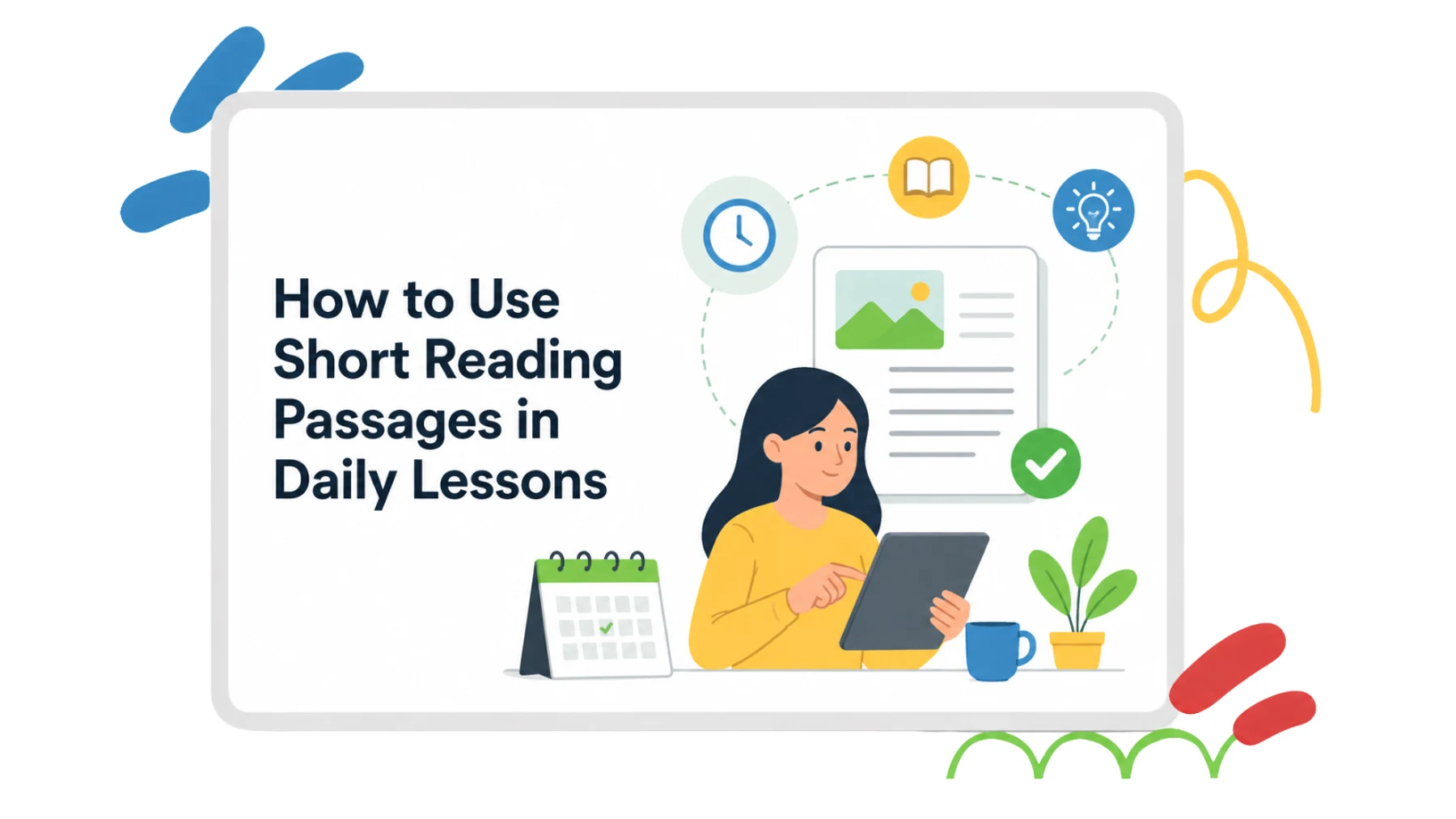
Short reading passages are one of the easiest ways to make reading practice part of a daily routine.
Teachers and parents often want students to read every day, but there is not always time for a long text, a full worksheet, or a complete reading lesson. A short passage can solve that problem. It gives students something focused to read, discuss, and respond to in a small amount of time.
Short reading passages are useful because they are quick to read, easy to match to a skill, and flexible enough for warm ups, fluency practice, vocabulary work, homework, ESL support, and homeschool lessons.
A short reading passage can turn 10 minutes into focused reading practice.
What is a short reading passage?
A short reading passage is a brief text that students can read in one sitting. It may be fiction, nonfiction, biography, poetry, or another text type. Short passages are often paired with a small number of comprehension questions.
The right length depends on the grade level, reading ability, and purpose of the lesson.
| Grade level | Typical short passage length |
|---|---|
| Grade 1 | 50 to 150 words |
| Grade 2 | 100 to 250 words |
| Grade 3 | 200 to 400 words |
| Grade 4 | 300 to 500 words |
| Grade 5 | 400 to 700 words |
| Grades 6 to 8 | 500 to 900 words, depending on the goal |
These ranges are only a guide. A short passage for one student may feel too long for another. A strong reader may handle a longer text, while a student who needs support may benefit from something shorter and clearer.
The best short reading passage is long enough to support the reading goal, but short enough to keep students focused.
Why short reading passages work well for daily lessons
Short passages work well because they make reading practice manageable.
A full chapter or long article may be useful for deeper reading, but it is not always practical for daily lessons. A short passage can fit into small parts of the day and still support meaningful comprehension practice.
Short reading passages can help teachers and parents:
- Reduce planning time
- Fit reading into small lesson blocks
- Focus on one reading skill at a time
- Give students repeated practice
- Make reading less overwhelming
- Provide quick feedback
- Connect reading to science, social studies, or SEL topics
- Differentiate for different levels
- Support both fluency and comprehension
Longer texts are still important. Students need practice with books, chapters, articles, and complex texts. But short passages are ideal for consistent practice because they are easier to use every day.

Use short passages as a daily reading warm up
A short reading passage can work well at the start of a lesson. It gives students a clear task and helps them move into reading mode.
A simple daily warm up routine could look like this:
- Students read the passage silently.
- The teacher reads it aloud, or students read with a partner.
- Students answer 2 to 4 questions.
- The class discusses one key answer.
- The teacher connects the passage to the day’s reading skill.
This works well for:
- Morning work
- The start of a reading block
- Transition time
- Bell ringer activities
- Homeschool warm ups
- Small group reading
For example, a Grade 3 nonfiction passage about frogs could be used as a quick warm up for main idea and details. Students read the passage, answer four questions, and discuss which detail best supports the main idea.
The whole activity can take about 10 minutes, but it still gives students focused reading practice.
Use short passages to teach one reading skill at a time
Short reading passages are especially useful when you want students to focus on one skill.
A long text can contain many ideas, events, and vocabulary words. That can be helpful, but it can also distract students from the main goal of the lesson. A short passage makes it easier to isolate one skill.
| Reading skill | Good passage choice |
|---|---|
| Main idea | Informational passage with a clear topic |
| Inference | Fiction passage with character clues |
| Context clues | Passage with 3 to 5 useful vocabulary words |
| Cause and effect | Nonfiction or event based fiction |
| Compare and contrast | Passage with two ideas, animals, people, or places |
| Text evidence | Passage with clear support details |
| Theme | Short fiction with a clear lesson |
For example, if you are teaching inference, choose a short fiction passage where a character’s feelings are shown through actions. Students can practice using clues instead of looking for a directly stated answer.
If you are teaching main idea, choose a short informational passage with one clear topic and several supporting details.
A short passage helps students focus on the skill instead of getting lost in the length of the text.
Use short passages for fluency practice
Short passages are also useful for reading fluency. Because the text is brief, students can read it more than once without feeling overwhelmed. You can also use a reader’s theater passage to let students practice repeated reading, expression, and fluency in a more engaging way.
A simple fluency routine could look like this:
- The student reads the passage once.
- The teacher, parent, or partner gives light support.
- The student reads the passage again.
- The student focuses on smoother reading, expression, or accuracy.
- The student answers 2 or 3 comprehension questions.
Good fluency passages should be:
- Short
- Readable
- Interesting
- Clear in structure
- Not packed with difficult vocabulary
- Easy to reread
The goal of fluency practice is not only speed. Students should also read with accuracy, expression, and understanding.
That is why it helps to include a few comprehension questions after rereading. Even if the focus is fluency, students should still understand what they read.
Use short passages for vocabulary practice
Short passages make vocabulary practice more manageable.
Instead of teaching many new words from a long chapter, a short passage can focus on 3 to 5 important words. This helps students notice how words work inside a real text.
A simple vocabulary routine could look like this:
- Preview 3 key words.
- Read the passage.
- Ask students to use context clues.
- Discuss the meaning of each word.
- Have students use one word in a new sentence.
Good vocabulary questions include:
- What does this word mean in the passage?
- Which clue helps you understand the word?
- Which word means the opposite of this word?
- How does this word help explain the topic?
- Why did the author choose this word?
For example, a short passage about volcanoes might include words like erupt, lava, ash, pressure, and crater. Students can use the passage to understand the words in context, instead of memorizing definitions separately.
This is especially helpful for ESL and ELL students, because vocabulary becomes easier to understand when it appears in a clear, meaningful passage.
Use short passages for fiction and nonfiction balance
Daily reading practice should include both fiction and nonfiction.
Fiction helps students understand characters, plot, setting, theme, feelings, and inference. Nonfiction helps students understand facts, main idea, details, vocabulary, and background knowledge.
A weekly pattern could look like this:
| Day | Passage type | Focus |
|---|---|---|
| Monday | Fiction | Character and setting |
| Tuesday | Nonfiction | Main idea and details |
| Wednesday | Fiction | Inference |
| Thursday | Nonfiction | Vocabulary |
| Friday | Paired fiction and nonfiction | Compare and discuss |
You can also use the same topic across two text types.
For example:
Fiction passage: a story about a child visiting a zoo
Nonfiction passage: a passage about how zookeepers care for animals
This helps students connect story, facts, vocabulary, and discussion. It also makes one topic useful across multiple lessons.
Use short passages for ESL and ELL support
Short reading passages can be very helpful for ESL and ELL students.
English learners often need clear structure, familiar topics, useful vocabulary, and enough time to process what they read. A short passage reduces the reading load and makes the task feel more achievable.
For ESL and ELL students, choose passages with:
- Clear structure
- Familiar topics
- Simple sentence patterns
- Useful vocabulary
- Short question sets
- Visual support when possible
- Opportunities for speaking
A simple ESL routine could look like this:
- Preview the topic.
- Pre teach 3 important words.
- Read the passage aloud.
- Students reread with a partner.
- Students answer simple comprehension questions.
- Students discuss one personal connection.

Good topics for English learners include:
- Food
- School
- Weather
- Animals
- Sports
- Family
- Daily routines
- Hobbies
- Places in town
- Simple science topics
For example, a short passage about soccer can help students practice sports vocabulary, action words, and simple comprehension questions.
Use short passages for homework or independent practice
Short reading passages are also useful for homework and independent reading.
A good homework passage should be manageable. Students should be able to read it and answer the questions without needing too much support.
Good homework passages usually include:
- Clear instructions
- A readable length
- 4 to 6 questions
- Mostly familiar vocabulary
- One clear skill focus
- An optional parent discussion question
Avoid homework passages that include:
- Too many questions
- Unclear vocabulary
- Too much background knowledge
- Very long paragraphs
- Vague open ended questions
- Several skills at once
For example, a short Grade 4 passage with 5 questions about main idea and vocabulary may work well for independent practice. A long passage with 12 mixed questions may feel too much for homework.
Short reading passage help keep reading practice consistent without making it feel like a heavy assignment.
Use short passages across subjects
Short reading passages can support more than reading class. They can connect reading comprehension to science, social studies, geography, SEL, holidays, and real world topics.
| Subject or theme | Passage idea | Reading skill |
|---|---|---|
| Science | How plants grow | Sequence |
| Social studies | A day in ancient Rome | Main idea |
| Geography | Life in Texas | Details |
| SEL | Solving a friendship problem | Inference |
| Sports | How teamwork helps players | Author’s purpose |
| Animals | Why turtles need protection | Cause and effect |
| Space | Facts about the Moon | Vocabulary |
This is useful because students can practice reading while also learning about other subjects.
For example, a science passage about plants can teach sequence words like first, next, then, and finally. A sports passage can teach teamwork, author’s purpose, or cause and effect. A friendship story can support SEL and inference at the same time.
Cross subject reading makes practice feel more meaningful because students are not only answering questions. They are learning something useful.
How many questions should a short passage have?
Most short reading passages work best with 3 to 6 questions.
For younger students, 3 to 4 questions may be enough. For Grade 3 to Grade 5 students, 5 to 6 questions often works well.
A simple question mix could include:
- One literal question
- One main idea or detail question
- One vocabulary question
- One inference or deeper thinking question
- One optional discussion or writing question
Short passages do not need long question sets. If the passage is short, too many questions can make the task feel heavier than the reading itself.
A good short passage should have questions that match the goal. If the goal is vocabulary, include a vocabulary question. If the goal is inference, include an inference question. If the goal is fluency, keep the questions light.
For a deeper breakdown, see How Many Questions Should a Reading Comprehension Passage Have?.
A simple 10 minute short passage routine
A short reading passage can fit into a 10 minute routine.
Here is a simple structure:
- 1 minute: Introduce the topic.
- 2 minutes: Students read the passage.
- 2 minutes: Students reread or partner read.
- 3 minutes: Students answer 3 to 5 questions.
- 2 minutes: Discuss one answer or vocabulary word.

This routine works well because it is focused and repeatable. Students know what to expect, and the teacher or parent does not need to plan a full reading block every time.
You can use this routine for:
- Morning work
- Reading warm ups
- Small group practice
- Homeschool lessons
- Tutoring
- ESL support
- Fluency practice
A consistent routine also helps students become more confident. They know they will read, think, answer, and discuss.
Example weekly plan for daily short reading passages
Here is a simple weekly plan for using short reading passages.
| Day | Passage focus | Skill |
|---|---|---|
| Monday | Short fiction | Character and setting |
| Tuesday | Short nonfiction | Main idea and details |
| Wednesday | Short fiction | Inference |
| Thursday | Short nonfiction | Vocabulary in context |
| Friday | Paired topic passage or review | Compare, discuss, write |
This plan can be adapted for classrooms, homeschool, tutoring, and ESL lessons.
For example, you might use the topic “animals” for a full week:
Monday: fiction story about a rescued turtle
Tuesday: nonfiction passage about sea turtles
Wednesday: fiction passage with inference questions
Thursday: nonfiction passage with vocabulary questions
Friday: compare the two passages and write a short response
This gives students repeated exposure to a topic while still practicing different reading skills.
Common mistakes when using short reading passages
Short passages work best when they are purposeful. They should not be random filler.
Common mistakes include:
- Choosing passages that are too hard
- Using too many questions
- Using random passages without a skill goal
- Ignoring student interest
- Only using fiction or only using nonfiction
- Skipping vocabulary support
- Making every passage feel like a test
- Not discussing answers
- Choosing passages that are too long for the time available
- Using questions that do not match the skill
For example, if the goal is main idea, but the questions are mostly about tiny details, the passage will not support the lesson well.
If the goal is fluency, but the passage is full of difficult vocabulary, students may struggle to read smoothly.
Short passages are simple, but they still need a clear purpose.
Can PicoBuddy help with short reading passages?
Yes. PicoBuddy helps teachers, parents, and homeschool families find or create short reading passages by grade, topic, and text type.
You can use PicoBuddy to find or create passages based on:
- Grade level
- Topic
- Text type
- Reading skill
- Student interest
- Difficulty level
- Lesson goal
For example, you might need:
- A Grade 2 fiction passage about friendship
- A Grade 3 nonfiction passage about animals
- A Grade 4 sports passage with inference questions
- A Grade 5 informational passage about Texas
- A beginner ESL passage about food
This is useful when you need a passage that fits a specific lesson. Instead of searching for a passage that almost works, you can create one that matches your grade, topic, and goal.
Need a short passage for tomorrow’s lesson? Browse PicoBuddy’s free reading passages or create your own custom passage by grade, topic, and text type.
Final thoughts
Short reading passages are one of the easiest ways to make reading practice consistent.
They work well for warm ups, skill practice, fluency, vocabulary, ESL support, homework, homeschool lessons, and cross subject reading.
The best short passage has a clear purpose, a manageable length, useful questions, and a topic students are willing to read.
A short passage does not need to do everything. It just needs to help students practice one useful reading goal well.
To connect short daily tasks to your wider lesson goals, use our elementary reading comprehension guide for passage selection, question planning, and discussion.
Browse PicoBuddy’s free short reading passages or create a custom passage for your next lesson.

Frequently Asked Questions
Related Articles
Helping kids read better, together.
Like this article? Join 500+ educators using PicoBuddy to generate high-quality reading materials in seconds.