
Read Aloud Fluency Practice: A Simple Listen and Reread Routine
Use read aloud fluency practice to help students hear fluent reading, reread short passages, and improve accuracy, phrasing, expression, and comprehension.
Read aloud fluency practice works best when students hear fluent reading and then practice the same passage themselves.
Many students are told to “read it again.” But rereading is much more useful when students know what they are practicing.
One student may need to focus on accuracy. Another may need smoother phrasing. Another may need to notice punctuation, use more expression, or read with more confidence.
Read aloud support gives students a model before they reread. They hear how the passage can sound. Then they try it themselves. The goal is not simply faster reading.
The goal is smoother, more meaningful reading that supports comprehension.
What is read aloud fluency practice?
Read aloud fluency practice combines listening and active rereading.
Students first hear a fluent model of the passage. Then they reread the same passage themselves. This helps them notice how the text sounds before they try to read it independently.
The listening part gives the model.
The rereading part gives the practice.
This works especially well with short reading passages because students can listen, reread, and answer a few comprehension questions without becoming overwhelmed.
Read aloud fluency practice is not passive listening. Students should stay connected to the text, follow the meaning, and practice reading with a clear goal.
For a shorter answer to whether read aloud support can improve fluency, see Can Read Aloud Support Improve Reading Fluency?
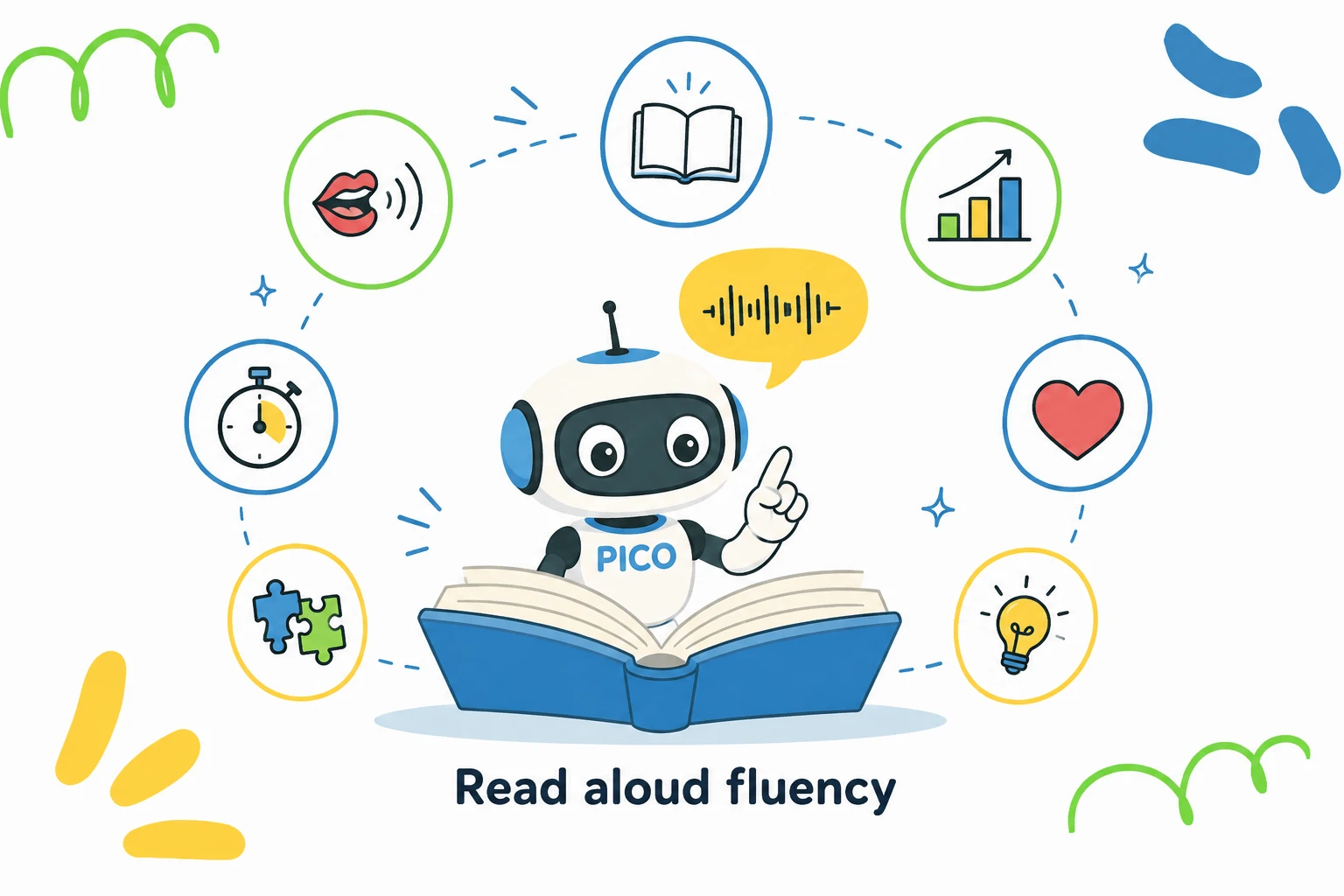
Why reading fluency is more than speed
Fluency is often misunderstood as reading quickly.
But fast reading is not always fluent reading.
A student may read quickly and still miss the meaning. Another student may read every word accurately but pause in strange places, ignore punctuation, or sound robotic.
Strong fluency means the student can read accurately, at an appropriate pace, with natural phrasing, expression, and understanding.
That is why fluency matters for reading comprehension.
When students read word by word, too slowly, or with awkward phrasing, it is harder to hold the meaning of the sentence in mind. Reading becomes a decoding task instead of a meaning task.
Fluency helps connect word reading to comprehension. It gives students enough smoothness and confidence to focus on what the passage actually means.
What are the parts of reading fluency?
Reading fluency is made up of several smaller skills.
When teachers and parents understand these parts, fluency practice becomes more focused.
Accuracy
Accuracy means reading the words correctly.
This is the foundation of fluency. If students misread many words, the meaning of the passage can quickly break down.
For example, if a student reads “desert” as “dessert” or skips important words in a sentence, comprehension may change.
Accuracy helps students stay connected to the actual meaning of the text.
Read aloud support can help because students hear how words sound before rereading the passage themselves.
Automaticity
Automaticity means students can recognize many words without working hard on each one.
This matters because attention is limited.
If every word takes effort, there is less attention left for understanding the passage.
Repeated reading can help build automaticity because students meet the same words and sentence patterns more than once. The passage becomes more familiar, and the second or third reading often feels smoother.
Pace
Pace means reading at a speed that supports meaning.
Reading too slowly can make it hard to remember the beginning of a sentence by the time the student reaches the end. Reading too quickly can cause students to ignore punctuation, skip words, or miss important details.
Good pace is not about racing.
It is about reading at a speed that keeps the meaning clear.
Phrasing
Phrasing means grouping words into meaningful chunks.
This is one of the most important parts of fluency because phrasing directly supports comprehension.
A student who reads every word separately may technically decode the sentence, but the meaning can feel disconnected.
When students group words together naturally, the sentence becomes easier to understand. For example:
The small dog / ran across the yard / after the ball.
Those chunks help the sentence make sense.
Expression
Expression means the voice matches the meaning of the text.
Students use expression when they read dialogue, questions, surprises, emotions, or important moments in a passage.
Expression is not just performance. It shows that students are thinking about meaning.
A student who understands that a character is worried may read that line differently from a line where the character is excited.
Read aloud support is helpful here because students hear how meaning can shape the voice.
Attention to punctuation
Punctuation tells readers when to pause, stop, or change their voice.
Periods, commas, question marks, exclamation points, and quotation marks all give clues about how the passage should sound.
Students who ignore punctuation may read too quickly or in a flat voice. This can make the passage harder to understand.
Fluency practice can help students notice punctuation as part of meaning, not just marks on the page.
Comprehension
Fluency only matters if it supports understanding. The goal of fluency practice is not to sound good. The goal is to read in a way that helps the text make sense.
That is why fluency practice should include a few comprehension questions or a short discussion after rereading.
Students should not only read more smoothly. They should also understand what they read.
How read aloud support helps fluency
Read aloud support gives students a model for fluent reading.
Students hear how the passage sounds before they reread it themselves. This can help with accuracy, pacing, phrasing, expression, punctuation, and comprehension.
- For accuracy, students hear unfamiliar words before trying them independently.
- For pace, they hear a reading speed that is smooth but not rushed.
- For phrasing, they hear how words group together naturally.
- For expression, they hear how the voice changes with meaning.
- For punctuation, they hear where the reader pauses or changes tone.
This is why read aloud fluency practice is useful. It does not simply tell students to “read better.” It shows them what better reading can sound like.
Choose one fluency focus at a time
Fluency practice works best when students have one clear focus. Instead of saying, “Read more fluently,” choose one small goal for the passage. One lesson might focus on pausing at punctuation.
Another lesson might focus on reading dialogue with expression. Another lesson might focus on reading a nonfiction passage at a steady pace. Useful fluency focuses include:
- Accuracy: reading the words correctly
- Pace: reading at a speed that supports meaning
- Phrasing: grouping words into meaningful chunks
- Expression: matching the voice to the meaning
- Punctuation: pausing and changing voice at punctuation
- Confidence: rereading with less hesitation
One small focus makes practice clearer. It also helps students notice progress.

Why repeated reading works
Repeated reading helps students build fluency because the passage becomes more familiar each time.
The first reading often takes the most effort. Students may be figuring out words, adjusting to the topic, and trying to understand the sentence structure.
During the second or third reading, students usually have more attention available for fluency. They can focus more on phrasing, expression, pace, and meaning.
This is why short passages work so well.
A long passage may be too tiring to reread. A short passage gives students a better chance to practice the same text more than once and actually notice improvement.
Repeated reading also builds confidence.
A student who struggled during the first reading may hear real progress during the second attempt.
That small success can make fluency practice feel more possible.
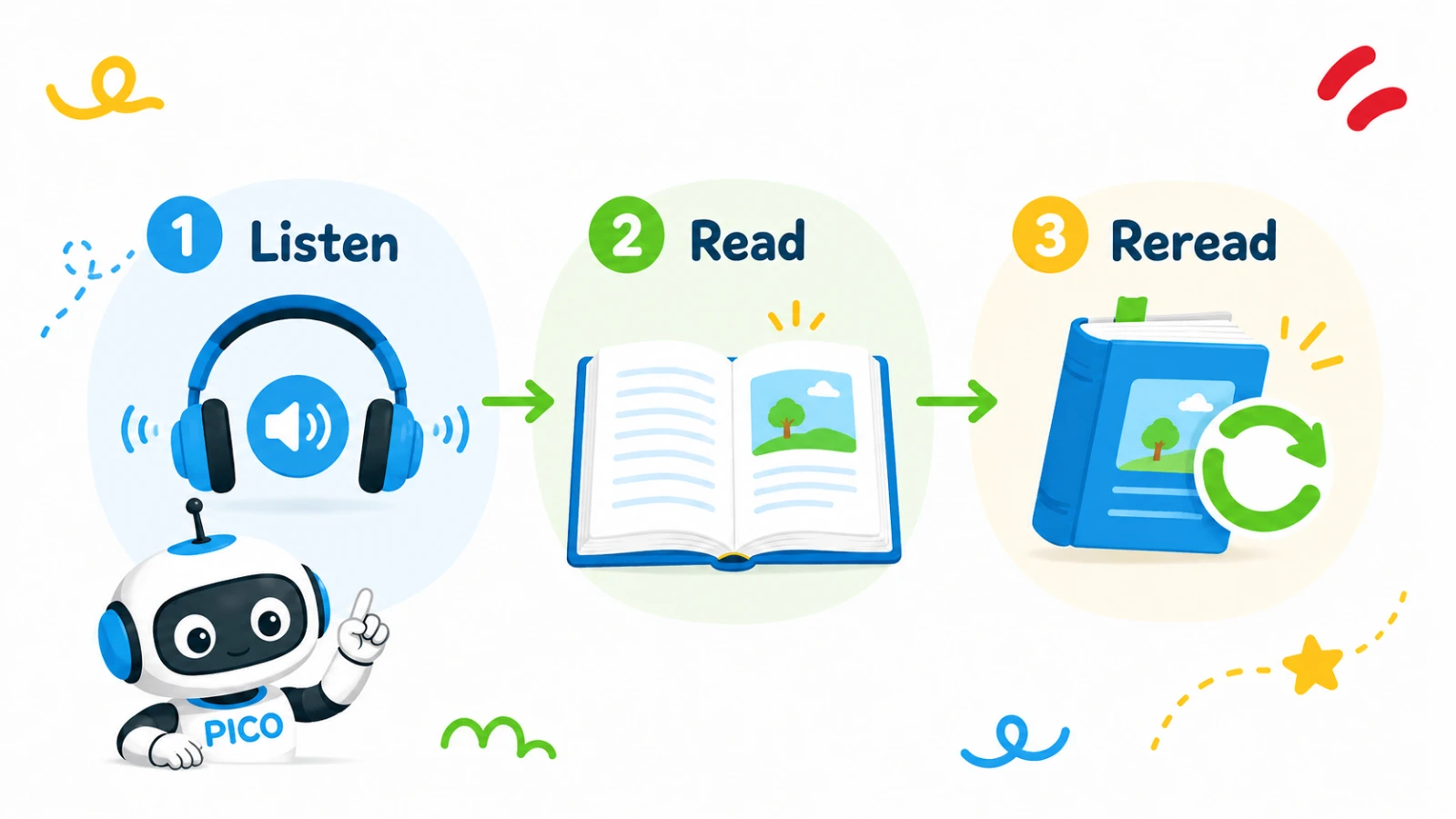
A simple listen, read, reread routine
One simple fluency routine is: Listen, read, reread.
- Listen to the passage once.
- Follow along with the written text.
- Reread the passage aloud.
- Reread again with one fluency focus.
- Answer one or two comprehension questions.
This routine keeps fluency connected to meaning.
Students hear the model, practice the passage, and still think about what the passage says.
It works well for classrooms, homeschool lessons, tutoring, intervention groups, and ESL or ELL support.
A 10 minute fluency practice routine
Read aloud fluency practice does not need to take a full lesson.
A short routine can be enough when the passage is focused.
Minute 1
Introduce the passage and choose one fluency focus.
For example: “Today we are listening for punctuation pauses.”
Minutes 2 and 3
Students listen to the passage.
They can follow along with the written text if the goal is reading support or fluency.
Minutes 4 and 5
Students read or partner read the passage.
This gives them a first chance to try the text after hearing the model.
Minutes 6 to 8
Students reread with the fluency focus.
They might practice smoother phrasing, stronger expression, or better attention to punctuation.
Minutes 9 and 10
Students answer one or two comprehension questions. This keeps fluency connected to meaning.

For example, the fluency focus might be expression. Students listen to a short fiction passage with dialogue, then reread one section while trying to make the character voices sound natural.
Another day, the focus might be punctuation. Students listen to a nonfiction passage and notice where the reader pauses at commas and periods.
This kind of routine is simple, repeatable, and easy to use with different topics.
What makes a good fluency passage?
A good fluency passage is not always the same as a good comprehension passage.
Some texts are useful for deep comprehension work but too long, dense, or vocabulary heavy for fluency practice. If students struggle through every sentence, they may never reach smooth rereading.
A strong fluency passage should be short enough to reread two or three times.
It should have clear sentence structure, manageable vocabulary, and a topic students are willing to revisit.
The passage should also match the fluency focus. A passage with dialogue works well for expression. A nonfiction passage with clear paragraphs can work well for pacing and phrasing. A passage with repeated sentence patterns can help students build confidence.
Interest matters too.
Students are more willing to reread when the topic feels inviting. Animals, gaming, knights and history topics can all work well.
Fluency practice for struggling readers
Struggling readers often need fluency practice that feels supported, not pressured.
For some students, reading independently takes so much effort that fluency never has a chance to develop. The student is working word by word, and the meaning keeps slipping away.
A read aloud model can make the passage feel more manageable.
When students hear the passage first, the words and ideas are no longer completely unfamiliar. Rereading may feel less stressful, and students may be more willing to try.
For struggling readers, it helps to keep the passage short, choose one fluency focus, and include a small amount of comprehension work.
The goal is not perfect reading. The goal is successful practice that builds confidence over time.
For more support ideas, see Read Aloud for Struggling Readers.
Fluency practice for ESL and ELL students
Read aloud fluency practice can also support ESL and ELL students.
Students learning English are not only learning new words. They are also learning how English sounds in connected text.
They need to hear pronunciation, sentence rhythm, word stress, phrasing, and natural pacing.
Listening to a passage before rereading gives English learners a model.
They hear how the sentence flows. They hear where the voice rises or falls. They hear how familiar and unfamiliar words sound inside a real passage.
For English learners, fluency practice should not only be about reading faster.
It can also support speaking confidence, vocabulary growth, oral language, and listening comprehension.
A helpful routine is to preview a few key words, listen to the passage, reread a short section, and then answer or discuss one question.
How to notice fluency progress
Fluency progress is not only measured by speed. Students may be improving even when they are not reading much faster yet.
Look for signs such as smoother phrasing, fewer awkward pauses, stronger expression, better attention to punctuation, and more confidence during rereading.
Comprehension matters too.
If students can reread a passage more smoothly and explain the meaning more clearly afterward, that is important progress.
A useful question after fluency practice is: What sounded better the second time? This helps students notice their own growth.
Common mistakes during fluency practice
One common mistake is focusing only on speed.
Fast reading is not always fluent reading. Students may rush through the passage, skip punctuation, or miss the meaning.
Another mistake is using passages that are too difficult. If students struggle with most of the words, rereading may become frustrating instead of helpful.
It also helps not to ask students to reread without a purpose. “Read it again” is less helpful than “Read it again and focus on pausing at punctuation.”
Finally, do not skip comprehension completely. Fluency should support meaning, so students should still answer a question, retell the passage, or discuss one idea after reading.
Can PicoBuddy help with fluency practice?
PicoBuddy helps teachers, parents, homeschool families, and intervention teams create short reading passages that work well for fluency practice.
This is useful because fluency passages need the right balance.
They should be short enough to reread, readable enough to avoid frustration, and interesting enough that students are willing to practice.
With PicoBuddy, you can create passages by grade, topic, text type, and reading goal. You can also create easier versions for support and add comprehension questions so fluency practice stays connected to meaning.
For example, you might create a short dialogue passage for expression, a nonfiction passage for pacing, an animal passage for repeated reading, or a simplified passage for intervention.
Need a short passage for fluency practice? Browse PicoBuddy’s free reading passages or create a custom passage by grade, topic, and reading level.
Final thoughts
Read aloud fluency practice helps students hear fluent reading before they try it themselves.
That model matters.
Students hear accuracy, pace, phrasing, expression, punctuation, and meaning in action. Then they reread with a clearer sense of what they are practicing. Fluency is not about reading as fast as possible. It is about reading in a way that makes the text easier to understand.
When students listen, reread, and focus on one fluency skill at a time, fluency practice becomes more purposeful, more manageable, and more connected to comprehension. Sometimes students do not need more pressure to read better. They need a clear model, a short passage, and a reason to reread.

Frequently Asked Questions
Related Articles



Helping kids read better, together.
Like this article? Join 500+ educators using PicoBuddy to generate high-quality reading materials in seconds.