
Can Read Aloud Support Improve Reading Fluency?
Read aloud support can help students hear fluent reading, reread with more confidence, and improve pacing, phrasing, expression, and comprehension.
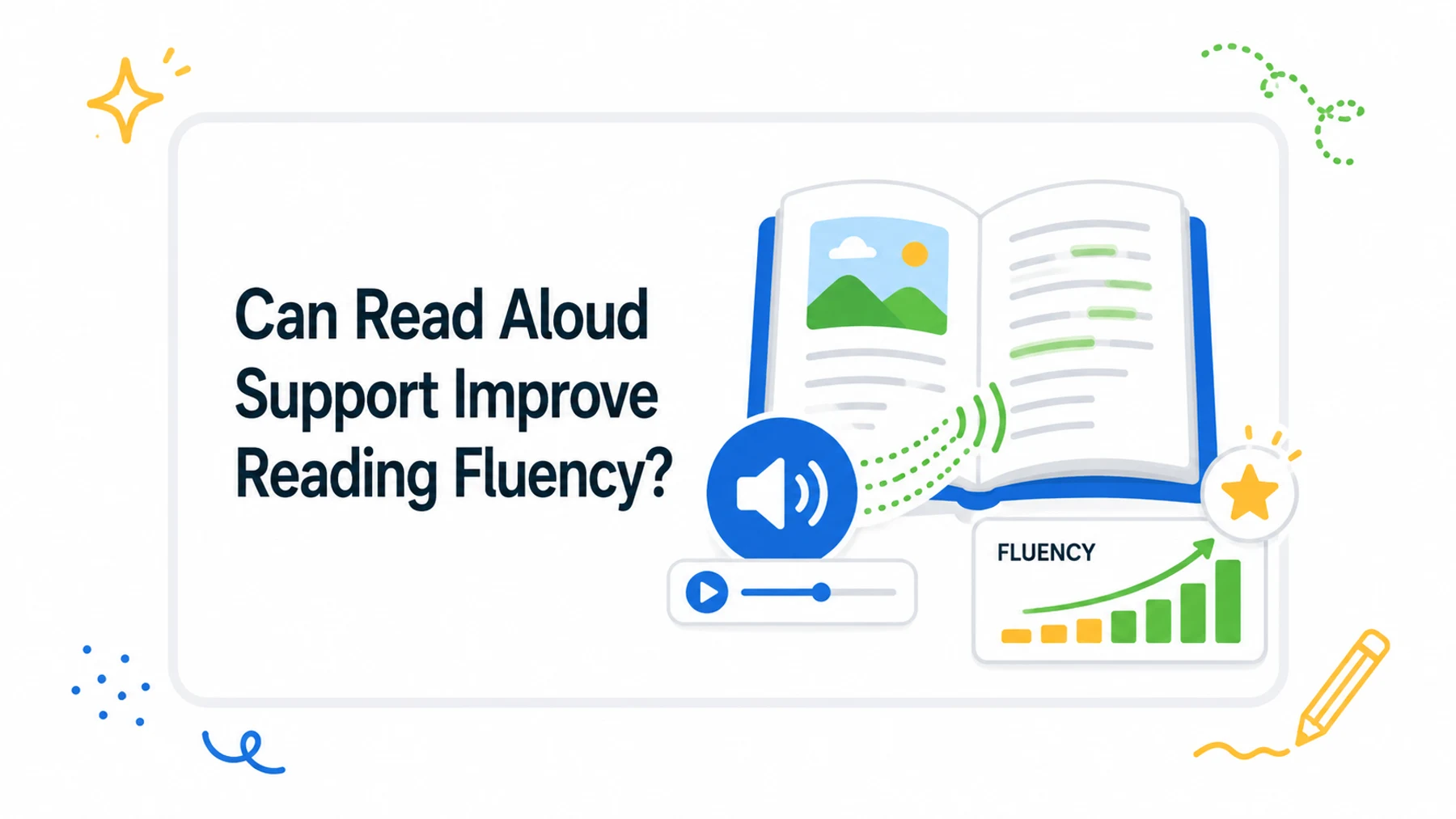
Read aloud support can help improve reading fluency. But only when students do more than listen.
Hearing fluent reading gives students a model for how reading can sound. They hear the pace, rhythm, expression, phrasing, and natural pauses that can be hard to create when every word takes effort.
This can be especially helpful for students who read slowly, lose meaning while decoding, or feel unsure about how a sentence should sound.
Listening alone is not enough to build fluency.
But listening, following along, reading, and rereading can become a strong fluency routine.
What is reading fluency?
Reading fluency is the ability to read smoothly, accurately, and with understanding.
A fluent reader does not only read quickly. Fluency also includes expression, phrasing, accuracy, attention to punctuation, and attention to meaning.
A fluent reader knows when to pause, how to group words together, and how to make a sentence sound natural.
Students who struggle with fluency may read word by word. They may ignore punctuation, read in a flat voice, or become so focused on sounding out words that they lose the meaning of the passage.
That is why fluency matters.
When reading becomes smoother, comprehension often becomes easier too.
Can read aloud support improve fluency?
Yes, read aloud support can improve fluency when it is connected to active reading practice.
Some students do not yet know what fluent reading should sound like. They may be able to read the words, but the reading sounds choppy, rushed, flat, or disconnected.
Hearing the passage read aloud helps students notice the rhythm of the text.
They can hear how a question sounds different from a statement. They can hear where to pause at a comma. They can hear how dialogue changes with expression.
This kind of modeling is especially useful when students then reread the same passage themselves.
The listening gives the model. The rereading gives the practice.
Why fluent reading models matter
Students learn a lot by hearing strong reading.
A fluent model shows how written language becomes spoken language. It helps students hear sentence rhythm, phrasing, expression, pacing, and punctuation.
This matters because many students who struggle with fluency are not only struggling with individual words. They are also struggling with how to put those words together in a meaningful way.
A sentence may be technically decoded, but still not understood.
For example, a student might read every word correctly but pause in odd places. The sentence becomes harder to understand because the phrasing is broken.
When students hear the sentence read fluently, the meaning often becomes clearer.
When read aloud support helps fluency
Read aloud support is most helpful when students listen with a purpose.
That purpose might be to hear smooth phrasing, notice expression, follow punctuation, or prepare for rereading.
For example, a student may listen to a short fiction passage before rereading a section of dialogue. The goal is not only to hear the words. The goal is to notice how the voice changes when a character speaks.
Another student may listen to a nonfiction passage and pay attention to where the reader pauses at commas and periods. Then the student rereads the same passage with smoother pacing.
Read aloud support can also help students who feel nervous about reading aloud. Hearing the passage first can make the second reading feel more familiar and less overwhelming.
That confidence matters.
A student who usually avoids reading may be more willing to try again after hearing the passage once.
When read aloud support does not help fluency
Read aloud support does not improve fluency when students only listen passively.
If students hear the passage but never follow along, never reread, and never think about meaning, the fluency benefit is limited.
Fluency grows through practice.
Students need to hear fluent reading, but they also need to try the passage themselves. They need to reread with a purpose. They need to notice pacing, phrasing, expression, or punctuation.
Audio support works best when it leads into reading. It should not replace the student’s chance to practice.
A simple listen, read, reread routine
One simple routine is:
Listen, read, reread.
This routine works well in classrooms, homeschool lessons, tutoring, and intervention groups.
- Listen: The student hears the passage read fluently.
- Follow along: The student tracks the text while listening.
- Read: The student reads the passage aloud.
- Reread: The student reads again with a focus on smoother phrasing or expression.
- Respond: The student answers a few comprehension questions.
This routine can take 10 to 15 minutes with a short passage.
It works especially well because students hear the model before they are expected to perform the skill independently. Then they get a chance to practice right away.
For a deeper fluency routine, see Read Aloud Fluency Practice.
What kinds of passages work best?
Short passages usually work best for fluency practice.
A passage does not need to be too simple, but it should be manageable enough to reread without frustration. If the passage is too long, too dense, or packed with difficult vocabulary, students may become exhausted before the rereading begins.
Good fluency passages often have clear sentence structure, natural phrasing, an interesting topic, and a few comprehension questions.
Fiction passages can work well because dialogue gives students a chance to practice expression. Nonfiction passages can also work well when the structure is clear and the topic is engaging.
The key is that students can read the passage more than once without feeling defeated.
What about struggling readers, dyslexia, and English learners?
Read aloud support can be especially helpful for students who need a clearer model before rereading.
For struggling readers, listening can make the passage feel less unfamiliar. The student hears the words and ideas first, then returns to the text with more confidence.
For students with dyslexia, read aloud support can reduce the pressure of decoding during fluency practice. It does not replace structured reading instruction, but it can help students access the sound and meaning of the passage before rereading.
For ESL and ELL students, listening can support pronunciation, sentence rhythm, phrasing, and confidence with spoken English. Hearing the passage while following along helps connect spoken and written language.
In each case, the goal is the same.
Students hear a fluent model, return to the text, and practice reading with more support and less frustration.
For more specific guidance, see Read Aloud for Struggling Readers and Read Aloud Support for Dyslexia.
Can PicoBuddy help with fluency practice?
PicoBuddy helps teachers, parents, homeschool families, and intervention teams create short reading passages that fit the student’s level, topic, and goal.
That is useful for fluency because the passage needs to be just right.
Too easy, and the student may not grow.
Too hard, and rereading becomes frustrating.
With PicoBuddy, you can create short passages by grade, topic, text type, and reading goal. You can also create easier versions when students need more support and add comprehension questions so fluency practice stays connected to meaning.
For example, you might create a short animal passage for repeated reading, a sports passage for a fluency warm up, or a simplified nonfiction passage for intervention.
Need a short passage for fluency practice? Browse PicoBuddy’s free reading passages or create a custom passage by grade, topic, and reading level.
Final thoughts
Read aloud support can improve reading fluency when students do more than listen.
They need to hear fluent reading, follow the text, read aloud, reread, and think about meaning.
Listening gives the model. Reading gives the practice. Rereading builds confidence.
The goal is not to make students dependent on listening.
The goal is to help them hear what fluent reading sounds like, practice it with support, and gradually build smoother, more confident reading.

Frequently Asked Questions
Related Articles

Helping kids read better, together.
Like this article? Join 500+ educators using PicoBuddy to generate high-quality reading materials in seconds.