
Reading Passage Questions: Types, Examples, and Tips
Learn how to create strong questions for a reading passage. See question types, examples, grade level tips, and a simple framework for building comprehension questions.
Creating a reading passage is only half the lesson. The questions matter just as much.
Good reading comprehension questions help students understand the passage, practice a specific reading skill, and explain their thinking. Weak questions can make reading feel random, confusing, or too much like a test.
A strong question set should match the passage, the student’s grade level, and the purpose of the lesson. The best questions are clear, text based, and useful.
Start with the purpose of the passage
Before writing questions, first decide why students are reading the passage.
Ask yourself:
- What is the passage about?
- What grade level is it for?
- Is it fiction or nonfiction?
- What reading skill should students practice?
- Is the goal quick practice, discussion, homework, fluency, or assessment?
The answers will help you choose the right question types.
For example, if the goal is main idea, the questions should focus on the central idea and supporting details. If the goal is inference, the questions should ask students to use clues from the passage. If the goal is vocabulary, the questions should focus on important words in context.
A question set should not feel random. Every question should have a reason.
Use a mix of question types
A strong reading passage usually needs more than one type of question.
Some questions check basic understanding. Others help students think more deeply, use evidence, or explain vocabulary.
A balanced question set may include:
| Question type | What it checks |
|---|---|
| Literal question | Basic understanding |
| Main idea question | Big picture understanding |
| Detail question | Important information |
| Vocabulary question | Word meaning in context |
| Inference question | Thinking beyond stated facts |
| Text evidence question | Support from the passage |
| Author’s purpose question | Why the author wrote something |
| Discussion or writing question | Deeper response |
A passage does not need every question type every time. A short Grade 1 passage may only need literal and simple detail questions. A Grade 5 nonfiction passage may need main idea, vocabulary, inference, and text evidence questions.
The best question mix depends on the passage and the lesson goal.
Literal questions: check basic understanding
Literal questions ask about information that is directly stated in the passage. They help you check whether students understood the basic facts or events.
Literal questions are especially useful for:
- Grade 1 and Grade 2
- Beginner readers
- ESL and ELL students
- Quick checks after reading
- The first question in a question set
Examples of literal questions:
- Who is the main character?
- Where does the story happen?
- What did the animal eat?
- What happened first?
- What is the passage about?

Literal questions are important, but they should not be the only type of question. If every question only asks students to find a simple fact, students may not practice deeper comprehension.
A good question set often starts with a literal question, then moves toward more thinking.
Main idea questions: check the big picture
Main idea questions ask students to understand what the passage is mostly about.
These questions are especially useful for nonfiction and informational passages, but they can also be used with fiction.
Main idea questions are good for:
- Grade 3 and up
- Informational reading
- Summarizing
- Identifying central ideas
- Connecting details to a larger point
Examples of main idea questions:
- What is the main idea of the passage?
- Which sentence best tells what the passage is mostly about?
- What is the most important idea in the passage?
- Which detail supports the main idea?
- What would be the best title for this passage?
Main idea questions work best when the passage has a clear topic and supporting details.
For example, a nonfiction passage about sea turtles might explain where they live, what they eat, how they lay eggs, and why they need protection. A good main idea question would ask students to understand the larger point, not just remember one small fact.

Detail questions: help students return to the text
Detail questions ask students to find information in the passage.
Good detail questions focus on meaningful details, not random facts. A weak detail question may ask about something small that does not matter. A stronger detail question asks about information that supports the passage’s meaning.
Weak detail question:
What color was the chair?
This may not be useful unless the chair color matters in the passage.
Better detail question:
Which detail shows that the character was nervous?
This question asks students to return to the passage and use an important clue.
Examples of detail questions:
- What detail explains why the plant grew?
- Which fact supports the main idea?
- What did the character do after lunch?
- What happened after the storm began?
- Which detail shows that the animal was in danger?
Detail questions are useful because they teach students to look back at the text instead of guessing.
Vocabulary questions: teach words in context
Vocabulary questions ask students to understand the meaning of a word or phrase based on how it is used in the passage.
These questions are especially useful for:
- Nonfiction passages
- ESL and ELL students
- Academic vocabulary
- Science and social studies topics
- Context clues practice
Examples of vocabulary questions:
- What does the word “enormous” mean in the passage?
- Which clue helps you understand the word “protect”?
- What word means the opposite of “ancient”?
- Why is the word “migrate” important in this passage?
- What does the phrase “under pressure” mean in this sentence?
Choose vocabulary words that matter to understanding the passage. Do not choose random difficult words just because they look challenging.
For example, in a passage about volcanoes, words like erupt, lava, ash, crater, and pressure may be important. Students need those words to understand the topic.
Vocabulary questions are stronger when students can use clues from the passage, not just memorize a definition.
Inference questions: help students read between the lines
Inference questions ask students to use clues from the passage to figure out something that is not directly stated.
These questions help students think more deeply about what they read.
Inference questions are useful for:
- Fiction passages
- Character feelings
- Problem solving
- Deeper comprehension
- Grade 3 and up
Examples of inference questions:
- Why do you think the character stayed quiet?
- How can you tell the dog was scared?
- What can you infer from the last paragraph?
- Why might the animal hide during the day?
- What does the character’s action tell you about them?
A good inference question should still be supported by the passage. Students should not have to guess without evidence.
For example, if a story says that a character looked at the floor, spoke softly, and avoided eye contact, students might infer that the character felt nervous or embarrassed. The answer is not directly stated, but the clues support it.
Text evidence questions: ask students to support their answers
Text evidence questions ask students to prove their answer using information from the passage.
These questions are especially useful for:
- Grade 4 and up
- Written responses
- Deeper comprehension
- Test preparation
- Fiction and nonfiction passages
Examples of text evidence questions:
- Which sentence supports your answer?
- What detail from the passage shows this?
- How do you know the character changed?
- Which evidence best supports the main idea?
- What part of the text helped you answer?
Text evidence questions work well after an inference or main idea question.
Example pair:
- What can you infer about the character?
- Which detail supports your answer?
This pair teaches students that answers should come from the text, not only from opinion or memory.
Author’s purpose questions: ask why the text was written
Author’s purpose questions ask students to think about why the author wrote the passage or included certain information.
These questions are especially useful for nonfiction, argumentative texts, and upper elementary grades.
Author’s purpose questions are good for:
- Informational passages
- Argumentative passages
- Grade 4 and up
- Middle school reading
- Comparing text types

Examples of author’s purpose questions:
- Why did the author write this passage?
- What is the author trying to explain?
- Why did the author include this example?
- Is the author trying to inform, entertain, persuade, or explain?
- How does this paragraph help the author make a point?
For example, in a passage about recycling, the author may be trying to inform students about waste, persuade them to recycle more, or explain how recycling works. The questions should match the purpose of the passage.
Discussion and writing questions: extend the lesson
Discussion and writing questions help students connect, explain, compare, or respond more personally.
These questions work well at the end of a reading activity, after students have shown they understand the passage.
Discussion and writing questions are useful for:
- Class discussion
- Homeschool lessons
- Writing practice
- Deeper thinking
- Small group lessons
- Personal connection
Examples of discussion and writing questions:
- What would you have done in the same situation?
- What lesson can readers learn from this story?
- How is this passage connected to something you already know?
- Do you agree with the author? Why or why not?
- What is one question you still have after reading?
Personal questions can be useful, but they should usually come after text based questions. Students should first understand the passage, then connect it to their own ideas.
How many questions should you create for one passage?
Most reading passages work well with 4 to 8 questions.
Short beginner passages may only need 3 to 5 questions. Longer upper elementary or middle school passages may use 8 to 10 questions.
| Passage type | Suggested question count |
|---|---|
| Short beginner passage | 3 to 5 questions |
| Standard elementary passage | 5 to 8 questions |
| Longer upper elementary passage | 6 to 10 questions |
| Middle school passage | 8 to 10 questions |
A simple 6 question set could include:
- Literal question
- Main idea or detail question
- Vocabulary question
- Inference question
- Text evidence question
- Discussion or writing question
The goal is not to ask as many questions as possible. The goal is to ask the right questions for the passage and lesson.
For a more detailed breakdown, see How many questions should a reading comprehension passage have?
How questions should change by grade level
Reading questions should become more complex as students grow.
Younger students need simple, clear questions about basic understanding. Older students can answer questions that require evidence, inference, comparison, and analysis.
| Grade | Best question focus |
|---|---|
| Grade 1 | Who, what, where, simple events |
| Grade 2 | Sequence, details, feelings, simple why questions |
| Grade 3 | Main idea, details, vocabulary, simple inference |
| Grade 4 | Inference, text evidence, cause and effect |
| Grade 5 | Theme, author’s purpose, compare and contrast, evidence |
| Grades 6 to 8 | Analysis, structure, argument, deeper evidence |
For Grade 1, a strong question might be:
Who is in the story?
For Grade 3, a strong question might be:
What is the main idea of the passage?
For Grade 5, a strong question might be:
Which evidence best supports the author’s main point?
The passage and questions should grow together. A more advanced passage needs more advanced questions, but the wording should still be clear.

How questions should change for fiction and nonfiction
The question types should also change based on the text type.
Fiction and nonfiction do not ask students to think in exactly the same way.
| Text type | Strong question types |
|---|---|
| Fiction | Character, setting, plot, inference, theme, point of view |
| Nonfiction | Main idea, details, vocabulary, author’s purpose, text evidence |
| Biography | Sequence, cause and effect, character traits, historical context |
| Functional text | Instructions, real world purpose, details, sequence |
| Argumentative text | Claim, reasons, evidence, author’s purpose |
A fiction question might ask:
How does the character change by the end of the story?
A nonfiction question might ask:
Which detail supports the main idea of the passage?
A biography question might ask:
What event changed this person’s life?
An argumentative question might ask:
What evidence does the author use to support the claim?
Good questions should fit the kind of text students are reading.
Common mistakes when creating reading passage questions
Even a good passage can be weakened by poor questions.
Common mistakes include:
- Asking questions that are too vague
- Asking only literal questions
- Asking questions students can answer without reading
- Using vocabulary that is harder than the passage
- Making every question feel like a trick question
- Asking too many questions
- Ignoring the reading goal
- Using the same question types for fiction and nonfiction
- Asking for opinions before checking understanding
- Asking questions that are not supported by the text
For example, the question “Did you like the passage?” may be fine for discussion, but it does not check comprehension by itself.
A better question would be:
Which part of the passage helped you understand the character’s problem?
This question is clearer, more text based, and more useful.
A simple framework for creating reading passage questions
Here is a simple process you can use when writing questions for a passage.
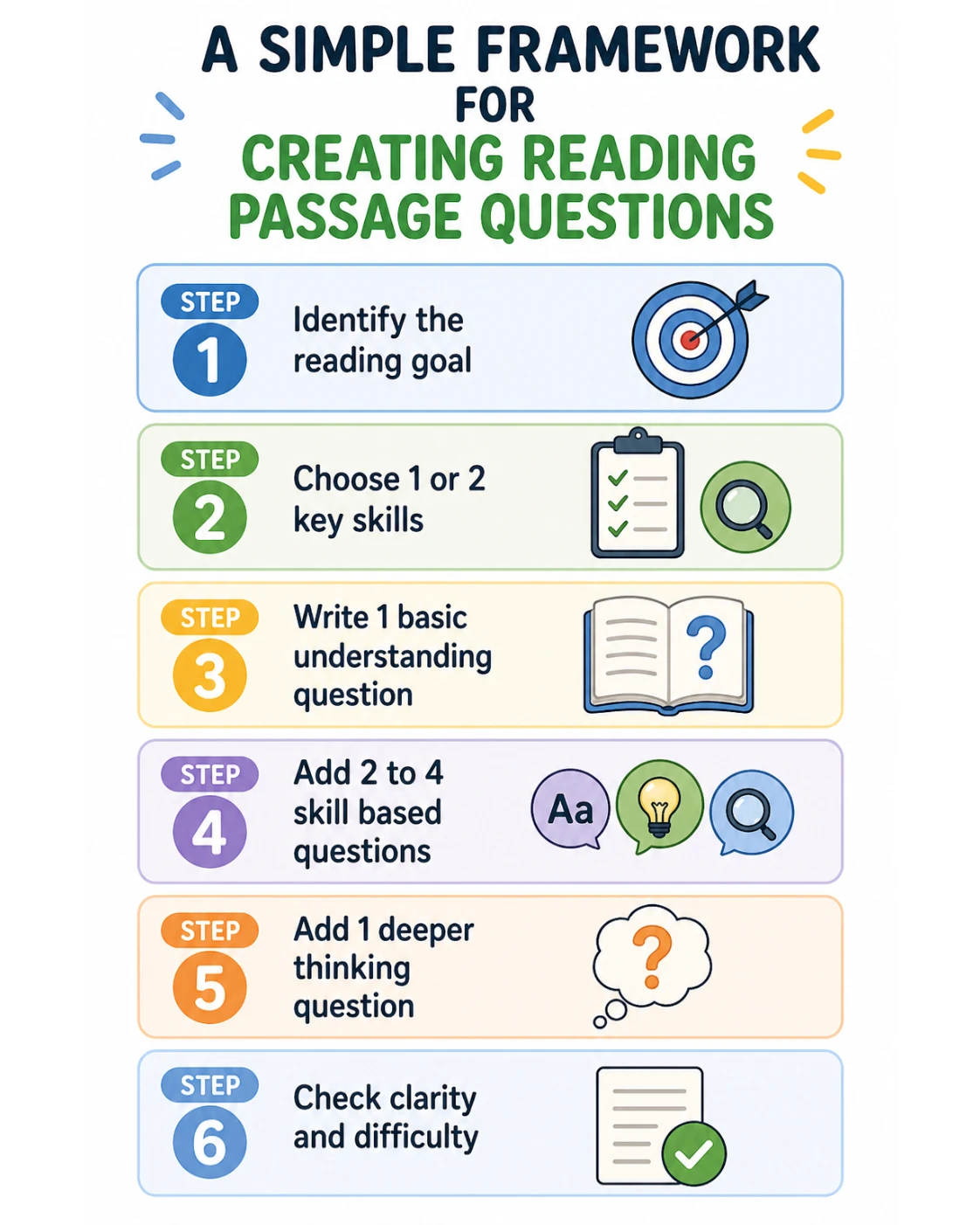
Step 1: Identify the reading goal
Decide what students should practice.
The goal might be:
- Main idea
- Inference
- Vocabulary
- Fluency
- Text evidence
- Character analysis
- Author’s purpose
Do not try to teach everything with one passage.
Step 2: Choose 1 or 2 key skills
A focused question set is usually better than a scattered one.
For example, a Grade 3 nonfiction passage might focus on main idea and vocabulary. A Grade 4 fiction passage might focus on inference and text evidence.
Step 3: Write 1 basic understanding question
Start with a simple question to make sure students understood the passage.
Examples:
- Who is the passage about?
- What is the passage mostly about?
- Where does the story happen?
- What happened first?
Step 4: Add 2 to 4 skill based questions
These questions should match your lesson goal.
If the goal is inference, ask students to use clues. If the goal is vocabulary, choose important words from the passage. If the goal is text evidence, ask students to support an answer.
Step 5: Add 1 deeper thinking question
End with a question that asks students to explain, connect, discuss, or write.
Examples:
- What lesson can readers learn?
- Which evidence best supports your answer?
- Do you agree with the author? Why or why not?
- How is this passage connected to something you already know?
Step 6: Check clarity and difficulty
Before using the questions, check:
- Are the questions clear?
- Can students answer them from the passage?
- Do they match the grade level?
- Do they match the reading goal?
- Are there too many questions?
- Is the wording fair?
Good questions should challenge students, not confuse them.
Example question set for a fiction passage
Passage topic: a child nervous about joining a new soccer team
Grade: Grade 3
Text type: fiction
Skill focus: inference and character feelings
Possible question set:
- Who is the main character?
- Why did the character feel nervous?
- What clue shows that the character started to feel better?
- What can you infer about the team?
- Which sentence supports your answer?
- What lesson can readers learn from the story?
This question set starts with basic understanding, then moves into feelings, inference, evidence, and theme.
Example question set for a nonfiction passage
Passage topic: sea turtles
Grade: Grade 4
Text type: nonfiction
Skill focus: main idea and text evidence
Possible question set:
- What is the passage mostly about?
- Which detail supports the main idea?
- What does the word “hatchling” mean in the passage?
- Why are sea turtles in danger?
- Which sentence gives evidence for your answer?
- What is one way people can help sea turtles?
This question set checks main idea, details, vocabulary, cause and effect, evidence, and deeper understanding.
Can PicoBuddy create questions for a reading passage?
Yes. Writing strong reading comprehension questions takes time because the questions need to match the passage, grade level, text type, and reading goal.
PicoBuddy can help teachers, parents, and homeschool families browse ready made passages with questions or create custom passages and quizzes.
You can use PicoBuddy to:
- Browse passages with questions
- Create custom reading passages
- Generate grade appropriate questions
- Choose fiction or nonfiction
- Create questions for a specific skill
- Adapt passages for different levels
- Make reading practice more specific to your students
For example, you might need:
- A Grade 3 fiction passage with inference questions
- A Grade 4 nonfiction passage with text evidence questions
- A Grade 5 sports passage with author’s purpose questions
- A beginner ESL passage with simple literal questions
- A short passage with vocabulary questions
Need a passage with clear, grade appropriate questions? Browse PicoBuddy’s free reading passages with questions or create your own custom passage and quiz in minutes.
Final thoughts
Good reading passage questions should be clear, text based, grade appropriate, and connected to a real reading skill.
A strong question set usually includes a mix of basic understanding, main idea or detail, vocabulary, inference, text evidence, and discussion. The exact mix depends on the passage, grade level, and lesson goal.
For the broader lesson sequence around your questions, see our guide to teaching reading comprehension in elementary school, including choosing a text and organizing daily practice.
Before creating questions, ask:
- What do students need to practice?
- What type of passage are they reading?
- What grade level are the questions for?
- Which questions will help students think?
- Can students support their answers from the text?
Browse PicoBuddy’s free reading passages with questions, or create your own passage and quiz for the exact grade, topic, and skill you need.

Frequently Asked Questions
Related Articles

Helping kids read better, together.
Like this article? Join 500+ educators using PicoBuddy to generate high-quality reading materials in seconds.