
Should Students Read Fiction or Nonfiction First?
Should students read fiction or nonfiction first? Learn when to start with stories, when to use informational texts, and how to balance both for stronger reading comprehension.
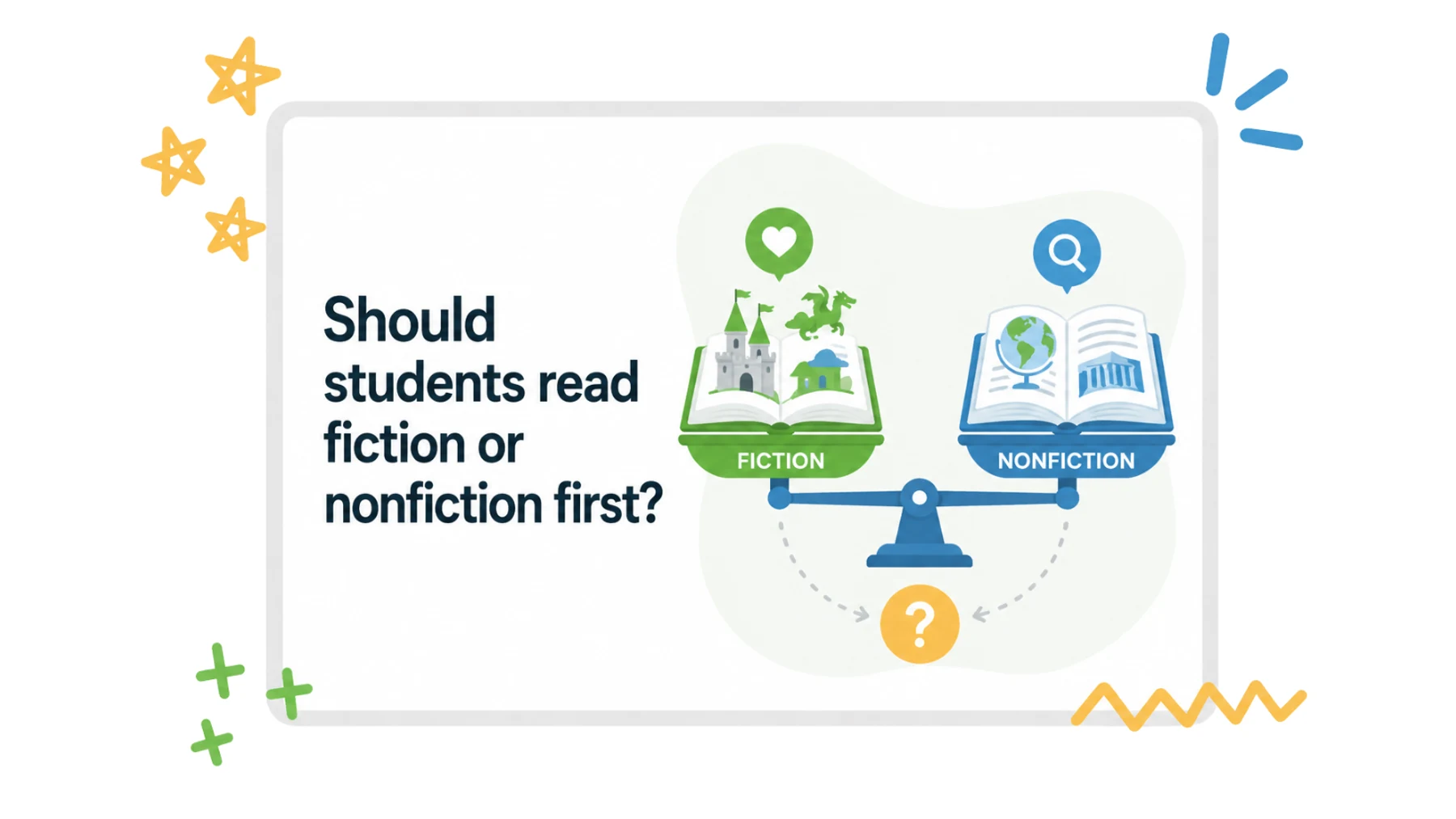
Students should read both fiction and nonfiction, but the best place to start depends on the student’s age, reading level, interests, and learning goal.
A familiar story can be a useful starting point for a student who enjoys characters and events. A clear informational passage about a favorite topic can be equally inviting. Neither genre is automatically easier: vocabulary, structure, background knowledge, and reading support all matter.
But nonfiction should also be introduced early. Nonfiction helps students build background knowledge, learn new vocabulary, and practice reading about real-world topics.
The best approach is not fiction or nonfiction. The best approach is a balanced mix of both.
Should students read fiction or nonfiction first?
There is no universal fiction-first sequence. Choose the first text for the student and the lesson: a story may suit work on characters and events, while an informational text may suit a topic the student wants to explore.
However, students should also read nonfiction early and often. Informational texts help children learn facts, build vocabulary, and understand the world around them.
So the simple answer is:
Start with fiction when you want to build confidence, motivation, and story understanding. Start with nonfiction when you want to build knowledge, vocabulary, and academic reading skills. Use both for the strongest reading growth.
When fiction is a better first choice
Fiction can be a good starting point when the student enjoys stories or the lesson focuses on narrative structure.
A fiction passage usually has a clear story structure. Something happens to a character. The character has a problem. Events happen in order. The story often has a feeling, message, or lesson.
This makes fiction useful when students are learning to understand:
- Characters
- Setting
- Sequence
- Problem and solution
- Feelings
- Plot
- Theme
- Cause and effect
For example, a Grade 1 student may understand a simple story about a lost dog more easily than an informational passage about animal habitats. The story has a character, a problem, and a clear ending. That makes it easier to discuss.
Fiction can also be more motivating for students who like imagination, humor, adventure, or emotional stories.
Use fiction first when:
- A familiar story fits the learner and the lesson goal
- The goal is confidence
- The lesson focuses on story structure
- The student needs motivation
- You want to practice discussion
- The child enjoys stories more than facts

When nonfiction is a better first choice
Nonfiction can be a better first choice when the student is curious about real-world topics.
Some children are more interested in facts than stories. They may love dinosaurs, space, sports, animals, volcanoes, machines, or history. For these students, nonfiction can feel more exciting than fiction.
Nonfiction is especially useful when the goal is to build:
- Vocabulary
- Background knowledge
- Main idea skills
- Detail recognition
- Cause and effect understanding
- Academic reading confidence
- Science and social studies knowledge
For example, a child who loves Space may be more motivated by a nonfiction passage about Mars than a fictional story set on Mars.
Nonfiction is also helpful before students read a more complex story or book. If students are about to read a story about a rainforest, a short nonfiction passage about rainforest animals can give them useful background knowledge first.
Use nonfiction first when:
- The topic connects to science or social studies
- The student loves facts
- The goal is vocabulary building
- The lesson focuses on main idea and details
- Students need background knowledge
- The student prefers real topics over made-up stories

Fiction vs nonfiction: what each teaches
Fiction and nonfiction support different parts of reading comprehension. One is not better than the other. They simply help students practice different skills.
| Text type | Helps students practice | Best for |
|---|---|---|
| Fiction | characters, setting, plot, sequence, theme, inference | story understanding and emotional engagement |
| Nonfiction | facts, main idea, details, vocabulary, text features, cause and effect | knowledge building and academic reading |
| Both | comprehension, fluency, vocabulary, discussion, written response | balanced reading growth |
A strong reading routine should include both.
Fiction helps students understand people, emotions, story events, and deeper messages. Nonfiction helps students understand information, facts, vocabulary, and real-world ideas.
Together, they build flexible readers.
What should younger students read first?
For early readers, choose a manageable text with a clear purpose. Familiar fiction and simple nonfiction can both work.
Stories usually have familiar characters, simple events, and a clear order. This helps children follow what is happening. A story about a friend, pet, school day, birthday, or small adventure can feel familiar and safe.
For Grade 1 students, fiction passages often work well because they support:
- Simple who, what, and where questions
- Sequence of events
- Character feelings
- Basic story understanding
- Confidence with short texts
But nonfiction should not be saved for later. Young students can also read simple nonfiction about familiar topics such as animals, weather, food, families, seasons, sports, and community helpers.
Include stories and informational texts from the early grades. There is no fixed genre ratio in this guide. Choose a mix across the week or unit that fits the curriculum, students' interests, and the knowledge and skills you want to build.
The key is to keep passages short, clear, and age-appropriate.
What should older students read first?
Older students should read fiction and nonfiction regularly. The first choice depends on the purpose of the lesson.
Start with fiction when teaching:
- Theme
- Character development
- Point of view
- Plot structure
- Dialogue
- Mood
- Conflict
- Inference
Start with nonfiction when teaching:
- Main idea
- Text evidence
- Author’s purpose
- Cause and effect
- Compare and contrast
- Academic vocabulary
- Text structure
- Science or social studies content
For example, if you are teaching author’s purpose, nonfiction may be the better first choice. If you are teaching theme, fiction may be the better first choice.
By Grade 4 and Grade 5, students should be comfortable reading both. By Grades 6 to 8, students need regular practice with more complex fiction and nonfiction so they can analyze ideas, compare information, and support answers with evidence.

What about ESL and ELL students?
For ESL and ELL students, the best first text is usually the one with the clearest language and the strongest context.
Fiction can help English learners because stories have characters and events. A simple story gives students something concrete to follow.
Nonfiction can also help because real-world topics often include familiar ideas and useful vocabulary. A passage about food, school, animals, weather, or sports may be easier to understand than a fantasy story with unfamiliar language.
For ESL and ELL students, use:
- Short passages
- Familiar topics
- Clear sentences
- Simple questions first
- Vocabulary support
- Visuals where possible
- Repeated topics in different formats
A helpful approach is to use fiction and nonfiction on the same topic.
Example topic: pets
Fiction passage: a story about a lost puppy
Nonfiction passage: a passage about how dogs communicate
This gives students story practice and real-world vocabulary at the same time.
Should fiction and nonfiction be paired?
Yes. Pairing fiction and nonfiction can be a useful way to connect a story with information about the same topic.
When students read both text types on the same topic, they can connect story, facts, vocabulary, and background knowledge.
For example, if the topic is volcanoes, students could read:
- A fiction passage about a child visiting a volcano museum
- A nonfiction passage about how volcanoes erupt
The fiction passage may help students connect emotionally with the topic. The nonfiction passage gives them facts and vocabulary.
Here are more examples:
| Topic | Fiction passage | Nonfiction passage |
|---|---|---|
| Space | A story about a moon adventure | Facts about the Moon |
| Friendship | A story about solving a conflict | Why friendship matters |
| Animals | A story about a rescued turtle | Facts about sea turtles |
| Texas | A story set in Texas | Facts about Texas history or geography |
| Sports | A story about a nervous soccer player | How teamwork helps athletes |
This approach is especially useful for teachers because it makes one topic work across multiple reading goals.
Students can practice story comprehension, informational reading, vocabulary, discussion, writing, and comparison using one shared theme.

Quick rule of thumb
Use this simple guide:
Start with fiction when the goal is confidence, story structure, motivation, character understanding, or emotional connection.
Start with nonfiction when the goal is vocabulary, background knowledge, academic content, facts, or main idea practice.
Use both when the goal is strong, balanced reading comprehension.
Let the student’s interest guide the first choice when motivation is the main challenge.
If a child loves sharks, start with sharks. If they enjoy adventure stories, start with fiction. If they love facts, start with nonfiction. The best reading passage is often the one the student is willing to read carefully.
Can PicoBuddy help with fiction and nonfiction passages?
Yes. Teachers and parents do not need to choose permanently between fiction and nonfiction. Students benefit from both.
With PicoBuddy, you can browse fiction and nonfiction reading passages or create custom passages by choosing a grade level, topic, and text type.
For example, if you need a Grade 3 passage about space, you could create:
- A fiction story set on the Moon
- An informational passage about the Moon
If you need a Grade 4 passage about sports, you could create:
- A fiction story about a nervous soccer player
- A nonfiction passage about teamwork in sports
This makes it easier to match the passage to the student, the lesson, and the reading goal.
Want fiction and nonfiction passages on the same topic? Browse PicoBuddy’s free reading passages or create your own custom passage in minutes.

Related Articles
Helping kids read better, together.
Like this article? Join 500+ educators using PicoBuddy to generate high-quality reading materials in seconds.