
AI in Education: What El Salvador’s School Pilot Can Teach Us
El Salvador’s 2026 school-pilot assessment is promising but limited evidence. Learn what it can show about AI in education, what it cannot prove, and how teachers can keep the learning goal in view.
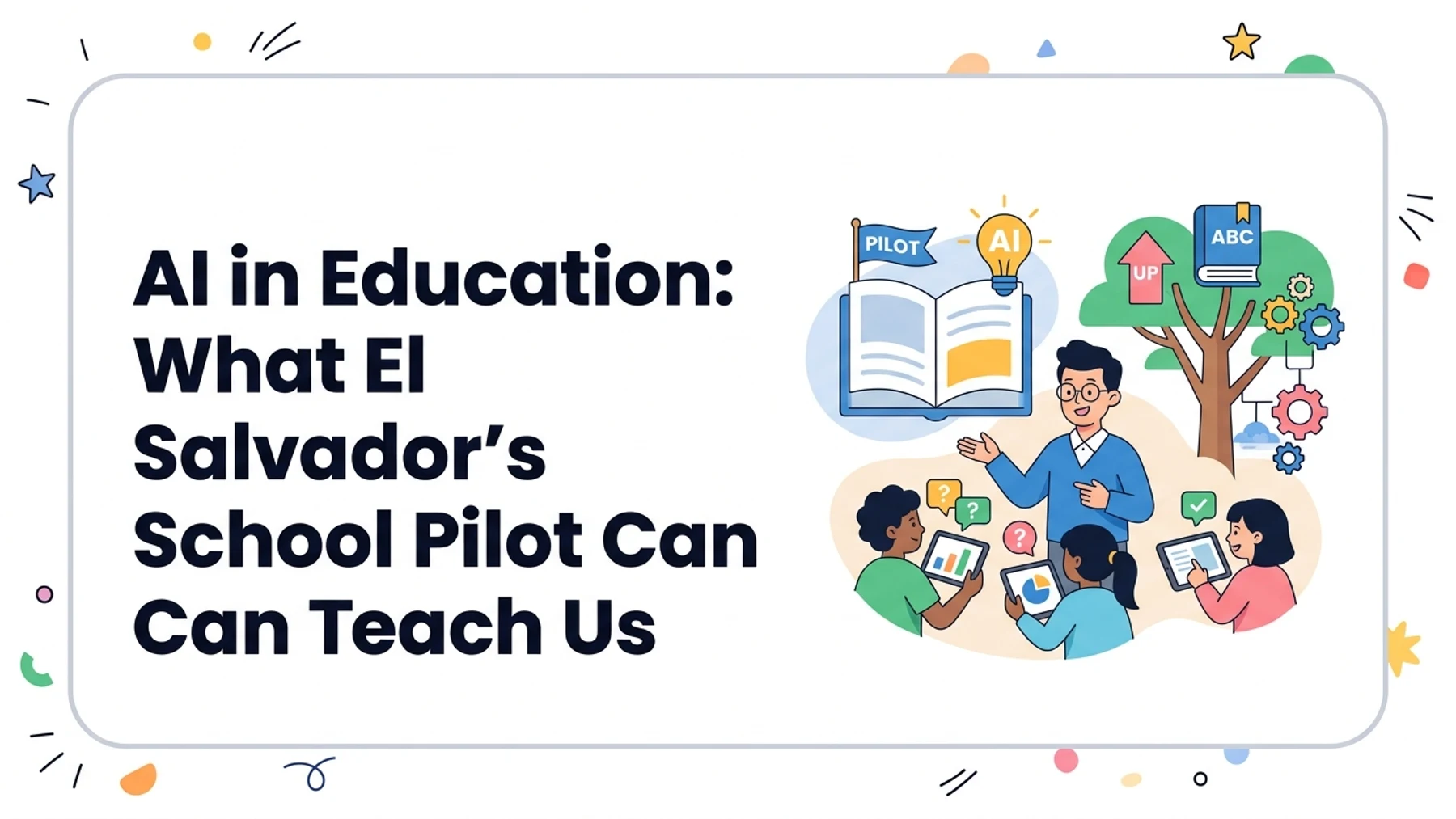
Artificial intelligence in education is often framed as a choice between embracing every new tool and keeping it away from students. El Salvador’s 2026 school-pilot results offer a more useful starting point: ask what a program includes, what its evidence can show, and what teachers and students still need to do.
What El Salvador reported in September 2026
El Salvador’s Ministry of Economy described its first PISA for Schools assessment on September 10, 2026. It covered 171 public schools in the country’s education modernization pilot and 1,198 volunteer students. The ministry said these students scored above the national average in reading, mathematics, and science, with results comparable to the averages for Germany and Sweden in the 2022 PISA assessment.
Those comparisons describe the participating students and the stated comparison with PISA 2022. They are not a national PISA result. The ministry explicitly said the pilot findings do not represent the whole Salvadoran education system.
The project also combines several supports: AI tutoring is one part of a wider modernization effort that includes teacher and school-leader support, learning materials, infrastructure, monitoring, and connectivity. A comparison of pilot participants with the national average cannot isolate the effect of AI tutoring—or establish that any one program component caused the scores.
That distinction matters. A promising result can be worth studying without being proof of a technology’s effect.
What PISA 2025 adds—and what it does not
The OECD released the first PISA 2025 results on September 8, 2026. The assessment covered more than 760,000 students in 91 countries and economies. The results report continued declines in average reading and mathematics performance across OECD countries, alongside findings about classroom device distraction and students’ use of AI for schoolwork.
PISA is an assessment of 15-year-olds, not a diagnosis of a particular classroom or a direct measure of every elementary or middle-school student. Its reported relationships between AI use and performance are observational. Students who did not use AI for specific schoolwork tasks tended to score higher in science than those who did; weekly users who used AI for the broader purpose of helping them learn performed similarly to non-users on average. Students who frequently used AI for learning and had school opportunities to assess AI-generated information tended to perform slightly better, but the OECD says these findings do not establish causality.
The practical lesson is not “AI raises scores” or “AI lowers scores.” The purpose of the task and the thinking students do around the tool both matter.
Put the learning goal before the tool
A teacher planning a reading activity can start with three questions:
- What should students practice? Name the target, such as finding evidence, summarizing, making an inference, or comparing claims.
- What work must students do themselves? Keep the reading, reasoning, or writing that is the lesson’s main goal in students’ hands.
- Where could a tool help without doing that work for them? It might help an adult prepare a starting text, give students a chance to compare explanations, or support a later review.
For example, if students are practicing how to support an inference, have them read and mark a relevant detail before asking a tool to comment on their reasoning. If they are practicing a summary, let them write one first and then compare it with another version. In each case, the adult should check generated claims and examples against dependable sources before using them as teaching material.
A digital activity is not automatically active or passive, just as a printed page is not automatically meaningful. Decide what the student will read, explain, question, or create, then choose the format that supports that work.
Make evaluation part of AI literacy
When students encounter an AI-generated claim, they can ask:
- What exactly is the claim?
- Which part of our source supports or contradicts it?
- What is missing from the source?
- What would we need to check before trusting it?
This gives students a concrete way to examine a fluent-sounding answer instead of treating fluency as proof. It also preserves the teacher’s role in choosing age-appropriate sources and setting the task.
PicoBuddy’s Grade 7 passage The Digital Tutor: How Artificial Intelligence Is Transforming Modern Classrooms is one text teachers can use to begin a discussion about AI in schools. As with any informational passage, review its claims and questions for the intended lesson before assigning it.
Keep the evidence in proportion
The El Salvador pilot is a case to follow, not a controlled test of AI tutoring. PISA 2025 is a large international assessment, but its associations do not show that AI, devices, or one classroom policy caused a score change. Both sources can inform thoughtful questions while leaving those limits clear.
For teachers, a useful starting point is modest: state the reading goal, preserve the thinking students need to practice, and use digital or AI tools only where they have a defined role. Then review whether the activity actually gives students that opportunity.
Frequently Asked Questions
Related Articles
Helping kids read better, together.
Like this article? Join 500+ educators using PicoBuddy to generate high-quality reading materials in seconds.