
Central American Independence Day: Why Five Countries Share September 15?
Five Central American countries share September 15 because of one 1821 independence declaration. Teach the shared history while keeping Costa Rica, El Salvador, Guatemala, Honduras and Nicaragua distinct.
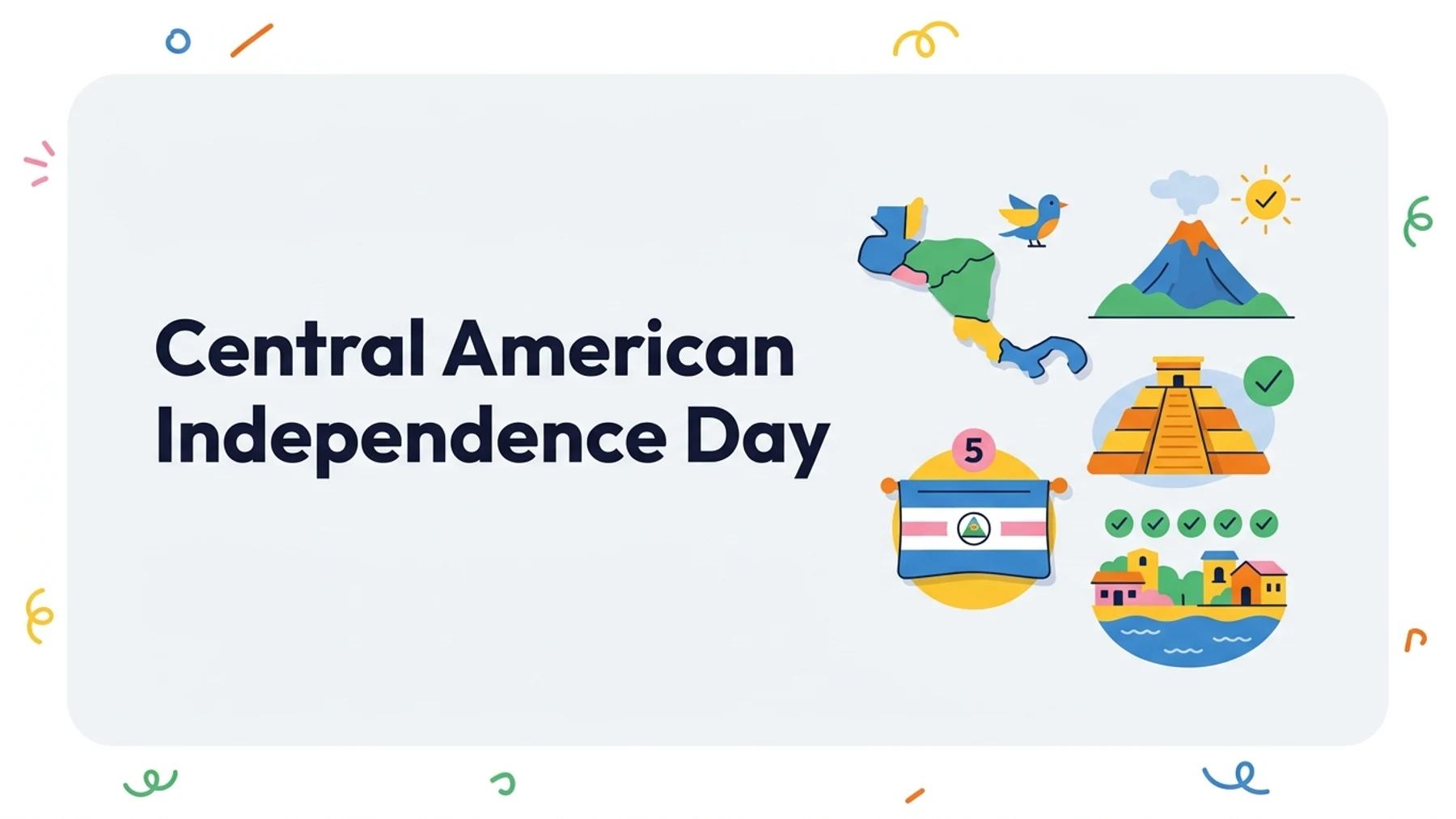
Five present-day Central American countries mark September 15 as their independence day: Costa Rica, El Salvador, Guatemala, Honduras, and Nicaragua.
The shared date comes from a shared historical turning point. The areas that became these five countries declared independence from Spain on September 15, 1821. That does not mean five modern nations appeared overnight, and it does not mean the countries have one interchangeable history or culture.
For students, that distinction creates a useful lesson frame: one shared event, five distinct national stories.
The Short Answer: One Shared Independence Declaration in 1821
On September 15, 1821, authorities in the Spanish Captaincy General of Guatemala declared independence from Spain. The territory included the provinces that later became Costa Rica, El Salvador, Guatemala, Honduras, and Nicaragua; those modern countries did not all appear as independent states on that day.
The provinces were briefly annexed to the Mexican Empire. After that empire fell, the Central American provinces formed a provisional union in 1823, which became the United Provinces of Central America. The federation broke apart in stages, and by the early 1840s the five countries were following separate political paths.
That is why September 15 can be both a shared historical milestone and the independence day of five different countries today.
A useful way to put it for grades 5–7 is:
They share an independence date because they were connected in the same 1821 independence event. They do not share one national story after 1821.
Which Five Countries Share September 15?
The five countries are:
- Costa Rica
- El Salvador
- Guatemala
- Honduras
- Nicaragua
Before students compare history, locate all five on a map. This keeps the lesson grounded in real geography instead of treating “Central America” as one vague place.
You can use PicoBuddy's Explore the World map to establish location first. Ask students to find each country, notice which countries border one another, and identify where the region sits between North and South America.
If you want one historical location to add to the map, mark Guatemala City. The Central American Act of Independence was signed there in 1821. Keep that point as historical context, not as a suggestion that Guatemala represents the other four countries.
One Date Does Not Mean One National Story
The strongest classroom comparison separates what is shared from what is specific.
What the five countries share in this lesson
Students can identify a common starting point:
- independence from Spain on September 15, 1821
- a period of regional political connection after independence
- participation in the United Provinces of Central America beginning in 1823
Those details explain the shared date.
What students should not collapse together
Each country has its own later political history, geography, communities, national identity, and ways of commemorating independence.
That means a lesson should avoid statements such as “Central Americans celebrate this way” unless a source genuinely supports a regional comparison. A tradition from Costa Rica should not automatically be presented as a tradition from Honduras, Nicaragua, Guatemala, or El Salvador.
The same rule applies to reading passages. A text about one country can deepen the lesson precisely because it adds specific detail to the shared historical frame.
A Simple Grades 5–7 Classroom Sequence
You can teach the topic in four steps without turning it into a large unit.
1. Map the five countries
Start with the five names and locations.
Ask students:
- Where is each country?
- Which countries share borders?
- What do you notice about the shape and position of the region?
- Why might geography matter when neighboring territories share part of a political history?
The goal is orientation, not memorizing every capital or border on the first pass.
2. Read one country-specific text closely
Next, move from the shared date to one specific country.
PicoBuddy's The Rich Coast: History and Heart of Costa Rica is one current Upper Elementary starting point. It notes Costa Rica's independence in 1821 and then continues into later parts of Costa Rican history.
That makes it useful for an important comparison question:
Which part of this reading belongs to the shared 1821 story, and which details are specifically about Costa Rica?
Students now have to separate common history from country-specific evidence.
3. Return to the shared-date question
After the reading, bring students back to the original question:
Why do five countries share September 15?
Have students answer in two parts:
- Explain the shared 1821 event.
- Give one detail from the country-specific reading that should not be generalized to all five countries.
This turns a history fact into a reading-comprehension and evidence task.
4. Compare with a second country or source
For a deeper lesson, add a second country-specific source from your curriculum, library, or another reliable classroom resource.
Keep the comparison focused. Students might compare:
- geography
- what happened after 1821
- one later historical development
- how a source describes national identity
- what details are shared and what details are unique
Avoid turning the comparison into a collection of food, clothing, music, or celebration stereotypes. Those topics can be valuable when taught with strong country-specific context, but they should not substitute for the historical question students are trying to answer.
Why Hispanic Heritage Month Begins on September 15
In the United States, National Hispanic Heritage Month runs from September 15 through October 15.
The September 15 starting date is significant because Costa Rica, El Salvador, Guatemala, Honduras, and Nicaragua all celebrate their independence anniversaries that day. Other independence dates follow soon after, including Mexico on September 16 and Chile on September 18.
That makes Central American independence a natural opening history lesson for Hispanic Heritage Month, but it should not become the whole story of the observance. Hispanic and Latino histories in the United States include many countries, communities, identities, and experiences.
For a broader month-long classroom framework, see Hispanic Heritage Month Activities for Students: 4 Reading Lenses for Grades 3–8.
Match the Follow-Up to the Learning Goal
The same reading can lead to different follow-up formats. Choose the response that matches what you want students to practice.
If the goal is geography: use the map and have students locate or compare places.
If the goal is comprehension: use a few focused questions or an online quiz to check what students understood.
If the goal is structured written practice: use a printable worksheet or short evidence response.
If the goal is synthesis: ask students to write a short compare paragraph that separates the shared 1821 event from country-specific details.
If the goal is discussion: ask students to explain why “same independence date” does not mean “same national story.”
The format is not the lesson goal. It is the tool you choose to make that goal visible.
Start With One Specific Country, Then Widen the Comparison
A strong Central American Independence Day lesson does not need to cover five countries in equal depth at once.
Start with the shared September 15 history. Put all five countries on the map. Then choose one specific reading and let students investigate what belongs to that country's story.
PicoBuddy's Hispanic Heritage Month reading collection gives you a live reading hub for the season. The current collection includes the Costa Rica passage above as one direct Central American starting point, alongside readings from other Hispanic and Latino histories and places.
Use the collection selectively. For this lesson, the goal is not to make every text fit Central American Independence Day. It is to choose a specific reading that helps students move from one shared date to a more accurate understanding of distinct countries and histories.
Frequently Asked Questions
Related Articles
Helping kids read better, together.
Like this article? Join 500+ educators using PicoBuddy to generate high-quality reading materials in seconds.