
Choosing Reading Passages: A Practical Guide for Teachers and Parents
Choosing the right reading passage depends on grade level, reading skill, topic, text type, passage length, and question difficulty. Learn how to pick a passage that fits your lesson.
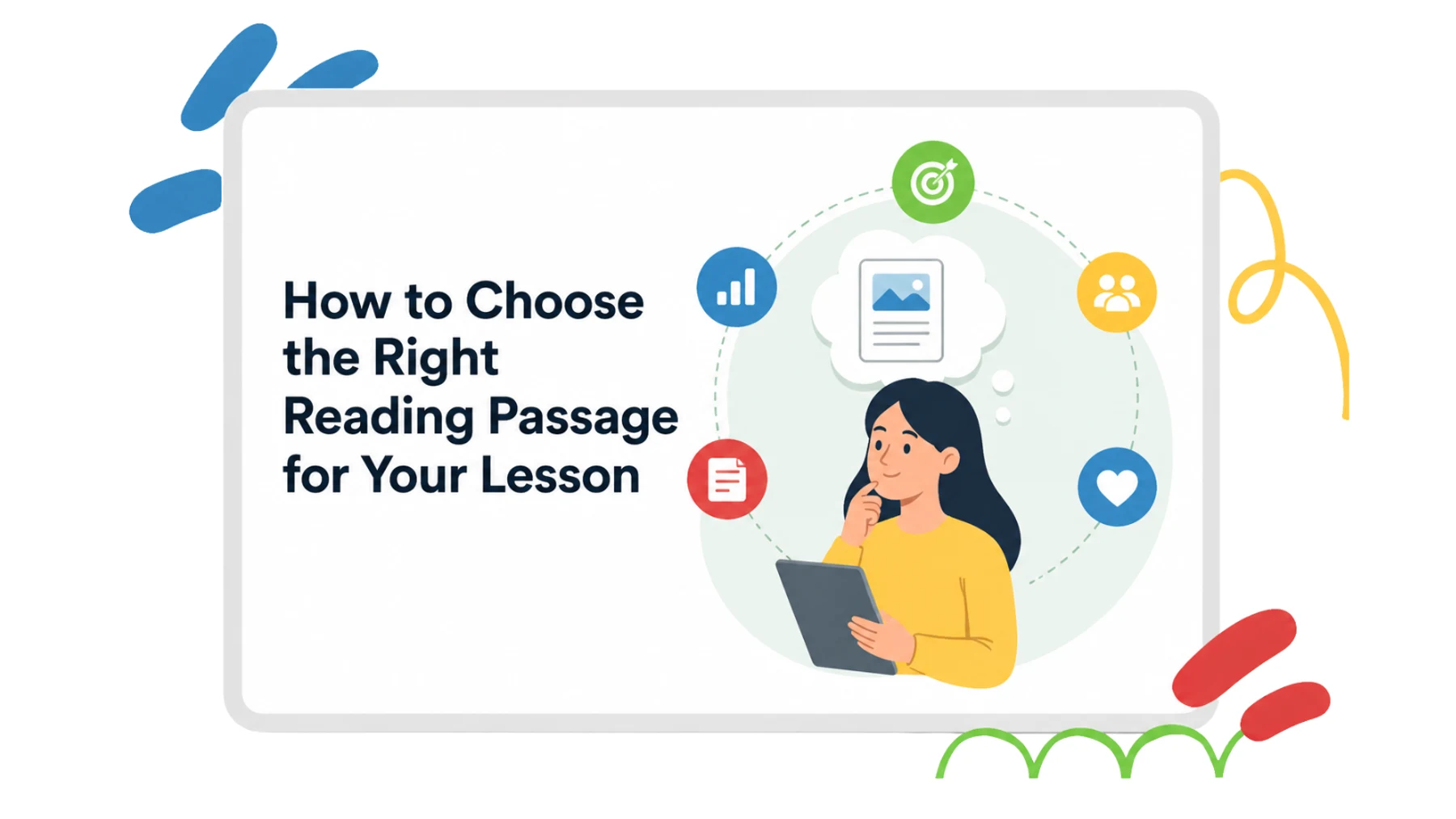
How to Choose the Right Reading Passage for Your Lesson
Choosing a reading passage sounds simple, but it can quickly become frustrating.
A passage might have the right topic, but the reading level may be too difficult. Another passage might match the grade level, but feel boring to students. A passage may include questions, but those questions may not support the skill you want to teach.
The best reading passage is not simply “a Grade 3 passage” or “a nonfiction passage.” The right passage should match the lesson goal, the student’s reading level, the topic, the text type, the question difficulty, and the time you have available.
A good reading passage helps students practice the exact skill you want to teach, while still feeling clear, manageable, and interesting.
Choosing the text is one part of the lesson. For the wider sequence, from reading goals to questions and discussion, see how to teach reading comprehension in elementary school.
Start with the lesson goal
The first question to ask is simple:
What do I want students to practice?
A reading passage is only the right passage if it fits the goal of the lesson. Before choosing a text, decide what the passage needs to do.
Your lesson goal might be to:
- Practice main idea
- Introduce a new topic
- Build vocabulary
- Practice inference
- Improve fluency
- Compare fiction and nonfiction
- Support an ESL or ELL learner
- Prepare for a test
- Start a classroom discussion
- Connect reading to science or social studies
For example, if the goal is to teach main idea, an informational passage with a clear topic and strong supporting details may work best.
If the goal is to teach character feelings, a fiction passage is usually a better choice.
If the goal is fluency, choose a short, readable passage that students can read more than once.
If the goal is background knowledge, choose a nonfiction passage about the topic students are learning.
A good passage is not just “good” in general. It is good for a specific purpose.

Match the passage to the grade level
Grade level is usually the first filter teachers and parents use. That makes sense, because a Grade 1 passage should look very different from a Grade 5 passage.
Still, grade level is only a starting point. It helps you narrow the choice, but you should also check the student’s actual reading ability, vocabulary, confidence, and lesson goal.
Here is a simple overview:
| Grade | Passage should usually include | Good question types |
|---|---|---|
| Grade 1 | Short text, clear events, familiar words | Who, what, where |
| Grade 2 | Sequence, details, simple problem | What happened first, why |
| Grade 3 | Clear topic, paragraphs, fiction and nonfiction mix | Main idea, detail, vocabulary |
| Grade 4 | Longer passages, richer vocabulary | Inference, evidence, cause and effect |
| Grade 5 | Complex ideas, theme, author’s purpose | Compare, analyze, justify |
| Grades 6 to 8 | Deeper texts, arguments, abstract ideas | Evidence, structure, author’s purpose |
For younger students, choose short passages with clear events and simple questions. For older students, choose passages that allow for deeper thinking, evidence, vocabulary, and analysis.
For example, a Grade 2 passage might ask students what happened first. A Grade 5 passage might ask students how the author supports the main idea.
Both are reading comprehension questions, but they require different levels of thinking.
Consider the student’s actual reading ability
Grade level matters, but students do not always read exactly at grade level.
One Grade 4 student may need a shorter Grade 3 passage to build confidence. Another Grade 4 student may be ready for a more advanced nonfiction text. Some students read fiction comfortably but struggle with informational text. Others can discuss a topic well, but lose focus when the passage is too long.
This is especially important for:
- Students who lack background knowledge on a topic
- Homeschool students
- Mixed-level classrooms
- ESL and ELL students
- Advanced readers
- Struggling readers
For students who struggle, choose passages that are clear, short, and confidence-building. Use familiar topics, fewer questions, and simple vocabulary. Start with literal questions before moving into inference or text evidence.
For advanced students, choose longer passages, richer vocabulary, deeper questions, nonfiction texts, and written response tasks. You can also ask them to compare two passages on the same topic.
The right passage should feel challenging but possible. If students are frustrated before they even begin, the passage is probably not the right fit.

Choose a topic students care about
Topic choice can make a big difference.
A student may work much harder on a passage about a topic they already care about. This is especially true for reluctant readers, homeschool students, and children who say they “do not like reading.”
Popular reading passage topics include:
For example, a student who dislikes reading but loves soccer may be more willing to read a soccer passage than a generic passage about school.
A student who loves animals may be more engaged by a nonfiction passage about sea turtles than a random fiction story.
The right topic can make a difficult reading task feel more approachable.
This does not mean every passage has to be “fun.” Students also need academic topics, nonfiction, and challenging texts. But interest is a powerful starting point, especially when motivation is low.
Choose the right text type
Different text types support different reading goals. Before choosing a passage, think about what kind of text best fits your lesson.
| Text type | Best for |
|---|---|
| Fiction | Character, plot, setting, theme, inference |
| Informational or nonfiction | Main idea, details, vocabulary, facts |
| Biography | Sequence, cause and effect, historical context |
| Poetry | Rhythm, imagery, figurative language |
| Functional text | Real-world reading, instructions, schedules, notices |
| Argumentative text | Claims, evidence, author’s purpose, opinion |
Choose fiction when you want students to understand characters, feelings, plot, conflict, or theme.
Choose informational text when you want students to practice main idea, facts, vocabulary, and evidence.
Choose biography when you want to connect reading with history, real people, or life events.
Choose functional text when students need practical reading, such as understanding a schedule, recipe, menu, sign, or set of instructions.
Choose argumentative text when older students are ready to identify claims, reasons, evidence, and opinion.
The text type should match the skill. A fiction passage can teach main idea, but nonfiction is often clearer for that goal. A nonfiction passage can include inference, but fiction often gives more natural opportunities to infer character feelings and motivation.

Check the passage length
Passage length should match the grade level, lesson goal, and time available.
A long passage is not automatically better. A short passage can be perfect for fluency, warm-ups, ESL support, or focused skill practice. A longer passage can work well for deeper analysis, test preparation, or multi-step questions.
Here is a simple guide:
| Lesson situation | Suggested passage length |
|---|---|
| Quick warm-up | Very short passage |
| Fluency practice | Short, readable passage |
| Grade 1 to 2 lesson | Short passage with simple questions |
| Grade 3 to 5 lesson | Medium passage with 5 to 8 questions |
| Test prep or deep analysis | Longer passage with more complex questions |
| ESL/ELL support | Shorter passage with clear structure |
A passage should be long enough to support the reading goal, but not so long that students lose focus.
For example, if the goal is to practice one reading skill, a short passage may be enough. If the goal is to compare ideas, analyze author’s purpose, or use evidence, students may need a longer text.
Also think about the time you have. A 15-minute warm-up needs a different passage than a full 45-minute lesson.
Passage length and question count go hand in hand. For more guidance, see How many questions should a reading comprehension passage have?
Look at the question quality
The passage itself is only half the lesson. The questions matter too.
A passage with weak questions may not support good reading practice. The questions should help students understand the text, think about what they read, and practice the target skill.
Good reading comprehension questions should:
- Be clear
- Match the passage
- Match the grade level
- Include the target skill
- Move beyond simple recall when appropriate
- Ask for evidence when students are ready
- Avoid trick wording
- Not overload the student
A balanced question set may include:
- Literal questions
- Main idea questions
- Detail questions
- Vocabulary questions
- Inference questions
- Text evidence questions
- Discussion or written response questions
For example, if your lesson goal is inference, the passage should include questions that ask students to use clues from the text. If every question only asks for a simple fact, the passage may not fit the lesson.
A good question set should feel purposeful, not random.
Make sure the vocabulary fits
Vocabulary can make or break a reading passage.
Sometimes a passage looks grade-appropriate at first, but it includes too many unfamiliar words. This can make comprehension difficult, especially for younger students, struggling readers, and ESL or ELL learners.
A passage may be too hard if:
- Too many words are unfamiliar
- Key vocabulary is not explained
- Sentences are too dense
- The topic requires background knowledge students do not have
- The questions use harder language than the passage
Before using a passage, scan it for important vocabulary. Look for 3 to 5 words that students may need to understand before reading.
Then decide whether to:
- Pre-teach the words
- Let students use context clues
- Choose a simpler passage
- Use the same topic at an easier level
- Add a vocabulary question after reading
For example, a passage about volcanoes may include words like erupt, lava, crater, pressure, and ash. If students do not know these words, they may struggle to understand the passage.
Vocabulary should challenge students, but it should not block the entire reading experience.
Think about the lesson format
Different lesson formats need different kinds of passages.
A passage for whole-class discussion may not be the best choice for independent homework. A passage for fluency practice may not work for test preparation. A passage for an ESL small group may need clearer language and more familiar vocabulary.
| Lesson format | Best passage choice |
|---|---|
| Whole-class lesson | Shared topic, clear discussion points |
| Small group | Targeted skill and level |
| Independent work | Clear instructions and manageable questions |
| Homework | Not too long, self-explanatory |
| Fluency practice | Short and readable |
| ESL/ELL lesson | Clear language and familiar topic |
| Homeschool lesson | Flexible topic and clear questions |
| Test prep | More formal question types |
For a whole-class lesson, choose a passage that everyone can discuss. The topic should be broad enough for shared conversation.
For small group work, choose a passage that matches the group’s specific need, such as inference, vocabulary, fluency, or main idea.
For homework, choose a passage that students can complete without too much teacher support.
For ESL or ELL lessons, choose a passage with clear structure, familiar topics, and simple questions.
For homeschool lessons, choose something flexible, interesting, and easy to discuss.
Use a simple passage selection checklist
Before choosing a reading passage, ask these questions:
- What is the lesson goal?
- What grade level is the student in?
- Is the passage at the right reading level?
- Is the topic interesting or useful?
- Is the text type right for the skill?
- Is the passage length manageable?
- Are the questions clear and purposeful?
- Is the vocabulary appropriate?
- Does the passage fit the lesson format?
- Do I need an easier or harder version?
This checklist can help you avoid choosing a passage only because it “looks good” or matches a broad grade level.
The best passage is the one that fits the student, the lesson, and the skill.

Example: choosing a passage for different lessons
Here are a few practical examples.
Example 1: Main idea lesson
For a main idea lesson, choose an Informational passage with a clear topic and strong supporting details.
A good passage for this goal should include:
- A clear central idea
- Several supporting details
- Vocabulary that fits the grade level
- Questions about main idea and evidence
- A manageable length
This works especially well for Grade 3 to Grade 5 students.
Example 2: Character feelings lesson
For a lesson about character feelings, choose a Fiction passage.
A good passage for this goal should include:
- A clear main character
- A problem or conflict
- A change in emotion
- Clues about how the character feels
- Inference or discussion questions
For example, a story about a student moving to a new school could help students discuss nervousness, friendship, and change.
Example 3: ESL vocabulary lesson
For an ESL vocabulary lesson, choose a short passage with a familiar topic and clear sentences.
A good passage for this goal should include:
- A familiar topic
- Simple structure
- 3 to 5 key vocabulary words
- Clear comprehension questions
- Optional visuals or discussion support
For example, a passage about food, school, weather, pets, or sports may work well for English learners.
Example 4: Fluency practice
For fluency practice, choose a short, readable passage that students can read more than once.
A good fluency passage should include:
- Clear sentences
- Manageable vocabulary
- A length that fits repeated reading
- Only a few quick comprehension questions
- A topic students will not mind reading again
For fluency, the passage should not be packed with difficult words. Students need to focus on accuracy, expression, and smooth reading.
Example 5: Mixed-level classroom
For a mixed-level classroom, choose the same topic at multiple reading levels.
A good setup might include:
- One easier version of the passage
- One grade-level version
- One more challenging version
- Questions matched to each level
- A shared discussion at the end
For example, all students could read about sea turtles, but different groups could read different versions. This lets everyone join the same topic conversation while reading at the right level.
Can PicoBuddy help you choose or create the right passage?
Yes. PicoBuddy helps teachers, parents, and homeschool families find or create reading passages by grade, topic, and text type.
You can browse ready-made passages or create a custom passage when you need something more specific.
For example, you can create:
- A Grade 3 nonfiction passage about space
- A Grade 4 fiction passage about friendship
- A Grade 5 sports passage with inference questions
- A beginner ESL passage about food
- The same topic at easier and harder reading levels
This is useful when a normal worksheet does not quite fit your lesson. Maybe you need a certain grade, a specific topic, a fiction version, a nonfiction version, or questions that target one skill.
Need the right passage for your next lesson? Browse PicoBuddy’s free reading passages by grade, topic, and text type, or create your own custom passage in minutes.

Final thoughts
The right reading passage is not just the one that matches the grade.
A strong passage should match the lesson goal, student ability, topic, text type, vocabulary, passage length, question quality, and lesson format.
A good passage helps students read with confidence and practice the exact skill you want to teach.
Before choosing a passage, ask:
- What do I want students to practice?
- Is this passage at the right level?
- Will this topic keep students engaged?
- Do the questions match the goal?
- Is this the best text type for the skill?
When those answers are clear, it becomes much easier to choose the right reading passage.
Browse PicoBuddy’s free reading passages or create a custom passage for your grade, topic, and lesson goal.

Frequently Asked Questions
Related Articles
Helping kids read better, together.
Like this article? Join 500+ educators using PicoBuddy to generate high-quality reading materials in seconds.