
Monarch Butterfly Migration Homeschool Lesson: Reading, Maps, and Community Science
Turn fall monarch migration into a compact homeschool science-and-reading lesson with one passage, a map, an observation, and optional community-science context.
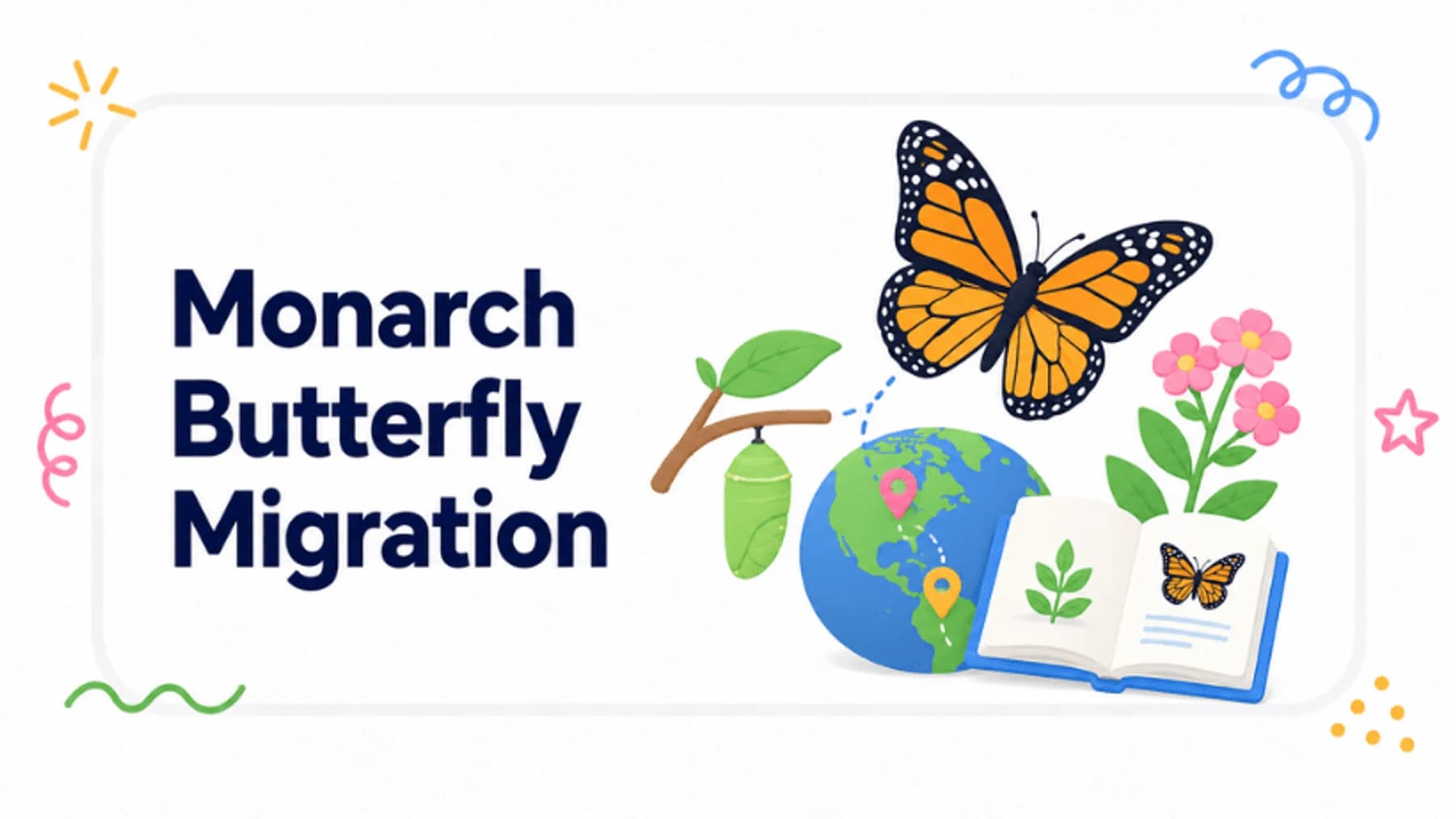
Each fall, monarch butterflies move south across North America toward overwintering sites in Mexico. That seasonal journey can become a compact homeschool lesson that combines reading, geography, observation, and careful use of community-science information.
You do not need to catch or tag a butterfly to study migration. Start with one accurate text, map the broad route, look for evidence outdoors when appropriate, and use an established program if your family wants to contribute observations.
Step 1: Read for the Migration Story
Begin with PicoBuddy’s Monarch Butterfly Migration passage or another current, age-appropriate source.
Ask your child to read for four parts of the migration story:
- where monarchs begin the fall journey;
- the general direction they travel;
- what they need along the way;
- where many eastern monarchs spend the winter.
Then write a one-sentence main idea. A good summary should describe a seasonal movement and its purpose without turning every detail into a list.
Step 2: Put the Journey on a Map
Use a map of North America to locate your home, the United States–Mexico border, and central Mexico. Add one or two possible stopping regions mentioned in the reading or a current migration source.

Keep the map honest. A migration route is not one narrow highway, and a classroom map is a model rather than a live tracking tool. Label broad direction and regions unless your source supports a more precise claim.
Ask:
- How does distance help explain why the journey takes time?
- Why might weather and flowering plants matter along the route?
- What does the map show clearly?
- What can the map not tell us?
Step 3: Make One Local Observation
If monarchs or other pollinators are active in your area, spend 10 to 15 minutes observing outside with an adult. Record the date, location, weather, plant, number seen, and how certain you are about the identification.
If monarchs are not present, the observation can focus on habitat instead: Which flowering plants are available? Is there a sunny, sheltered area? What evidence suggests that insects have visited?
Do not handle wildlife for the sake of completing the lesson. A no-sighting result is still data, and a photo or field note can be more useful than trying to force an encounter.
Step 4: Compare Reading With Current Evidence
Open a current migration map or update from a trusted conservation or community-science organization. Compare it with the route your child sketched.
Use three columns:
- The reading explained…
- The current map or report shows…
- We still wonder…
This turns a seasonal topic into source comparison. The passage gives background; current observations show what people are reporting now.
Step 5: Choose a Responsible Community-Science Extension
Monarch Watch operates a long-running tagging program to study fall migration through mark and recapture. It publishes current instructions and annual data materials. Tagging is a structured research activity, not a casual craft.
If your family wants to participate, use the current instructions of an established program, obtain the correct materials, and supervise the activity as required. Do not reuse an old data sheet or improvise a tag.
A lower-contact option is to submit a verified sighting through an appropriate observation project, attend a local educator program, or keep a private seasonal nature journal.
Adapt the Lesson by Age
For grades 1–2, read aloud, trace one southward arrow, and draw one thing a migrating butterfly needs.
For grades 3–5, write a main idea, map broad regions, and record one observation with date and weather.
For grades 6–8, compare two sources, discuss what migration data can and cannot prove, and evaluate the requirements of a real community-science protocol.
A Simple One-Hour Plan
- 15 minutes: read and identify the migration story.
- 10 minutes: map the broad route.
- 15 minutes: make one outdoor or habitat observation.
- 10 minutes: compare the reading with a current map or report.
- 10 minutes: write a claim supported by one detail from each source.
End with a choice: continue a nature journal, explore the live Insects reading collection, or investigate an established community-science program. The lesson works even if you never see a monarch. Careful reading, honest observation, and responsible use of evidence are the real goals.
Frequently Asked Questions
Related Articles

Helping kids read better, together.
Like this article? Join 500+ educators using PicoBuddy to generate high-quality reading materials in seconds.