
National Punctuation Day Activities: Use a Reading Passage for Contextual Practice
Turn a reading passage students already understand into contextual punctuation practice with its Fix the Sentence worksheet, an explanation prompt, and a short transfer into real writing.
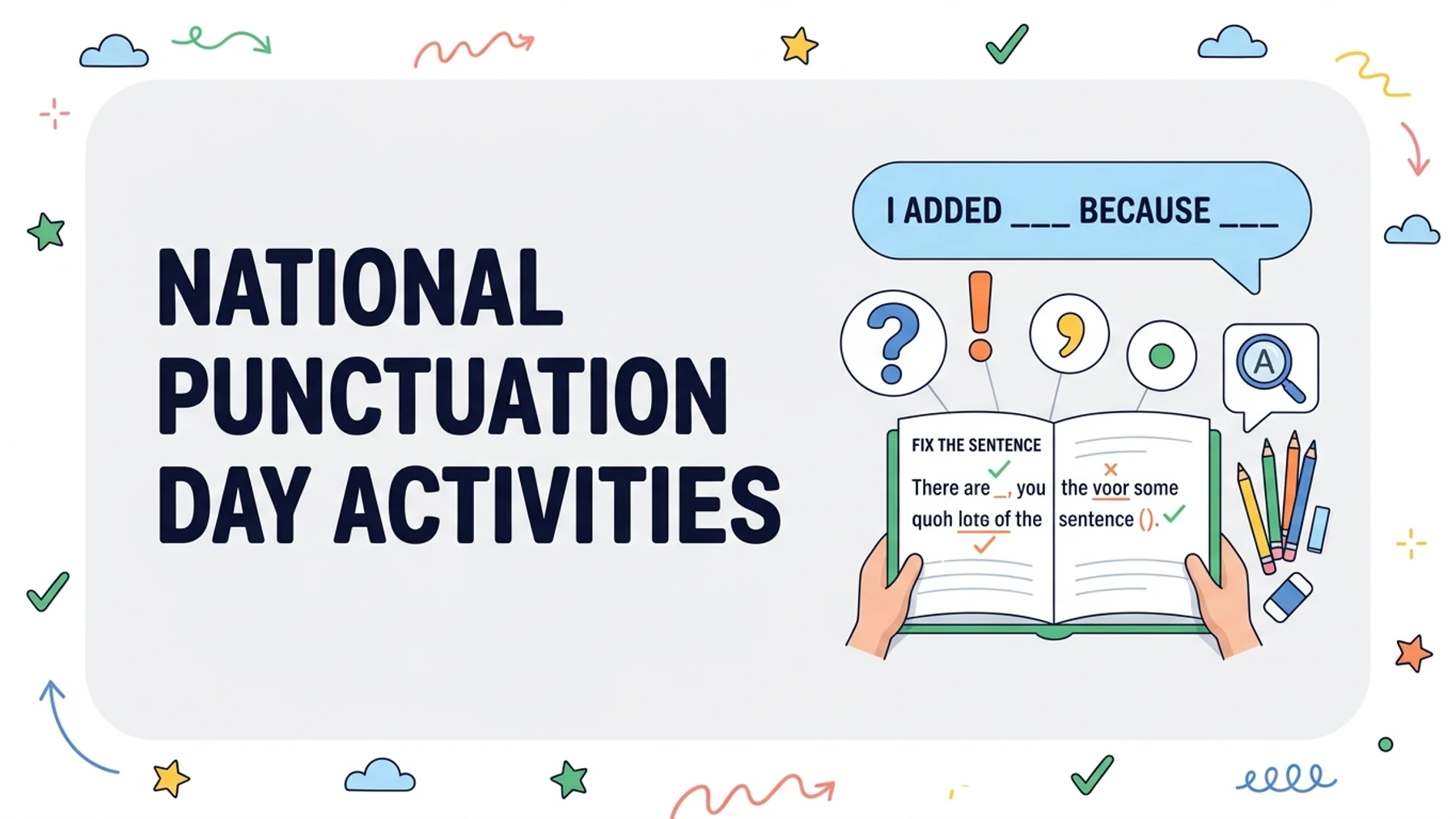
National Punctuation Day falls on September 24, but you do not need a collection of disconnected novelty activities to make the day useful.
Start with a reading passage your students are interested in. Read it for meaning first. Then use that passage's Fix the Sentence worksheet to restore capitalization and punctuation in sentences drawn from the same text.
The sequence is simple:
Read → Notice → Repair → Explain → Transfer
Students meet the sentences in context before they edit them. That makes it easier to discuss what each mark is doing for the reader instead of treating punctuation as a list of symbols to memorize.
Choose a Passage With the Right Kind of Challenge
Begin in the PicoBuddy reading passage library and choose a passage that matches your students' reading level, interests, or current content.
Open the passage and check its printable activities. Current passage pages can include a Fix the Sentence worksheet made from the passage text, with an answer key. Choose a passage that displays that worksheet before you build the lesson around it.
Read the passage together or let students read independently. Keep the first reading focused on meaning:
- What is the text mainly about?
- Which details matter?
- Who is speaking?
- Where does one idea end and another begin?
- Which sentence was especially clear, surprising, or interesting?
Do not begin by hunting for errors in the original passage. Students first need to understand the intact text.
Preview What the Worksheet Removes
The Fix the Sentence activity presents sentences from the passage without some of the features students need to restore. Depending on the source sentence, that may include:
- capital letters;
- periods, question marks, or exclamation points;
- commas;
- apostrophes;
- quotation marks;
- other punctuation required by the sentence.
Tell students that their job is not merely to make the sentence look like the answer key. Their job is to rebuild a sentence that clearly communicates the original meaning.
A useful prompt is:
What does the reader need to see in order to understand this sentence?
That question keeps the activity connected to reading and writing.
Use the Worksheet as the Main Activity
1. Notice Before Rewriting
Before students rewrite anything, ask them to mark the places where something seems to be missing.
They might draw a small line where a sentence ends, circle a word that needs a capital letter, or place a symbol where dialogue punctuation belongs.
This first pass slows down guessing. It also reveals what students notice independently.
2. Repair the Sentence
Students rewrite each sentence with the capitalization and punctuation they believe it needs.
If the worksheet contains several sentences, you do not have to discuss every correction as a class. Choose one or two that reveal a useful idea.
For example, a sentence may require students to recognize:
- the boundary between two complete thoughts;
- an introductory phrase;
- a contraction or possessive;
- the beginning and end of spoken dialogue;
- a question rather than a statement;
- a proper noun that needs a capital letter.
The worksheet remains the core practice. Discussion helps students explain what they did.
3. Explain One Choice
Ask each student to select one correction and finish this sentence:
“I added ___ because ___.”
Examples include:
- “I added a period because both groups of words are complete thoughts.”
- “I used quotation marks because these are the character's exact words.”
- “I added an apostrophe because the word shows ownership.”
- “I capitalized the name because it is a proper noun.”
One short explanation is enough. The goal is to connect a visible change to a reason.
4. Compare With the Passage and Answer Key
Now return to the intact sentence in the reading passage and compare it with the student's version and the supplied answer key.
Ask:
- Which corrections match?
- Did the context help?
- Does a different answer create a complete, correctly punctuated sentence?
- Would that alternative change the original wording or meaning?
- Which rule needs more practice?
The answer key is useful evidence, but it does not have to function only as a score sheet. Use it to make the reasoning visible.
Four Ways to Adjust the Same Activity
For Students Who Need More Support
Use fewer worksheet sentences and narrow the target.
You might focus only on:
- sentence capitals;
- names and other proper nouns;
- end punctuation;
- one clear example of dialogue;
- one sentence boundary.
Read the intact sentence aloud again before students repair it. You can also cover the answer key and reveal one part at a time.
For Students Ready for Grade-Level Editing
Ask students to complete the full worksheet, then explain two different kinds of correction.
For example, one explanation might address sentence structure while another addresses dialogue or an apostrophe.
Keep the focus on the conventions that actually appear in the selected passage. There is no need to force every punctuation mark into one lesson.
For Students Ready for More Challenge
Invite students to find another suitable sentence in the passage and create their own Fix the Sentence item.
They should:
- copy the original sentence accurately;
- create an editing version by removing selected capitals or punctuation;
- prepare a correct answer;
- explain which clues a classmate should use.
Before sharing the challenge, check that the sentence has one clear intended answer or that reasonable alternatives can be discussed.
For a Small Group or Tutoring Session
Ask the student to think aloud while repairing one sentence.
Listen for the point where the reasoning becomes uncertain. That tells you whether the next step should focus on sentence boundaries, dialogue, apostrophes, commas, capitalization, or another convention.
Do not turn one mistake into a diagnosis. Use it to choose the next small teaching target.
Transfer the Skill Into Real Writing
End the activity by moving beyond the worksheet.
Ask students to open a current draft, reading response, notebook entry, or teacher-created paragraph. They should find one sentence that needs the same kind of attention they practiced.

For example, a student who repaired dialogue punctuation can check a conversation in a story. A student who worked on sentence boundaries can look for one run-on or fragment. A student who corrected capitals can review names, places, and sentence beginnings.
This transfer step answers the most important question:
Can the student use the convention in their own writing, not only recognize it on a worksheet?
Add Grammar Practice Only When It Matches the Need
The reading passage and its Fix the Sentence worksheet form the main National Punctuation Day activity.
If the worksheet reveals a specific gap that needs more repetition, PicoBuddy Grammar can provide a focused follow-up by grade and skill.
Use the additional practice deliberately:
- choose sentence-boundary work when fragments or run-ons are the problem;
- choose capitalization practice when that is the recurring issue;
- choose a different grammar target only when the student's work provides evidence for it.
A quiz, printable, teacher discussion, and writing revision can all be useful. The best format is the one that matches the next learning job.
Use the Day as a Hook, Not a Deadline
National Punctuation Day is observed on September 24. That gives teachers a timely reason to pay attention to how punctuation supports meaning.
The lesson still works on any other day.
You can repeat the same workflow with a new passage later in the year:
Read the intact text → Repair passage-based sentences → Explain a choice → Check the source → Transfer the convention
Because the examples come from a text students have already read, the activity connects comprehension, editing, and writing without requiring a separate punctuation packet.
A Two-Minute Exit Check
Finish with one new sentence that contains the same kind of challenge as the worksheet.
Ask students to:
- rewrite it correctly;
- underline the punctuation or capitalization they added;
- explain one choice in a sentence.
Collect the answers or discuss one example.
You now have a quick indication of whether students can apply the convention to a fresh sentence. That evidence can guide the next lesson without turning National Punctuation Day into a test.
Keep Punctuation Connected to Meaning
Punctuation instruction includes rules, practice, correction, and repetition. It is most useful when students can also explain how a mark helps the reader.
A passage-linked Fix the Sentence worksheet gives that practice a shared context. Students know what the sentence is trying to say. They can repair it, compare it with the source, and use the same convention in their own writing.
Choose one passage, teach one clear editing job, and let the punctuation do what it is meant to do: make written meaning easier to follow.
Frequently Asked Questions
Related Articles



Helping kids read better, together.
Like this article? Join 500+ educators using PicoBuddy to generate high-quality reading materials in seconds.