
PISA 2025 Results: What Teachers Should Know About Reading, AI, and Digital Distraction
PISA 2025 offers a more useful classroom story than rankings alone: slow down the read, protect attention, and give AI a defined learning role without removing the thinking students need to practice.
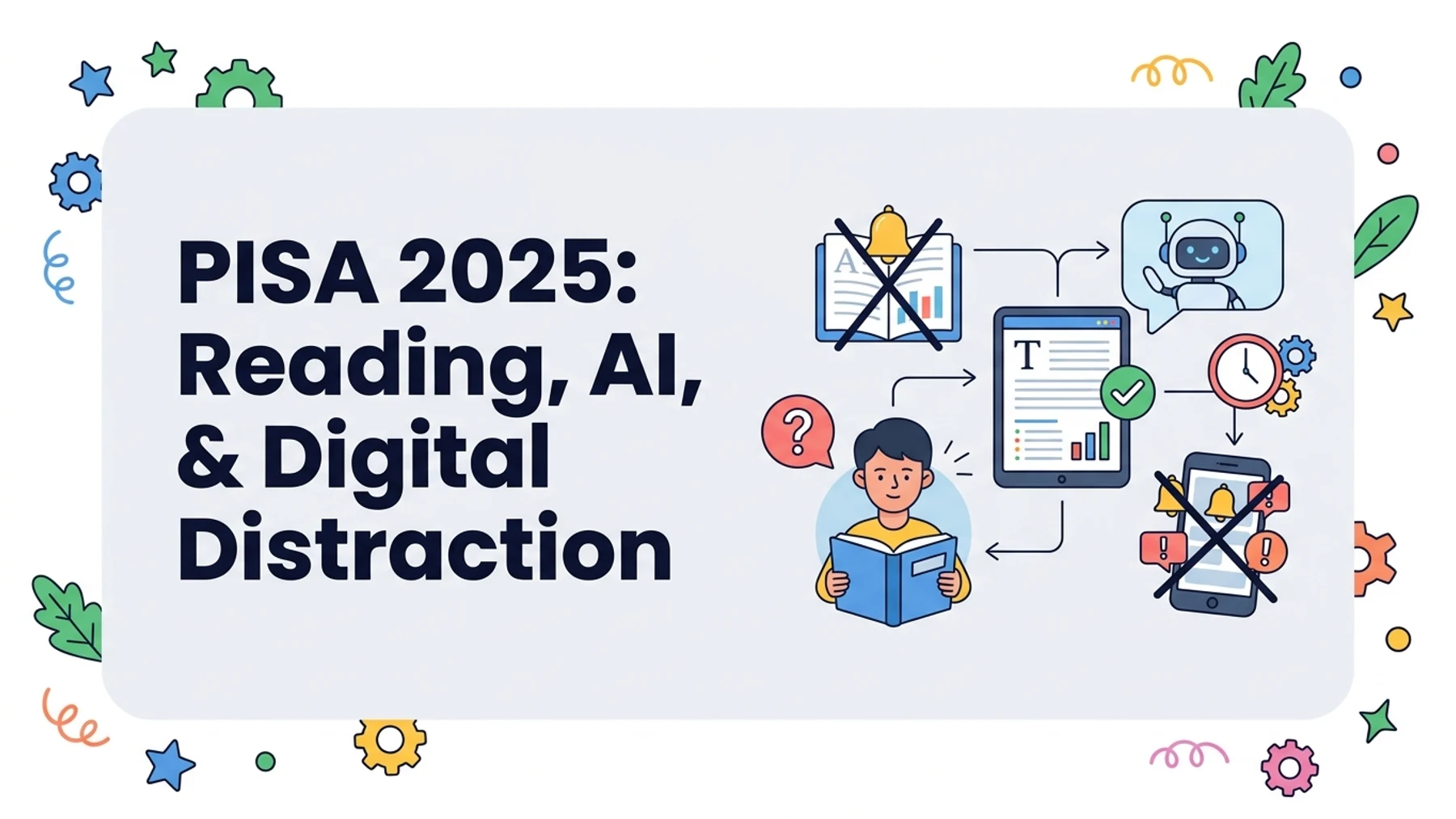
PISA 2025 gives teachers a more useful question than “Which country ranked highest?”
The stronger classroom question is this: What do the results suggest about the reading habits, attention, and digital choices students need to practice?
The OECD released PISA 2025 on September 8, 2026. More than 760,000 15-year-olds in 91 countries and economies took part. Reading performance continued a long decline across many education systems, while the report also examined digital distraction and how students use AI for schoolwork.
Those findings do not prove that screens or AI caused the reading decline. They do point to three classroom decisions that are immediately useful: make evidence come before the answer, protect attention during the first read, and give AI a defined role that does not replace the skill students are supposed to practice.
The PISA 2025 Reading Story Is Bigger Than the Ranking
PISA assesses 15-year-olds, so its results are not a direct measure of every middle school student. The 2025 cycle also focused primarily on science, with reading and mathematics assessed alongside it.
Still, the reading trend is difficult to ignore. Across OECD countries, average reading performance fell by 28 score points between 2015 and 2025. Looking only at the 35 OECD countries with comparable data from 2018 to 2025, the average decline was 25 points.
The concern is not simply whether students can locate a fact. Reading in a digital environment also requires students to connect information, evaluate claims, notice when something does not fit, and decide what deserves their attention.
That is why one of the most interesting PISA 2025 findings is about how students approached the reading task itself.
Finding 1: Hasty Reading Is a Useful Classroom Signal
The OECD uses a specific test-based definition of a “hasty” response. It refers to an incorrect response given faster than the time threshold established from students who answered the item correctly.
In the separate reading-fluency task, the share of students classified as hasty test-takers rose from 6.6% in 2018 to 11.4% in 2025 across the comparable OECD countries. That is close to a doubling.
This does not mean that a student who answers quickly in class has a reading problem. PISA is describing a population-level test behavior, not diagnosing individual learners.
But it gives teachers a useful instructional idea: instead of repeatedly telling students to “slow down,” build one small piece of evidence into the response routine.
Use evidence before answer
Try this sequence:
- Read the question.
- Find the sentence, detail, or part of the text that matters.
- Mark or name that evidence.
- Answer the question.
- Check whether the answer actually matches the evidence.
The routine is deliberately small. It does not require a full close-reading lesson every time.
A student answering a main-idea question might first point to two details that repeat the same idea. A student making an inference might identify the clue that made the inference possible. A student evaluating an argument might mark the claim before judging the evidence.
The habit is proof before speed.

Finding 2: Digital Distraction Is Different From Purposeful Device Use
PISA 2025 does not support a simple “screens are bad” conclusion.
On average across OECD countries, students reported using digital devices at school for about 1.7 hours a day for learning activities and 1.1 hours for leisure. Moderate use for learning was associated with higher science performance than either no use or very high use.
At the same time, 28% of students said classmates were distracted by digital devices during most or every science lesson. Students who reported more classroom distraction also tended to show lower performance and less positive attitudes toward learning.
These are associations, and the distraction measure comes from science lessons rather than ELA. It would be a mistake to turn the finding into proof that a phone, laptop, or online quiz automatically weakens reading.
A more useful distinction is device present versus device has a job.
Protect the first read
For a short reading task, try giving the first few minutes a single purpose:
- read the text
- locate the main claim or idea
- mark one important piece of evidence
- note one point of confusion
Remove avoidable interruptions during that first pass. Then introduce the digital tool when it has a defined learning job.
A device might then be used to:
- complete a quick comprehension quiz
- compare two sources
- look up a necessary background fact
- listen to a passage for rereading support
- revise a written response
- check an explanation
The goal is not less digital learning. It is less competition for attention while students are trying to understand the text.
Finding 3: AI Use Is Not One Behavior
PISA 2025 also makes the AI conversation more complicated than “students who use AI do worse” or “AI improves learning.”
Students reported using AI for several different purposes, including preliminary research, summarizing assigned reading, drafting written assignments, and helping them learn. The performance patterns differed by purpose and frequency.
Students who did not use AI for specific schoolwork tasks tended to have higher science performance than users. However, students who used AI about weekly for the broader purpose of helping them learn performed at a similar level to non-users on average after accounting for socioeconomic background.
Among students who used AI to help them learn once a week or more, those who reported school opportunities to learn how to assess the quality of AI-generated information tended to have slightly higher science performance than peers without those opportunities.
Again, these are associations. They do not show that one AI behavior caused a particular score.
For teachers, the useful question is simpler:
What thinking is the student supposed to do before the tool enters the task?
Learning support is different from outsourcing the target skill
If the goal is to practice writing a claim from evidence, having AI write the first claim removes the practice.
If the student writes the claim first and then asks AI to challenge it, explain a weakness, or offer a competing interpretation, the tool has a different role.
If the goal is to summarize a text, asking AI for the summary before the student reads substitutes for the target work. If the student writes a summary first and compares it with an AI summary, the activity can become an evaluation task.
The same tool can therefore support learning or replace the learning opportunity. The difference is in the task design.
Teach Students to Evaluate AI-Generated Information
PISA 2025 also highlights a skill schools increasingly need to teach directly: judging the quality of AI output.
A simple classroom check can use four questions:
- What claim is the AI making?
- What evidence from our source text supports or contradicts it?
- What information appears in the AI response but not in the source?
- What would we need to verify before trusting that information?
This moves AI use away from “Is the answer fluent?” and toward “Is the answer supported?”
That distinction matters because generated text can sound certain even when a claim is incomplete, unsupported, or wrong.
Choose the Follow-Up That Matches the Learning Goal
PISA 2025 is not an argument for replacing one classroom format with another.
Different follow-ups reveal different kinds of learning.
| If you want to... | A useful follow-up might be... |
|---|---|
| hear students reason through a claim | discussion or partner talk |
| make a quick comprehension check | short quiz |
| see evidence use independently | written response or worksheet |
| compare interpretations | second text, peer response, or AI critique |
| revisit the same skill later | focused digital or printable practice |
The key is matching the response to the goal rather than adding more work automatically.
If you need a current technology text for the evidence-before-AI routine, PicoBuddy's Technology Reading Passages collection includes informational, biography, and opinion texts for elementary and middle school readers. For an older middle school argument-analysis lesson, Beyond the Ban: Why Classrooms Must Embrace Generative AI gives students a strong claim they can test against the evidence instead of treating the passage itself as the final word.
What Teachers Should Take From PISA 2025
The results do not justify a simple ban on devices, a ban on AI, or a claim that technology caused the reading decline.
They do make three instructional priorities harder to ignore.
First, make students show where an answer comes from. Evidence-before-answer routines can interrupt guessing without turning every text into a long assignment.
Second, protect attention when comprehension is the job. Digital tools can stay in the lesson, but they should enter with a clear purpose rather than competing with the first read.
Third, define what AI is allowed to do. If students need to practice reading, reasoning, or writing, preserve that thinking first. Then use AI to explain, check, compare, or challenge.
PISA 2025 is a large international assessment of 15-year-olds, not a diagnosis of your class. Its value for a teacher is not in copying the test. It is in noticing the habits underneath the findings and deciding which of those habits deserve deliberate practice in everyday reading lessons.
Frequently Asked Questions
Related Articles
Helping kids read better, together.
Like this article? Join 500+ educators using PicoBuddy to generate high-quality reading materials in seconds.