


fix the sentence
Sentences from the passage with the capitals and punctuation removed — rewrite each one correctly.
Web preview · Open larger preview (opens in a new tab)
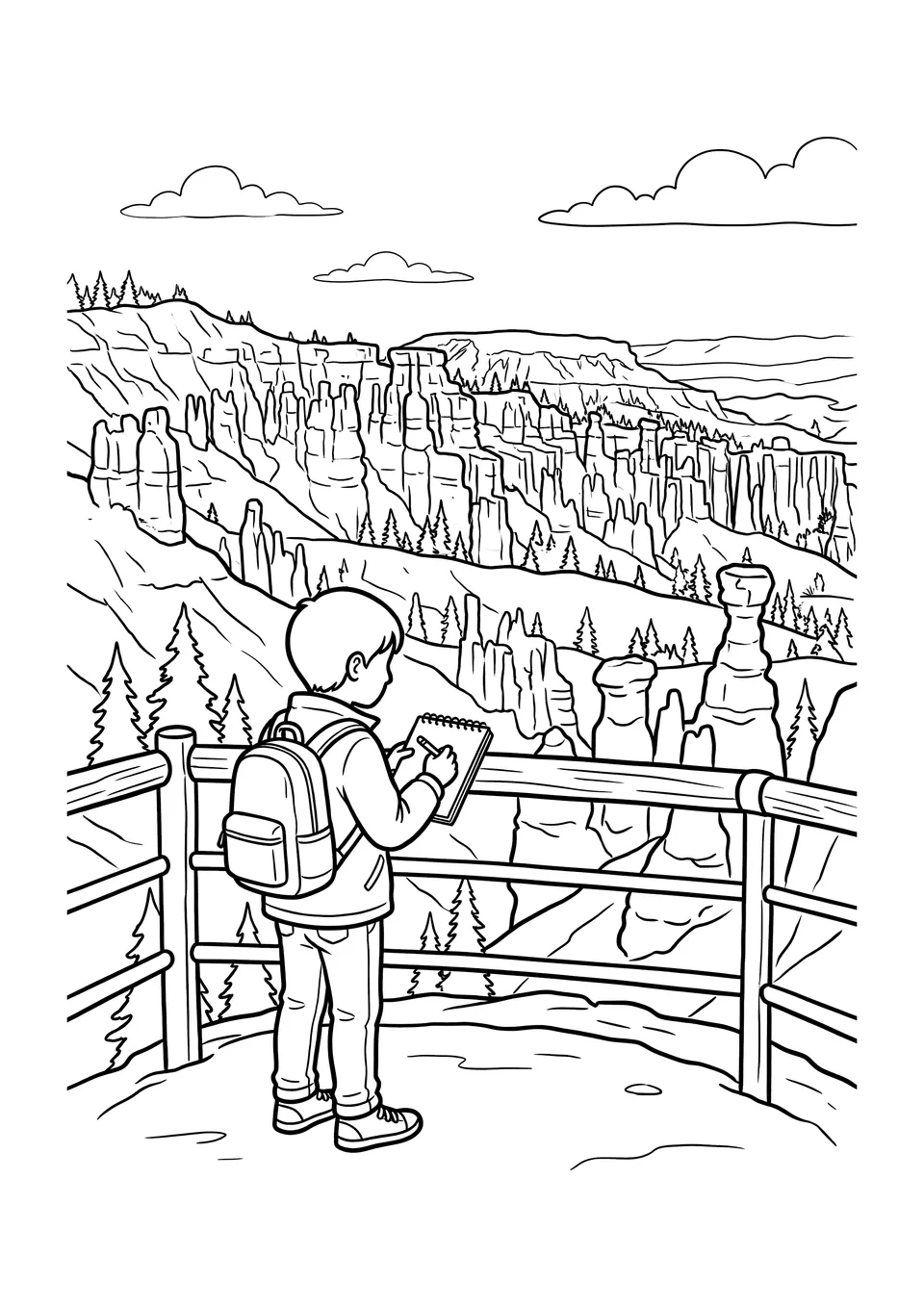
Color Bryce Canyon’s hoodoos as a young artist sketches from a safe overlook. Explore how these remarkable rock formations change over time.
PDF · Your plan’s download limits apply
From a viewpoint at Bryce Canyon National Park in Utah, a child can see hundreds of tall, thin rock formations rising from the land below. These natural towers are called hoodoos. Some have narrow necks and wider tops, while others look like crooked columns. Their orange, red, and pale colors make them interesting subjects for a drawing.
A child sketching at Sunset Point can observe the hoodoos from the established overlook, staying behind its railing. From there, the child might draw the largest shapes first, then add shadows and smaller details. Looking carefully reveals that no two hoodoos are exactly alike.
Hoodoos form over a very long time. Water seeps into cracks in the rock. When the water freezes, it expands and pushes against the sides of the cracks. As this happens again and again, pieces of rock can break away. Rain also helps wear down the rock and carry loose material away. These processes gradually shape fins, or thin walls of rock, into arches and separate spires.
The hoodoos are still changing today. Some will eventually crumble, while others may form as the rock continues to wear away. A sketch captures how a small part of this landscape looks at one moment in its long history.
The overlook is a good place to enjoy the view without getting too close to the edge. Staying on established paths and behind barriers also helps protect the fragile landscape. With a pencil, paper, and a safe place to stand, a visitor can take a closer look at a remarkable work of nature.
What is the main idea of the passage, and which two details support it?
Why might a child draw the largest shapes before adding smaller details?
How does freezing water help break apart rock?
How do freezing water and rain work in different ways to shape hoodoos?
What does the word “fragile” suggest about the landscape?
Which details show that hoodoos do not all look the same?
Why does the author describe both how hoodoos formed and how they are still changing?
How can a sketch capture only one moment in the landscape’s history?
How do the passage’s opening and ending connect careful observation with safety?
Summarize how a visitor can enjoy and protect the landscape at Sunset Point.
More ways to practice with this story — every sheet is built from the text itself, answer key included where it counts.
One PDF with a cover, a contents page and every answer key at the back — color the page in, then keep going on paper.
Sentences from the passage with the capitals and punctuation removed — rewrite each one correctly.
Match the passage words to their meanings, then fill the missing words back into real sentences.
Two writing tasks that build on the passage, with plenty of lines to write on.
This free coloring page shows a child sketching hoodoos from an established viewpoint at Bryce Canyon National Park. Download the coloring page and print it for a nature or geology activity.
Pair the printable coloring page with the informative reading passage, “Sketching Bryce Canyon’s Stone Spires.” Comprehension questions and a glossary support close reading and help students explore how water and freezing shape rock.
Use these resources in the classroom or at home to combine art, science, and reading. After coloring, students can sketch their own imaginary hoodoo and describe its shape.