


fix the sentence
Sentences from the passage with the capitals and punctuation removed — rewrite each one correctly.
Web preview · Open larger preview (opens in a new tab)
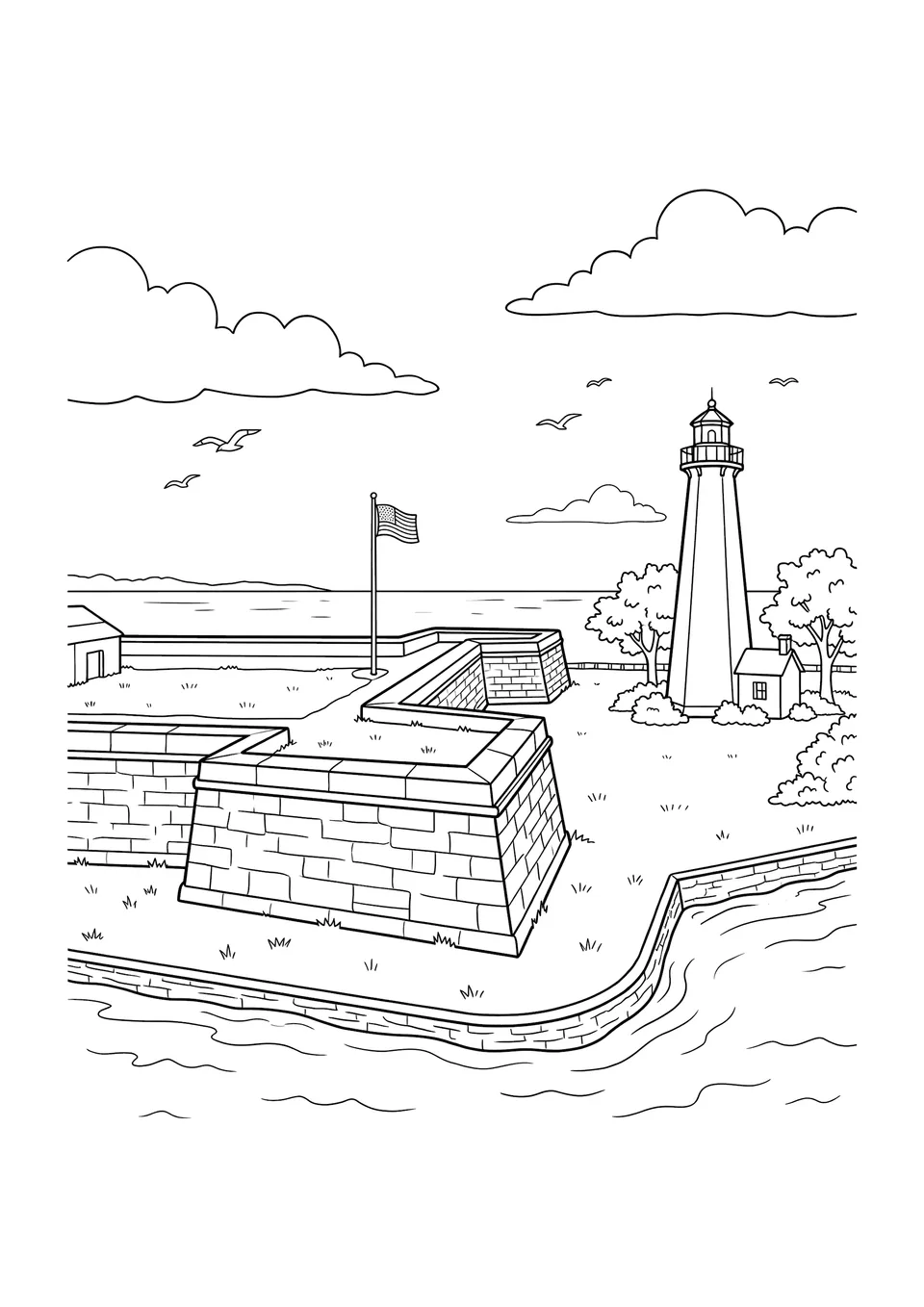
Explore Fort Monroe’s coastal walls and nearby lighthouse with this coloring page and American history reading passage.
PDF · Your plan’s download limits apply
At the edge of Hampton, Virginia, thick stone walls stand near the waters of the Chesapeake Bay. Their angled corners give Fort Monroe the look of a giant star. Nearby, the Old Point Comfort Lighthouse has guided ships through these busy waters for generations.
Construction of Fort Monroe began in 1819, after the War of 1812 showed that the United States needed stronger coastal defenses. The fort’s pointed sections, called bastions, allowed defenders to watch and protect the walls from several directions. A moat surrounds much of the fort, creating another barrier between the walls and anyone approaching them.
During the Civil War, Fort Monroe remained under United States control, even though Virginia joined the Confederacy. In 1861, three enslaved men—Frank Baker, James Townsend, and Shepard Mallory—escaped to the fort. When their enslaver demanded their return, Union General Benjamin Butler refused. The men had been forced to work on Confederate defenses. Butler said he would not return them because they had been used to help the Confederate war effort. His decision became known as the Contraband Decision. The term “contraband of war” was later used for enslaved people who escaped into Union-controlled places. The three men were kept at the fort rather than sent back to enslavement. Many more people seeking freedom came to the area, and Fort Monroe became known as “Freedom’s Fortress.”
The site also holds an earlier and painful history. In 1619, the first recorded Africans in English Virginia arrived at Point Comfort, where Fort Monroe was later built. Their arrival became an early, significant event in the history of slavery in English Virginia, which developed into more than two centuries of enslavement.
Today, visitors can walk near the stone walls, see the lighthouse, and discover the many layers of history held within this coastal place.
What is the main idea of the passage, and what two details support it?
How did the War of 1812 help lead to the construction of Fort Monroe?
How did the fort’s design help protect it from attack?
Why was Fort Monroe a place where enslaved people could seek freedom during the Civil War?
What does the name “Contraband Decision” refer to?
What does the name “Freedom’s Fortress” suggest about Fort Monroe’s role during the Civil War?
How are the events at Point Comfort in 1619 and Fort Monroe in 1861 different?
Why might the author include the history of 1619 after describing the events of 1861?
What does the word “barrier” mean when describing the moat?
How do the lighthouse and the fort serve different purposes at the coastal site?
More ways to practice with this story — every sheet is built from the text itself, answer key included where it counts.
One PDF with a cover, a contents page and every answer key at the back — color the page in, then keep going on paper.
Sentences from the passage with the capitals and punctuation removed — rewrite each one correctly.
Two writing tasks that build on the passage, with plenty of lines to write on.
Download this free coloring page to discover the angled stone walls of Fort Monroe and the nearby Old Point Comfort Lighthouse. It’s an engaging choice for students learning about American history and coastal landmarks.
Pair the printable coloring page with the informative reading passage, “Fort Monroe: Stone Walls and Stories of Freedom.” Use the passage alongside comprehension questions and a glossary to explore the fort’s history and its connection to freedom seekers.
Free coloring pages like this one can support classroom lessons or at-home learning. Print a copy for an independent activity, a history discussion, or a creative break.