


vocabulary
Match the passage words to their meanings, then fill the missing words back into real sentences.
Web preview · Open larger preview (opens in a new tab)
Discover the story of Pharaoh Hatshepsut's maritime voyages with this printable ancient Egypt coloring page. Accompanied by an informative reading passage, it provides a hands-on way to explore history.
PDF · Your plan’s download limits apply
Among the powerful rulers of ancient Egypt, Pharaoh Hatshepsut stands out not only for being one of the few female monarchs to wield absolute power, but also for her revolutionary approach to governance. Reigning during the Eighteenth Dynasty in the fifteenth century BCE, Hatshepsut initially served as regent for her young stepson, Thutmose III. However, she eventually assumed full royal titles and ruled as pharaoh for over two decades. Unlike many of her predecessors who sought glory through military conquest, Hatshepsut prioritized economic growth, monumental building projects, and maritime trade, securing Egypt's wealth and diplomatic influence throughout the ancient Mediterranean and Red Sea regions.
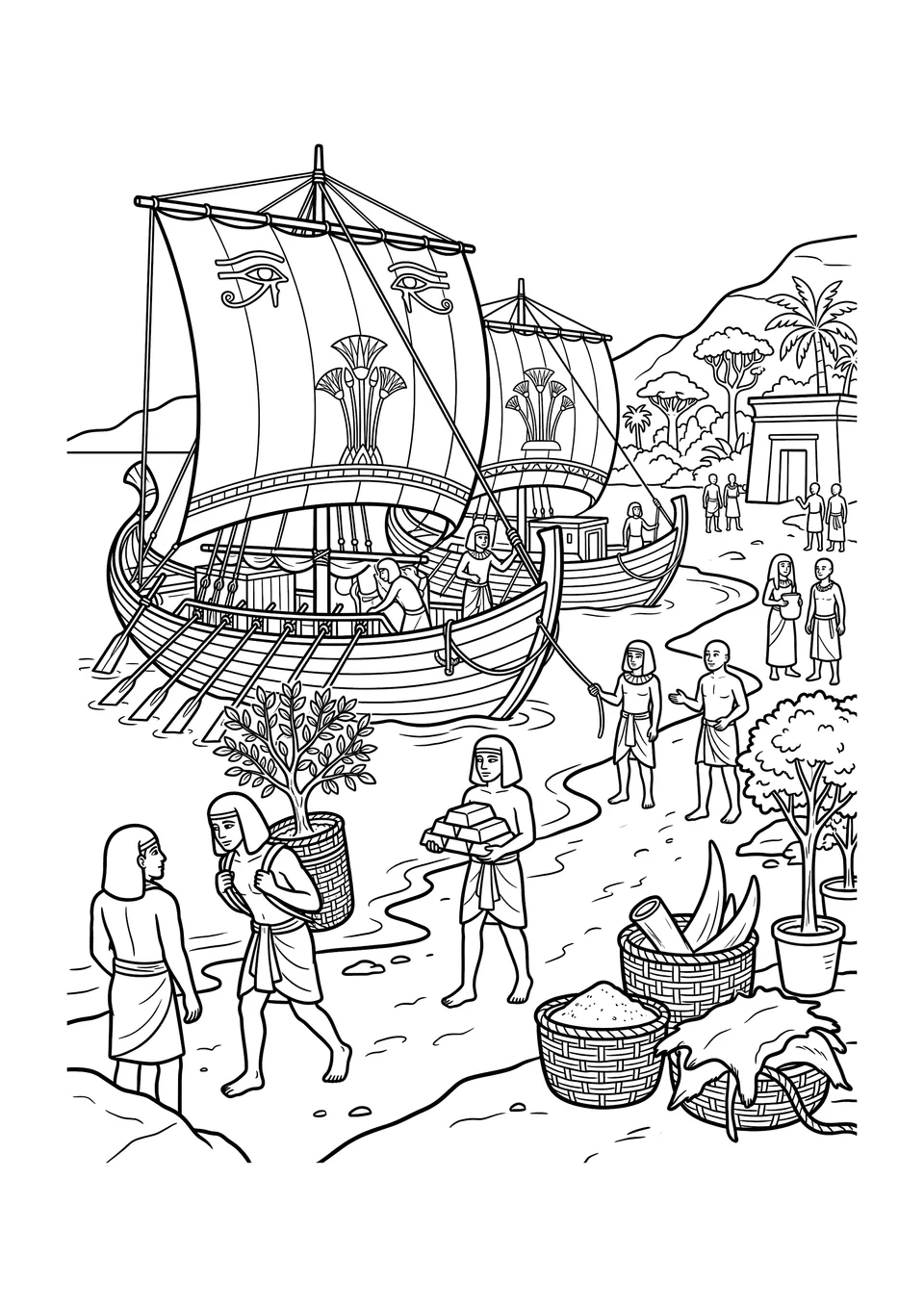
The crowning achievement of Hatshepsut's foreign policy was her legendary trade expedition to the mysterious Land of Punt, a region believed to have been located along the eastern coast of Africa in modern-day Eritrea or Somalia. Around the ninth year of her reign, she dispatched a fleet of five large wooden sailing ships down the Red Sea. Egyptian traders exchanged manufactured goods such as fine linen robes, woven papyrus sheets, bronze weapons, and jewelry for Punt's rich natural resources. The fleet returned laden with valuable treasures, including gold, ivory, ebony, exotic wild animals, and, most importantly, living myrrh trees with their roots packed in baskets—marking one of the earliest recorded attempts to transplant foreign flora.
This monumental journey was immortalized in intricate low-relief carvings on the walls of Hatshepsut's magnificent mortuary temple at Deir el-Bahari, near modern-day Luxor. These detailed artwork panels vividly depict Egyptian sailors loading cargo, foreign leaders offering gifts, and trees being carried aboard the vessels. By recording this commercial triumph so prominently, Hatshepsut legitimized her rule and demonstrated that peaceful commerce could expand an empire's prestige just as effectively as conquest. Her reign established a period of unprecedented stability and prosperity, cementing her reputation as one of ancient Egypt's most visionary rulers.
Who was Hatshepsut initially serving as regent for before becoming pharaoh?
During which dynasty and century did Pharaoh Hatshepsut rule ancient Egypt?
How did Hatshepsut's approach to governance differ from many of her predecessors?
Where is the ancient Land of Punt believed to have been located in modern terms?
What types of manufactured goods did Egyptian traders exchange during the expedition?
What valuable natural resources and treasures did the Egyptian fleet bring back from Punt?
Why was bringing back living myrrh trees historically significant?
Where were the detailed carvings depicting the Punt expedition located?
What specific scenes are depicted in the relief artwork at Deir el-Bahari?
According to the passage, how did the trade expedition help legitimize Hatshepsut's rule?
More ways to practice with this story — every sheet is built from the text itself, answer key included where it counts.
One PDF with a cover, a contents page and every answer key at the back — color the page in, then keep going on paper.
Match the passage words to their meanings, then fill the missing words back into real sentences.
Two writing tasks that build on the passage, with plenty of lines to write on.
Step back into ancient Egypt with this free coloring page depicting Pharaoh Hatshepsut's legendary trade voyage to the Land of Punt. Designed for middle school social studies, this worksheet pairs historical line art with an informative reading passage to deepen students' understanding of ancient trade, culture, and female leadership.
This printable coloring page with reading passage is an excellent resource for classroom social studies units, homeschool curriculum, or at-home history enrichment. Paired with comprehension questions and vocabulary glossary practice, students gain a multi-sensory learning experience that builds reading comprehension and retention.
Easy to download and print, this educational worksheet lets middle schoolers visualize historic sailing ships, myrrh trees, and Egyptian traders. Download coloring page resources today to make ancient Egyptian history engaging and accessible for every learner.