


fix the sentence
Sentences from the passage with the capitals and punctuation removed — rewrite each one correctly.
Web preview · Open larger preview (opens in a new tab)
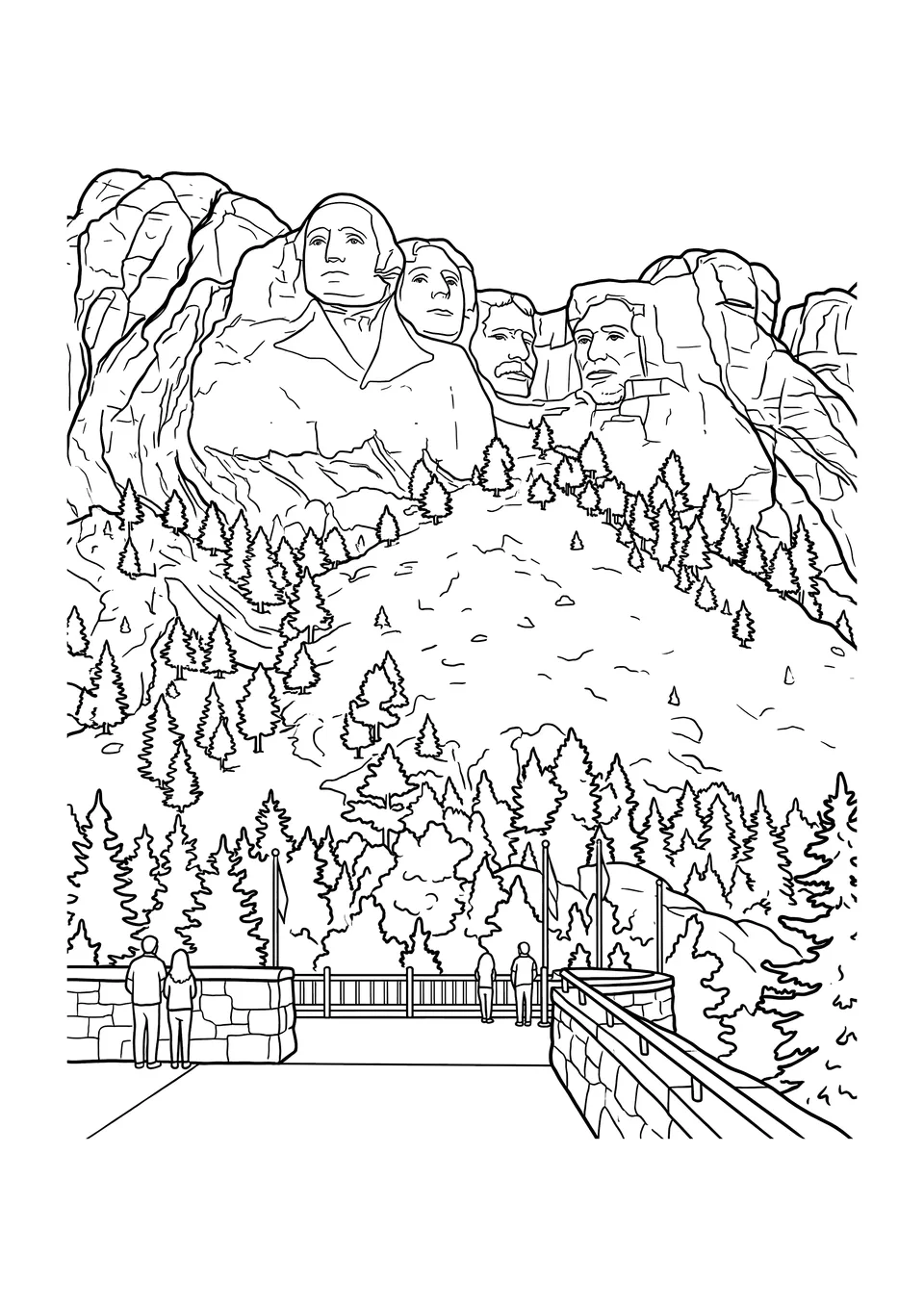
Explore Mount Rushmore and its surrounding landscape with this coloring page. Pair it with “The Faces on Mount Rushmore” to learn about the memorial and its history.
PDF · Your plan’s download limits apply
High in South Dakota’s Black Hills, four enormous faces look out from a granite mountainside. From the Grand View Terrace at Mount Rushmore National Memorial, visitors can see the sculptures framed by forested slopes and pine trees.
The faces belong to four United States presidents: George Washington, Thomas Jefferson, Theodore Roosevelt, and Abraham Lincoln. Sculptor Gutzon Borglum chose them to represent important parts of the nation’s history. Washington led the country at its beginning, while Jefferson helped expand it through the Louisiana Purchase. Lincoln worked to preserve the nation during the Civil War, and Roosevelt supported conservation and the growth of the United States.
Work on the memorial began in 1927 and ended in 1941. Hundreds of workers helped shape the mountain. They used dynamite to remove large amounts of rock, then used drills and other tools to refine the features. Each face is about 60 feet tall—as high as a six-story building.
The Black Hills are also a place of deep importance to the Lakota and other Native peoples. The United States took control of the Black Hills after gold was discovered there, despite an 1868 treaty that recognized the area as part of a reservation for the Lakota and other Sioux people. Many Native Americans see the memorial differently from visitors who celebrate the presidents it depicts.
Today, people come to Mount Rushmore to view the huge carving and explore the surrounding landscape. The mountain can inspire wonder, while its history encourages visitors to consider whose stories are told—and whose are not.
What is the main idea of the passage, and which two details support it?
Why did Gutzon Borglum choose the four presidents for the memorial?
How did workers shape the mountain, and why did they use different tools?
How does the comparison to a six-story building help readers understand the memorial?
What does the word “preserve” mean when the passage describes Lincoln’s work?
How might the memorial mean different things to visitors and to many Native Americans?
What detail explains why the United States took control of the Black Hills?
Why does the author include information about the 1868 treaty?
How does the passage move from describing the memorial to exploring its history?
What does the final sentence encourage visitors to consider?
More ways to practice with this story — every sheet is built from the text itself, answer key included where it counts.
One PDF with a cover, a contents page and every answer key at the back — color the page in, then keep going on paper.
Sentences from the passage with the capitals and punctuation removed — rewrite each one correctly.
Match the passage words to their meanings, then fill the missing words back into real sentences.
Two writing tasks that build on the passage, with plenty of lines to write on.
Download this free Mount Rushmore coloring page for a printable activity featuring the memorial and the trees of South Dakota’s Black Hills. It is a useful addition to a collection of free coloring pages about American places and landmarks.
Pair the coloring page with the reading passage “The Faces on Mount Rushmore,” comprehension questions, and a glossary. Students can learn how the monument was made and consider its significance to both visitors and Native peoples.
Use printable coloring pages like this one in the classroom or at home to support a lesson on national monuments, history, and different perspectives.