


fix the sentence
Sentences from the passage with the capitals and punctuation removed — rewrite each one correctly.
Web preview · Open larger preview (opens in a new tab)
Explore the North Carolina State Capitol with a coloring page and an informative reading passage about state government.
PDF · Your plan’s download limits apply
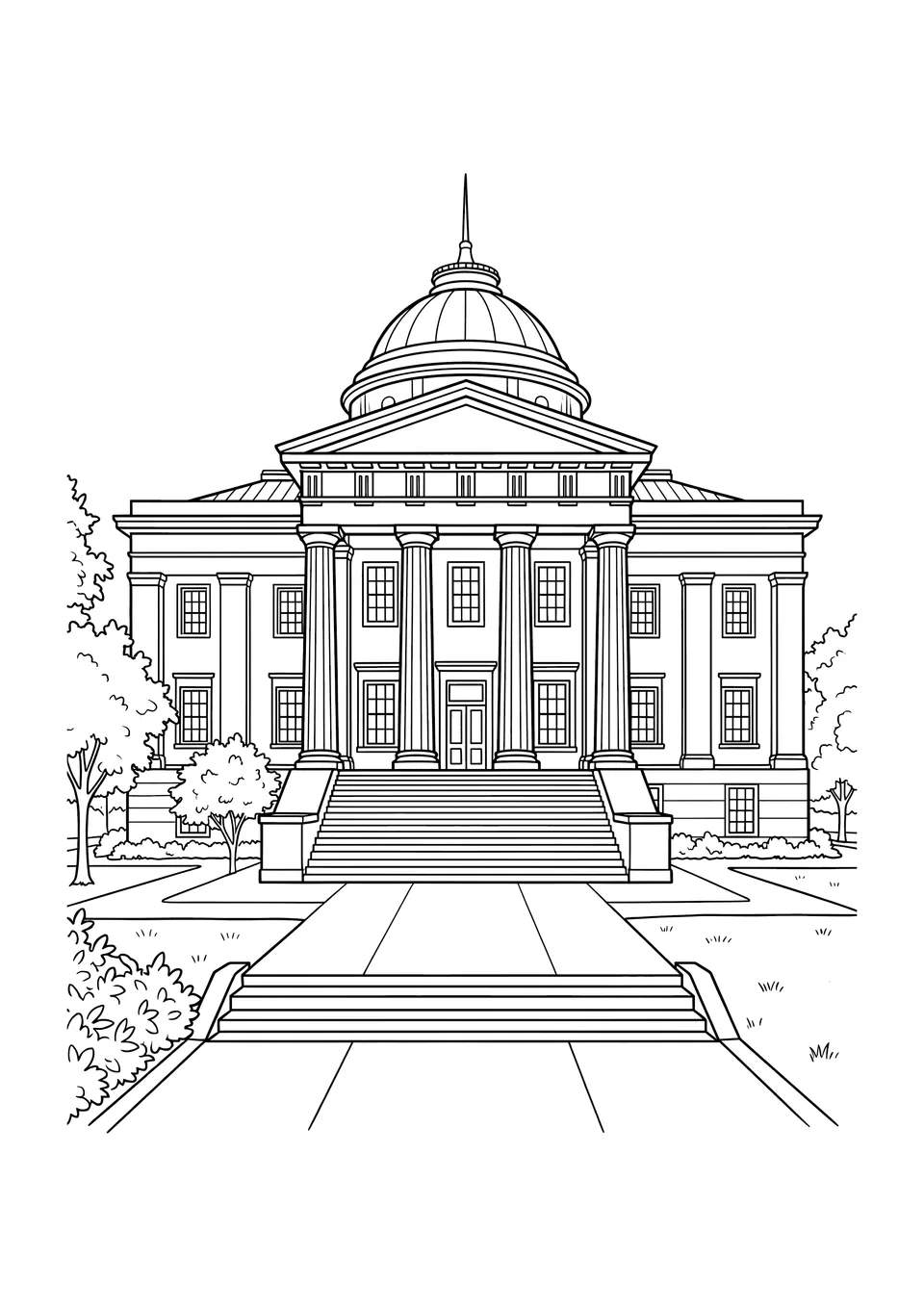
From the front of the North Carolina State Capitol, a row of tall columns rises above a broad set of steps. A triangular roof rests over the entrance, while a low dome crowns the center of the building. The Capitol stands in Raleigh, the state capital, surrounded by green grounds and city streets.
The building’s design is called neoclassical. This style draws ideas from buildings in ancient Greece and Rome. The columns, balanced shape, and triangular section above the entrance are features of that style. The Capitol’s walls are made largely of granite, a hard stone that gives the building its sturdy gray appearance.
Construction began after a fire destroyed an earlier statehouse in 1831. The new Capitol was completed in 1840. Skilled craftspeople and laborers worked on it, including enslaved people whose labor contributed to its construction. Inside, a central open space rises toward the dome. Rooms around it once held important parts of North Carolina’s government.
For many years, lawmakers met in the Capitol to discuss and pass state laws. As the state government grew, it needed more room. In 1963, the legislature moved to a separate building nearby. The governor still has an office in the Capitol, though many other state offices are elsewhere.
Today, visitors can explore the historic building and see spaces connected to North Carolina’s past. Its columns and dome are more than decoration: they help make the Capitol recognizable as a place where the state’s government has worked for generations.
What main idea does the passage communicate about the North Carolina State Capitol?
How do the columns and triangular section show the building's neoclassical design?
Why was a new Capitol needed after 1831?
What does the passage tell readers about the people who built the Capitol?
How did the Capitol's role change when state government grew?
What does the governor's office show about the Capitol's role today?
Why might the author describe the building's appearance before explaining its history?
What does the word “sturdy” suggest about the Capitol's granite walls?
How are the Capitol's past and present uses similar?
Which details show that the Capitol is connected to both North Carolina's history and its government today?
More ways to practice with this story — every sheet is built from the text itself, answer key included where it counts.
One PDF with a cover, a contents page and every answer key at the back — color the page in, then keep going on paper.
Sentences from the passage with the capitals and punctuation removed — rewrite each one correctly.
Match the passage words to their meanings, then fill the missing words back into real sentences.
Two writing tasks that build on the passage, with plenty of lines to write on.
Download this free coloring page to explore the Capitol’s columns, dome, and neoclassical design. The printable coloring page offers plenty of space for students to add their own colors.
Pair the coloring page with the reading passage, “A Capitol Built in Stone,” to learn about the building’s history and role in state government. Comprehension questions and a glossary support reading and vocabulary practice.
Use this activity in the classroom or at home as part of a lesson on North Carolina history, architecture, or government. It’s a useful addition to a collection of free coloring pages for upper elementary learners.