


fix the sentence
Sentences from the passage with the capitals and punctuation removed — rewrite each one correctly.
Web preview · Open larger preview (opens in a new tab)
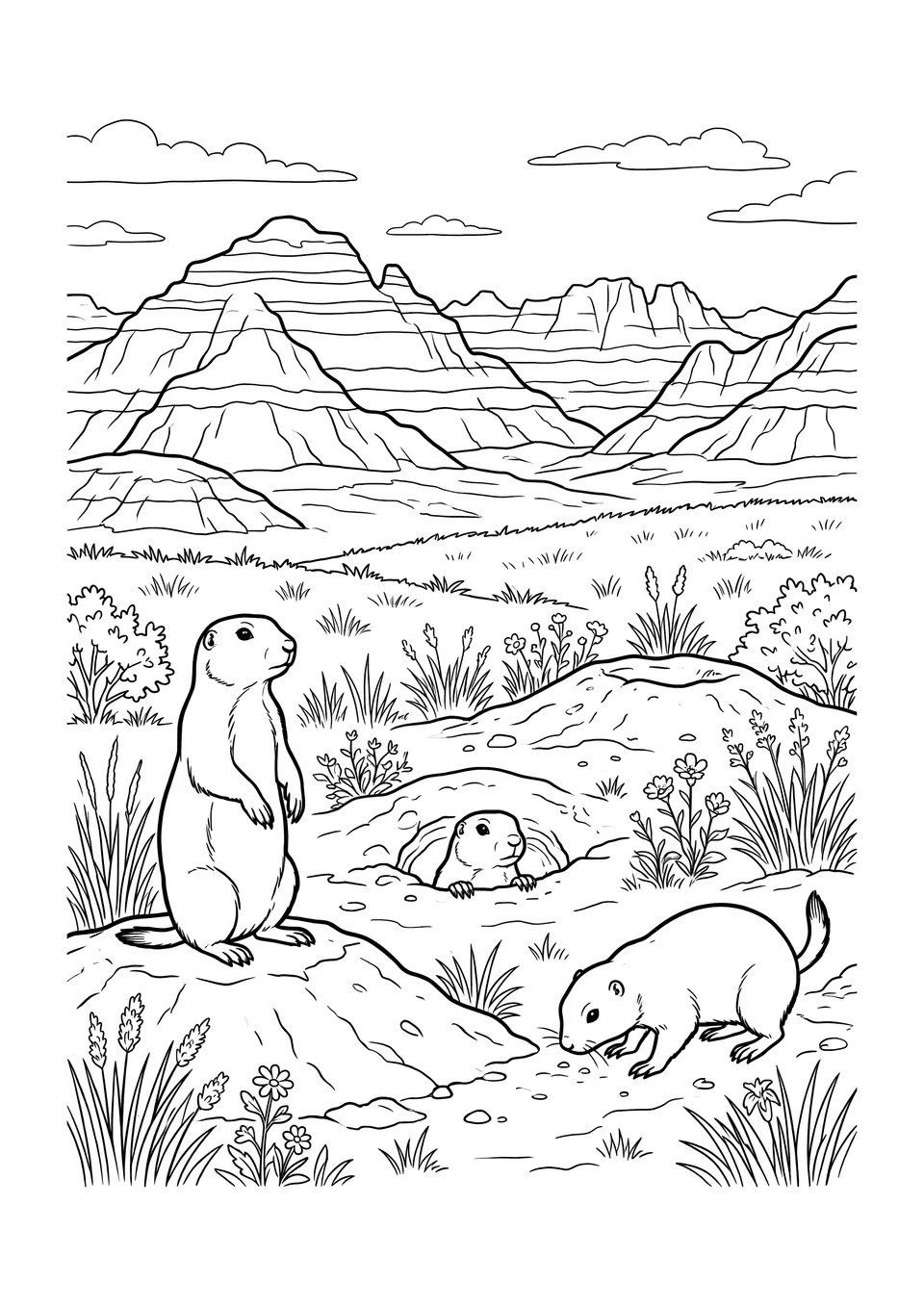
Explore prairie dog burrows and the layered hills of South Dakota’s Badlands with this printable coloring page. Pair it with the informative reading passage for a closer look at prairie wildlife.
PDF · Your plan’s download limits apply
A sharp call breaks the quiet grassland. A black-tailed prairie dog stands near a burrow entrance, watching the open land. Behind it rise the striped hills and steep ridges of South Dakota’s Badlands.
Despite their name, prairie dogs are not dogs. They are rodents, related to squirrels. Black-tailed prairie dogs have tan fur, short legs, and black tips on their tails. They live in groups called colonies, sometimes known as prairie dog towns. In Badlands National Park, these towns spread across patches of grassland among the rocky formations.
Prairie dogs dig burrows with their strong claws. The underground tunnels provide shelter from harsh weather and predators. Raised mounds of soil around some entrances can help keep rainwater out and give prairie dogs a place to look for danger. When one spots a possible threat, it may give an alarm call. Other prairie dogs can then hurry toward their burrows.
These animals eat mostly grasses and other plants. Their digging and feeding also affect the land around them. Burrowing loosens and mixes the soil, while clipped plants can make it easier for prairie dogs to see approaching predators. Other animals, including burrowing owls, may use empty prairie dog burrows for shelter or nesting.
The colorful Badlands formations have a different story. Their layers formed as sediment, such as sand and mud, collected over millions of years. Wind and water later wore away the softer material, carving the hills and valleys seen today. On the grassland below, prairie dogs continue to dig, call, and share their busy neighborhood with many other creatures.
What is the main idea of the passage, and which two details support it?
How do raised mounds help prairie dogs in two different ways?
What happens after a prairie dog gives an alarm call, and why?
How might clipped plants help prairie dogs survive?
How do prairie dog burrows benefit both prairie dogs and other animals?
What does the word “predators” mean as it is used in the passage?
How are prairie dog towns and the Badlands formations different in the way they formed?
Why might the author begin the passage with a sharp call and a prairie dog watching the grassland?
How do wind and water help explain the shape of the Badlands today?
What details show that prairie dogs affect their surroundings?
More ways to practice with this story — every sheet is built from the text itself, answer key included where it counts.
One PDF with a cover, a contents page and every answer key at the back — color the page in, then keep going on paper.
Sentences from the passage with the capitals and punctuation removed — rewrite each one correctly.
Match the passage words to their meanings, then fill the missing words back into real sentences.
Two writing tasks that build on the passage, with plenty of lines to write on.
Download this free coloring page to bring a prairie dog town to life. The printable scene features burrows, grassland, and the layered Badlands of South Dakota.
Use the coloring page with the reading passage, comprehension questions, and glossary to explore how prairie dogs live and how the Badlands formed. It’s a useful addition to a classroom lesson or an at-home activity for upper elementary learners.