


fix the sentence
Sentences from the passage with the capitals and punctuation removed — rewrite each one correctly.
Web preview · Open larger preview (opens in a new tab)
Explore the Tennessee State Capitol with a coloring page and an informative reading passage. Discover the building’s architecture and its role in state government.
PDF · Your plan’s download limits apply
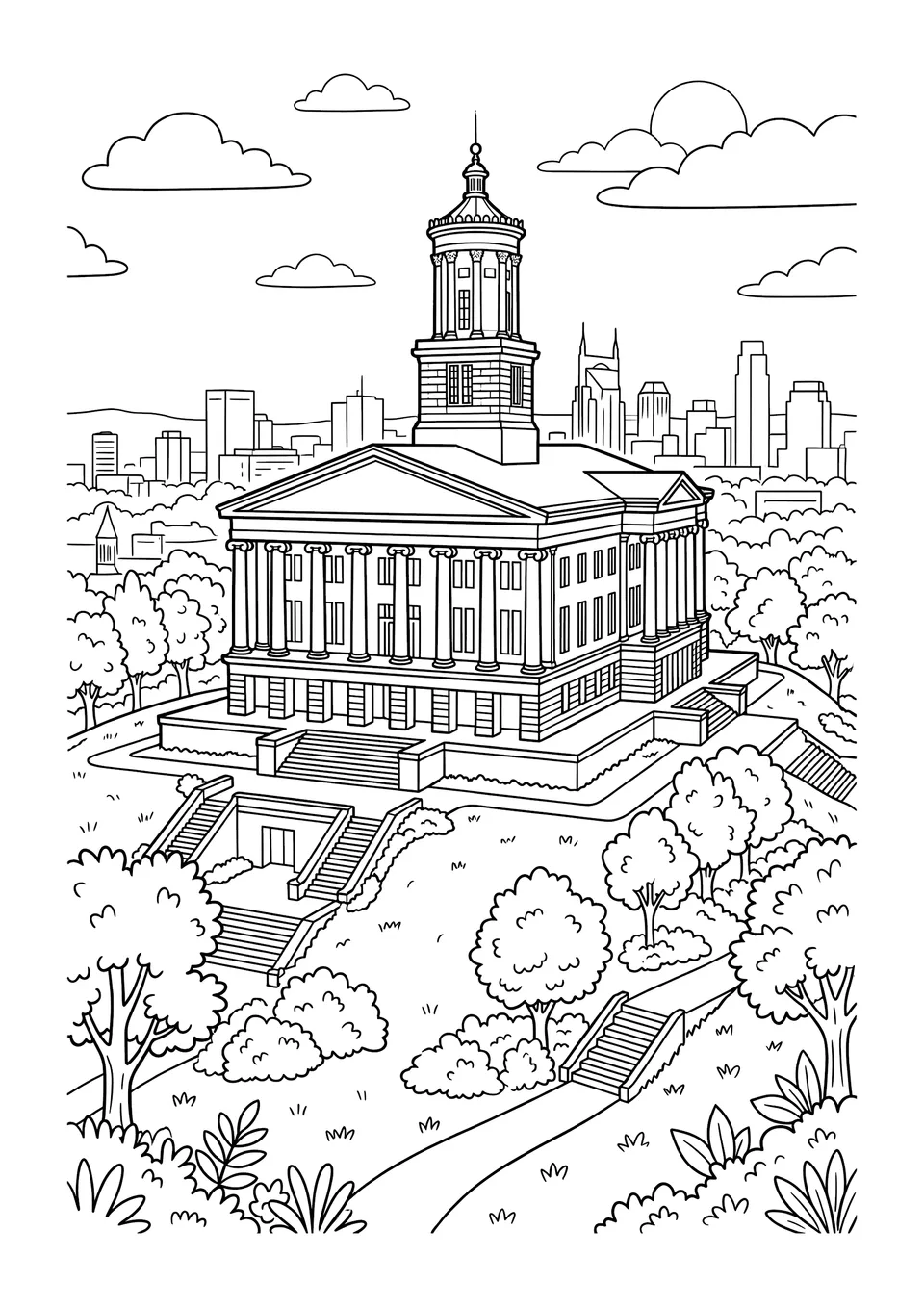
High on a hill in Nashville stands a building that looks a little like an ancient Greek temple. It is the Tennessee State Capitol, where important decisions about the state are made. Trees surround the grounds, and the city skyline rises nearby.
The capitol is home to the Tennessee General Assembly, the group of elected lawmakers who make state laws. It has two parts: the Senate and the House of Representatives. Lawmakers meet in separate chambers, or meeting rooms, to discuss and vote on proposed laws. The governor’s office is also in the capitol.
The building’s design makes it stand out. Architect William Strickland modeled parts of it after ancient Greek buildings. Tall columns support the roof above entrances on its sides. Unlike many state capitols, Tennessee’s does not have a large rounded dome. Instead, a square tower rises above the roof, topped by a smaller structure called a cupola.
Construction began in 1845, and the building was completed in 1859. Workers used limestone from Tennessee to build its walls. Strickland died before construction was finished, and he was buried within a wall of the building he designed.
The capitol grounds hold reminders of Tennessee’s past, including monuments and the tomb of President James K. Polk and his wife, Sarah Childress Polk. Today, visitors can see the building and learn about its history. From its hilltop, the capitol remains both a working center of government and a familiar part of Nashville’s landscape.
What is the main idea of the passage, and which two details support it?
How do the Senate and the House of Representatives work in similar ways at the capitol?
Which detail shows that Tennessee’s Capitol differs from many other state capitols?
How did ancient Greek buildings influence the capitol’s design?
What does the word “proposed” mean in the phrase “proposed laws”?
Why does the passage describe both the capitol’s government offices and its historical features?
How do the capitol grounds help visitors learn about Tennessee’s past?
What can you infer about William Strickland’s connection to the capitol? Use a detail from the passage.
How does the passage organize information after introducing the capitol?
How would you summarize the capitol’s importance to Tennessee today?
More ways to practice with this story — every sheet is built from the text itself, answer key included where it counts.
One PDF with a cover, a contents page and every answer key at the back — color the page in, then keep going on paper.
Sentences from the passage with the capitals and punctuation removed — rewrite each one correctly.
Match the passage words to their meanings, then fill the missing words back into real sentences.
Two writing tasks that build on the passage, with plenty of lines to write on.
Download this free coloring page to explore the Tennessee State Capitol, its hilltop setting, and the Nashville skyline. The printable design highlights the building’s columns and distinctive tower.
Pair the coloring page with the reading passage, “Tennessee’s Capitol on the Hill,” to learn about state government and the building’s history. Use comprehension questions and a glossary to support understanding and build vocabulary.
Print the page for classroom lessons or at-home learning. It’s a simple way to combine art, reading, and social studies.