


fix the sentence
Sentences from the passage with the capitals and punctuation removed — rewrite each one correctly.
Web preview · Open larger preview (opens in a new tab)
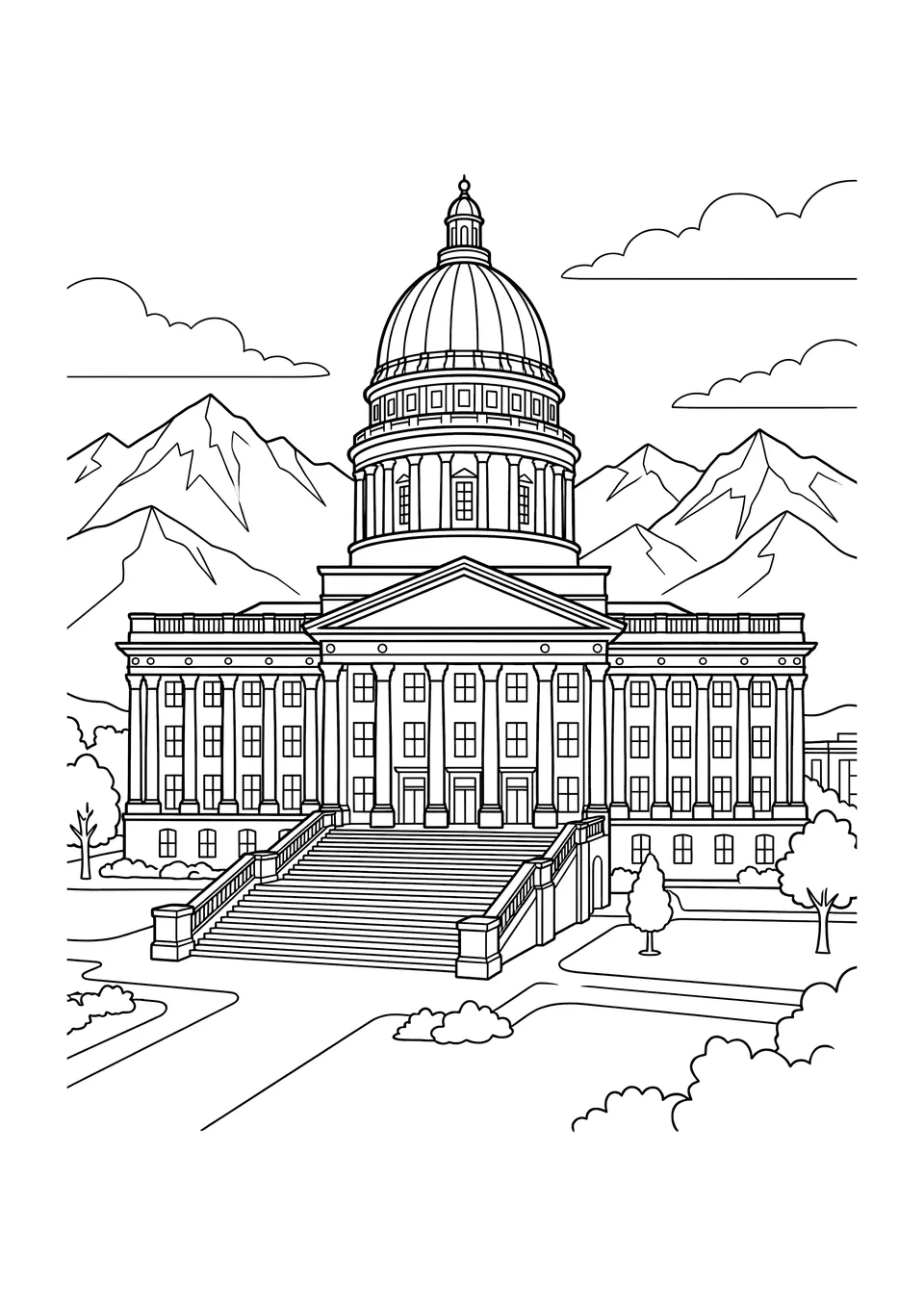
Color the Utah State Capitol beneath the Wasatch Mountains. Explore state government with an informative reading passage.
PDF · Your plan’s download limits apply
From the front of the Utah State Capitol, a visitor can see a broad staircase leading toward tall columns. Above them rises a large dome, while mountains frame the building in the distance. The capitol stands on a hill overlooking Salt Lake City, Utah’s capital.
The building is more than a landmark. It is a place where Utah’s state government works. State lawmakers meet there to debate ideas and make laws. The governor also has an office in the capitol. Decisions made inside can affect people throughout Utah, from busy cities to small rural communities.
The capitol opened in 1916. Its design includes features inspired by ancient Greek and Roman buildings, such as columns and a triangular shape above the front entrance. Much of the outside is covered in Utah granite, a strong stone that gives the building its light gray color. Inside, visitors can look up into the rotunda, a large round space beneath the dome.
The mountains behind the capitol are part of the Wasatch Range. Their appearance changes with the seasons. Snow may cover their peaks in winter, while warmer months reveal more of their rocky slopes. The view connects the center of state government with the landscape that surrounds it.
The capitol has been strengthened to help protect it during an earthquake. Workers placed special supports beneath the building that allow it to move separately from the shaking ground. This improvement helps preserve a historic gathering place while preparing it for the future.
What is the main idea of the passage? Give two details that support it.
How does the capitol serve both as a landmark and as a place of government?
Why can decisions made at the capitol matter to people far from Salt Lake City?
How does the passage connect the capitol to the landscape around it?
What do the columns and triangular shape suggest about the building's design?
What does the word “preserve” mean in the final paragraph?
How do the special supports help protect the capitol during an earthquake?
Why might the author describe the building's appearance before explaining its role?
How are the capitol's appearance and the mountains' appearance different over the seasons?
Summarize how the capitol connects Utah's past, present, and future.
More ways to practice with this story — every sheet is built from the text itself, answer key included where it counts.
One PDF with a cover, a contents page and every answer key at the back — color the page in, then keep going on paper.
Sentences from the passage with the capitals and punctuation removed — rewrite each one correctly.
Match the passage words to their meanings, then fill the missing words back into real sentences.
Two writing tasks that build on the passage, with plenty of lines to write on.
Download this coloring page and print it for a closer look at the capitol’s dome, columns, and mountain setting. It’s a useful addition to a collection of free coloring pages and printable coloring pages about important places.
Pair the coloring page with the reading passage, “A Capitol Beneath the Mountains,” to learn about Utah’s state government and the building’s history. Comprehension questions and a glossary help students explore the topic further.
Use this activity in the classroom during a civics lesson or at home for independent learning.