


fix the sentence
Sentences from the passage with the capitals and punctuation removed — rewrite each one correctly.
Web preview · Open larger preview (opens in a new tab)
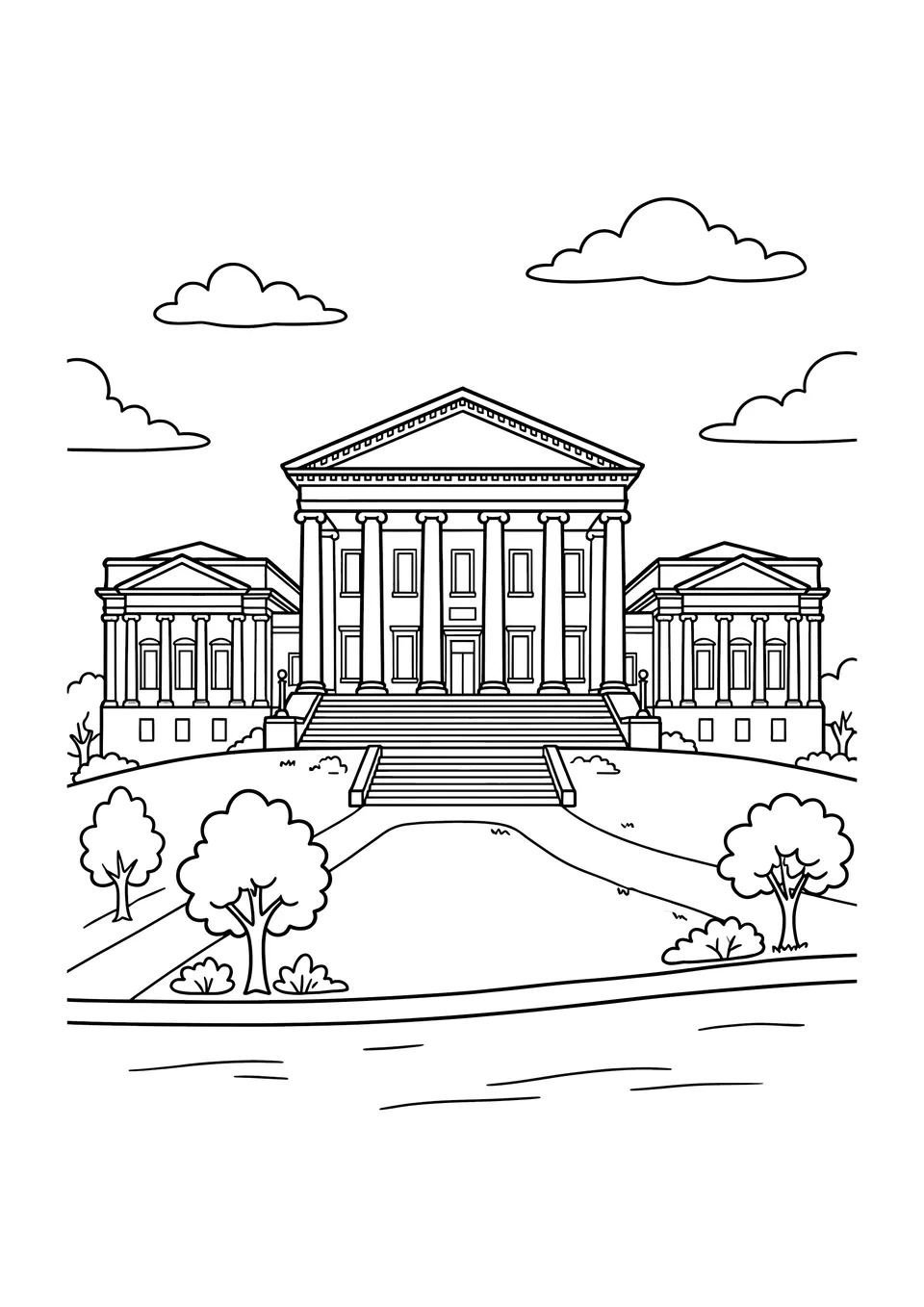
Explore Virginia’s state government while coloring the Capitol in Richmond. Pair the printable page with an informative reading passage.
PDF · Your plan’s download limits apply
On a hill in Richmond stands a building that looks a little like an ancient Roman temple. Its white exterior, tall columns, and triangular roofline make the Virginia State Capitol easy to recognize. A few trees grow on the grounds around it.
The Capitol is home to Virginia’s General Assembly, the state’s lawmaking body. Its members meet to debate ideas and pass laws that affect people across Virginia. The building has also witnessed important moments in American history. In 1788, Virginia’s convention met in Richmond and voted to ratify, or approve, the United States Constitution. The convention met at another building, not the Capitol.
Thomas Jefferson helped design the Capitol with French architect Charles-Louis Clérisseau. They drew inspiration from the Maison Carrée, an ancient Roman temple in France. The Capitol’s style is called neoclassical because it borrows features from the buildings of ancient Greece and Rome. Its columns support a porch, while a broad set of steps leads up to the entrance.
Construction began in 1785, and Virginia’s lawmakers first met in the building in 1788. Over time, the state needed more room, so wings were added to the sides in the early 1900s. The Capitol has an interior dome, but it does not have the large exterior dome seen on some other capitol buildings.
Today, visitors can tour the Capitol and see spaces where Virginians have gathered to make decisions for generations. The building connects the state’s work today with its long history.
What is the main idea of the passage, and which two details support it?
How do the Capitol’s appearance and design connect it to ancient buildings?
Why did Virginia add wings to the Capitol in the early 1900s?
How was the 1788 convention different from the lawmakers’ first meeting in the Capitol?
What does the word “interior” mean when describing the Capitol’s dome?
Which details show that the Capitol is still important to Virginia today?
Why might the author mention that the convention met somewhere other than the Capitol?
How is the Capitol’s dome different from those on some other capitol buildings?
How does the passage move from describing the Capitol’s appearance to explaining its importance?
What can you infer about the Capitol’s connection to Virginia’s past and present?
More ways to practice with this story — every sheet is built from the text itself, answer key included where it counts.
One PDF with a cover, a contents page and every answer key at the back — color the page in, then keep going on paper.
Sentences from the passage with the capitals and punctuation removed — rewrite each one correctly.
Match the passage words to their meanings, then fill the missing words back into real sentences.
Two writing tasks that build on the passage, with plenty of lines to write on.
Download this free coloring page to explore the Virginia State Capitol’s columns, triangular pediment, and surrounding grounds. It is one of our printable coloring pages designed for upper elementary learners.
The coloring page with reading passage introduces Virginia’s General Assembly and the building’s neoclassical design. Comprehension questions and a glossary help students review the ideas and vocabulary.
Use the page for a state government lesson in the classroom or as a creative learning activity at home.