
fix the sentence
Sentences from the passage with the capitals and punctuation removed — rewrite each one correctly.
Web preview · Open larger preview (opens in a new tab)
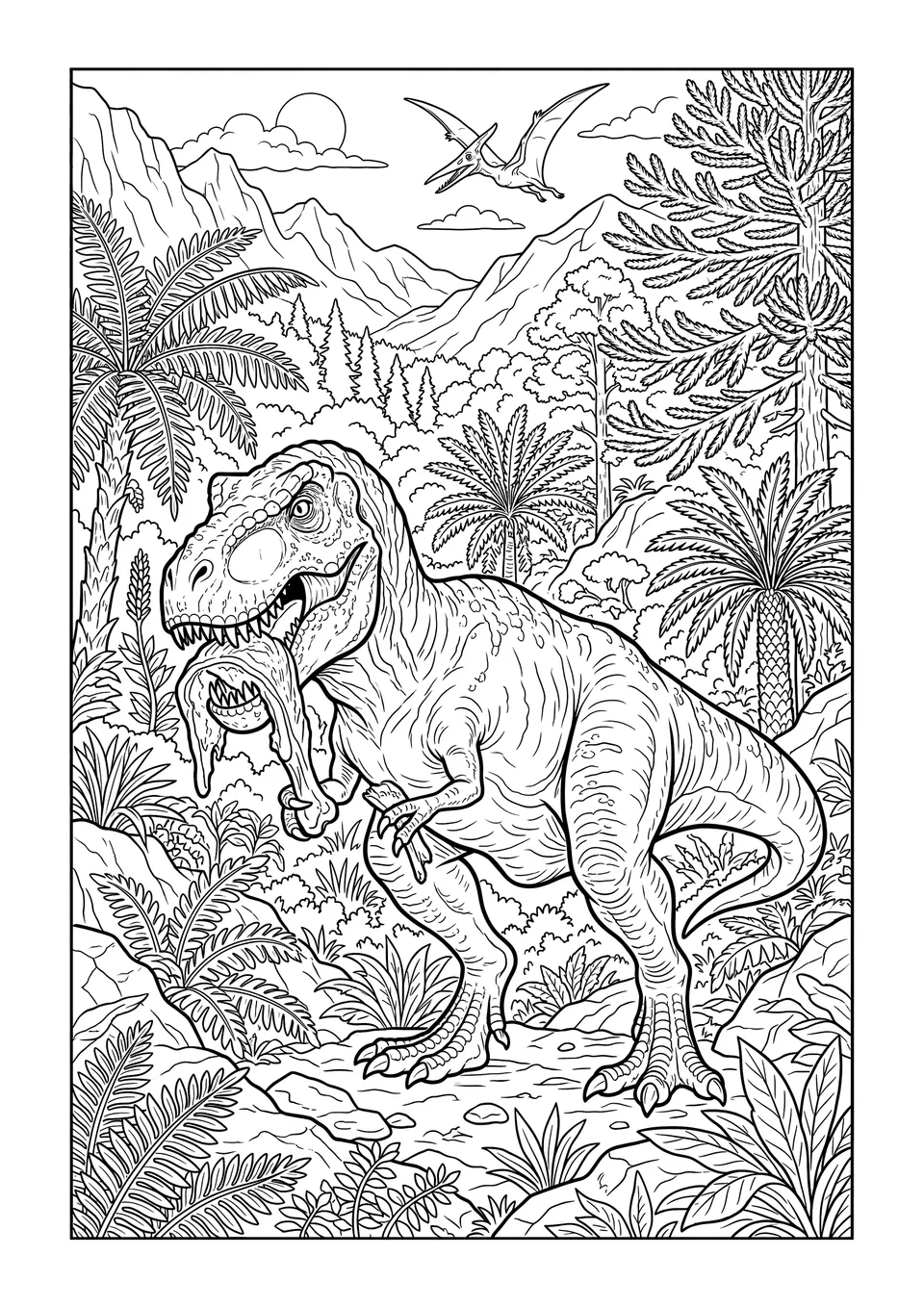
Bring the prehistoric world to life with this detailed coloring page of a T-Rex at mealtime, accompanied by a fascinating passage about how this apex predator fueled its massive body.
PDF · Your plan’s download limits apply
The Tyrannosaurus rex, often called the T-Rex, was one of the most fearsome predators to ever walk the Earth. This "King of the Tyrant Lizards" lived during the late Cretaceous period, about 66 to 68 million years ago. Standing nearly 20 feet tall and stretching 40 feet long, the T-Rex needed a massive amount of food to power its giant body. But what exactly did this prehistoric giant eat, and how did it find its meals?
Scientists know for certain that the T-Rex was a carnivore, which means it only ate meat. Its primary menu consisted of other large dinosaurs. Fossils of creatures like the three-horned Triceratops and the duck-billed Edmontosaurus have been found with T-Rex bite marks on them. Some of these bones were even crushed, proving that the T-Rex had an incredibly powerful bite force—the strongest of any land animal that has ever lived. Its banana-sized teeth were designed to crunch through bone and rip through tough hides.
For many years, paleontologists have debated whether the T-Rex was an active hunter or a scavenger. A scavenger is an animal that eats creatures that are already dead. Some scientists believe the T-Rex used its large nose to smell rotting meat from miles away, much like a modern vulture. However, other evidence suggests it was a skilled hunter. Its eyes faced forward, giving it binocular vision to judge distances, which is a trait common in predators. It is likely that the T-Rex did both—hunting when it could and scavenging when an easy meal was available.
The T-Rex was the apex predator of its ecosystem, meaning it was at the very top of the food chain. Whether it was chasing down a meal or finding one left behind, this massive dinosaur was a master at finding the energy it needed to rule the prehistoric world. Studying its diet helps scientists understand how the entire ecosystem functioned millions of years ago.
What is the meaning of the name 'Tyrannosaurus rex'?
During which time period did the T-Rex live?
Approximately how long was a T-Rex from head to tail?
Why is the T-Rex classified as a carnivore?
What specific evidence shows that the T-Rex could crush bones?
What does a scavenger do to find food?
How did the T-Rex's sense of smell help it survive?
Why do scientists believe the T-Rex had binocular vision?
What does it mean for a dinosaur to be an apex predator?
Which two dinosaurs are specifically mentioned as being part of the T-Rex's diet?
More ways to practice with this story — every sheet is built from the text itself, answer key included where it counts.
One PDF with a cover, a contents page and every answer key at the back — color the page in, then keep going on paper.
Sentences from the passage with the capitals and punctuation removed — rewrite each one correctly.
Match the passage words to their meanings, then fill the missing words back into real sentences.
Two writing tasks that build on the passage, with plenty of lines to write on.
This complex T-Rex coloring page is designed specifically for upper elementary students, offering a rich scene that captures the power of the most famous carnivore in history. By combining a high-quality coloring activity with an informative reading passage, kids can explore the science of paleontology. This resource helps students understand the role of an apex predator and the biological features that made the T-Rex a master hunter and scavenger.
Our printable dinosaur coloring pages are perfect for classroom supplements, homeschool science lessons, or a fun afternoon activity. The included passage, "Dinner with a King: The Diet of the T-Rex," provides a great opportunity for reading comprehension practice. Students can learn about bite force, binocular vision, and the food chain while they fill in the detailed line art.
Download this free coloring page to provide your students with an engaging way to connect with the Cretaceous period. It is easy to print and formatted for 2K quality, ensuring a clean and professional look for any educational setting. Whether you are teaching a unit on ecosystems or simply looking for high-quality dinosaur art, this PicoBuddy resource is a perfect fit.