
What If My Child Refuses to Do Homeschool Work?
Refusal is a signal, not a diagnosis. Check difficulty, task length, fatigue, timing, transitions, clarity, and the pattern around the work before deciding what to change.
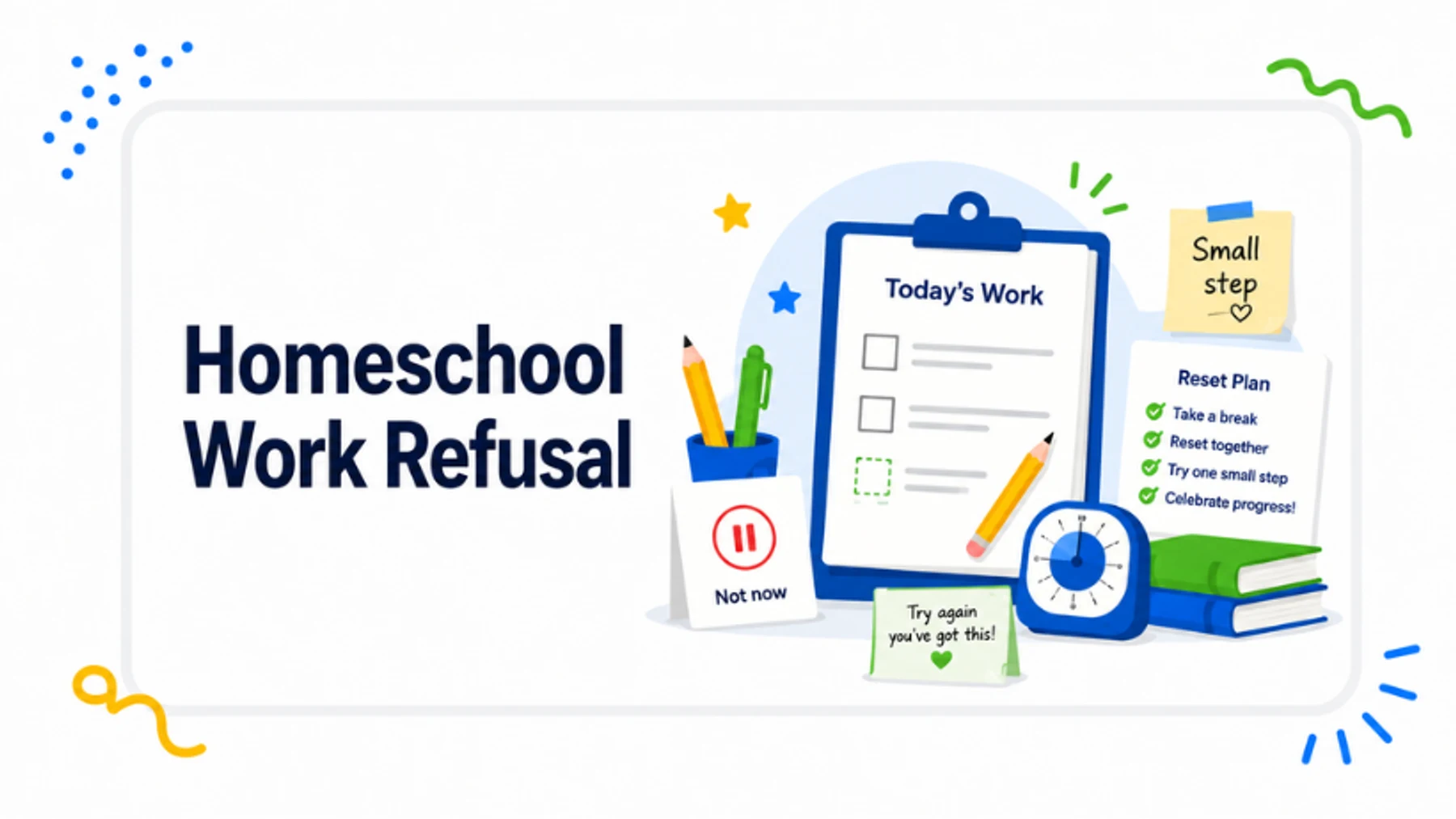
If your child refuses homeschool work, start by treating the refusal as information, not as a complete explanation.
“I'm not doing this” can come from many different places: the task may be too hard, too long, unclear, boring, badly timed, physically uncomfortable, or connected to a pattern of conflict that has grown around schoolwork.
Before you add consequences, switch curriculum, or decide the child is simply unmotivated, check what the refusal is telling you.
For the broader system around schedules, workload, independence, and flexible learning, start with Homeschool Without the Overwhelm.
1. Is the Work Too Hard?
Watch what happens right before the refusal.
Does the child:
- get stuck on the first step?
- need much more help than expected?
- read the directions but not understand what to do?
- avoid a specific skill repeatedly?
- become upset only when independent work begins?
A child can refuse because the task exposes a gap they do not know how to explain.
Try reducing the difficulty temporarily, doing the first example together, or breaking the task into a smaller step. If the resistance drops quickly, difficulty may be part of the problem.
2. Is the Task Too Long?
A reasonable assignment can become unreasonable after attention is gone.
If the child works well for ten minutes and then the battle starts, notice that pattern.
You might:
- shorten the first work block
- divide the task into two sessions
- stop after a clear section rather than an arbitrary page count
- use a visible finish point
The goal is not to remove useful practice. It is to find the amount the child can engage with productively, then build from there.
3. Is the Timing Working Against You?
Refusal can be much stronger when a child is:
- hungry
- tired
- coming directly from a preferred activity
- overwhelmed by several transitions
- waiting for a break
- trying to work while the room is noisy or distracting
If the same lesson goes better at another time of day, the curriculum may not be the main problem.
4. Does the Child Know What “Done” Means?
Vague tasks create resistance.
“Do your reading” can feel endless.
“Read these two pages, answer three questions, then you are done” gives the child a visible endpoint.
Use concrete instructions:
- what to start with
- how much to do
- what help is available
- what finished work looks like
- what happens afterward
Clarity can reduce conflict without lowering expectations.
5. Is the Refusal About This Task or About Homeschool in General?
Look for patterns.
If resistance appears only during writing, math, reading aloud, or independent work, the problem may be specific.
If nearly every task has become a fight, the family may be dealing with a broader routine, relationship, workload, or burnout problem. That deserves a wider look than changing one worksheet or lesson.
Change One Variable First
When parents are frustrated, it is tempting to change everything at once.
Instead, choose the most likely factor and test one adjustment:
- easier first step
- shorter block
- clearer instructions
- different time of day
- fewer transitions
- more direct help at the start
- more choice within the task
Then observe what changes.
If refusal persists across subjects and settings, causes significant distress, or seems connected to a learning, attention, emotional, or developmental concern, consider discussing the pattern with an appropriate qualified professional. A homeschool routine can reveal a difficulty, but it cannot diagnose the reason for it.
Refusal Is a Starting Point for Troubleshooting
You can hold expectations and still be curious about why the work is failing.
Check difficulty. Check length. Check timing. Check clarity. Check the transition into the task. Then change one thing and watch the result.
If the problem is no longer one task but a repeated daily battle, the next question is broader: how the whole homeschool pattern needs to change.
Frequently Asked Questions
Related Articles


Helping kids read better, together.
Like this article? Join 500+ educators using PicoBuddy to generate high-quality reading materials in seconds.