
Homeschool Without the Overwhelm: A Practical Guide to Building a Week That Works
Build a homeschool week around priorities, family rhythm, independence, shared learning, and enough flexibility to keep the system working in real life.
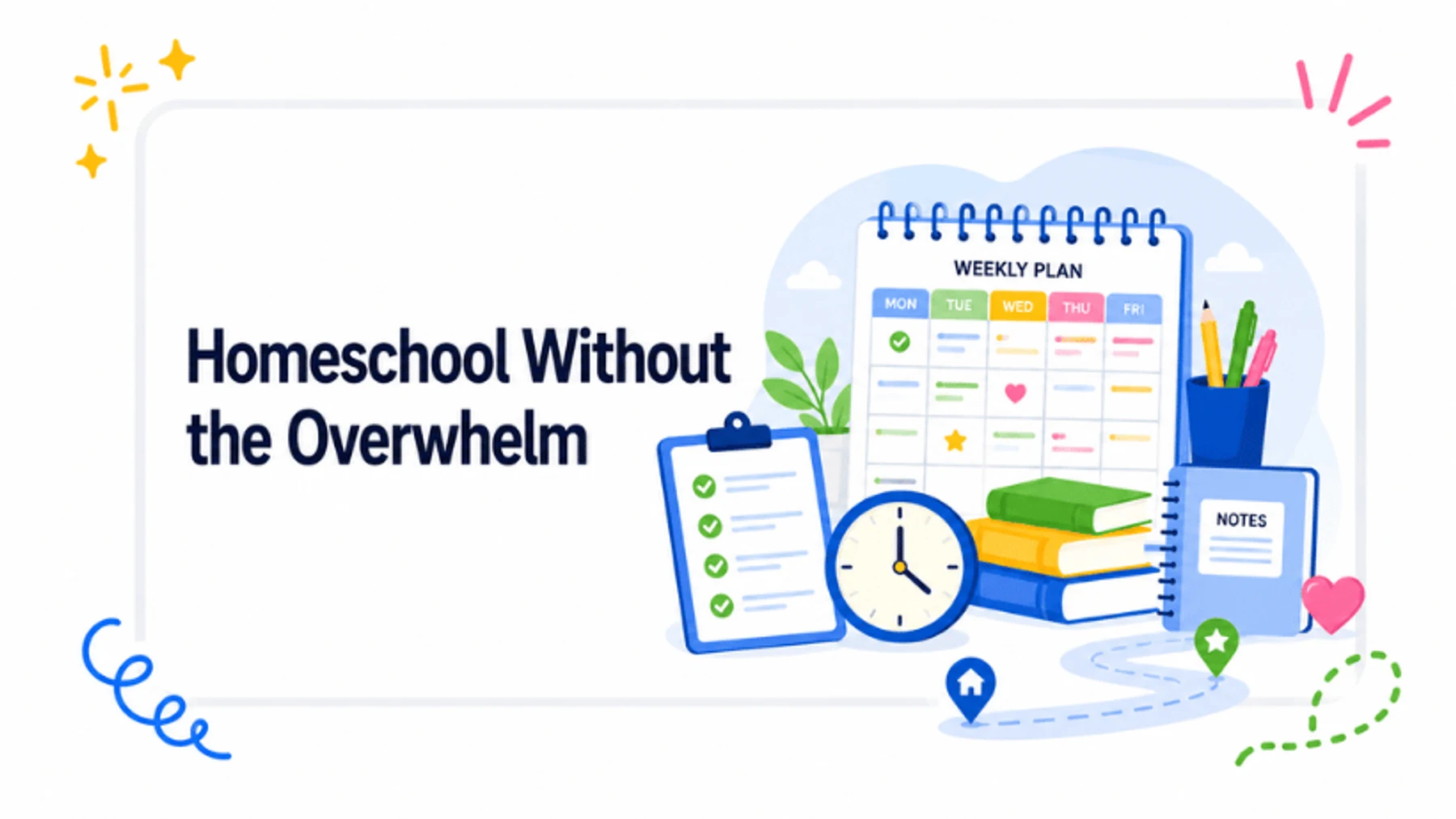
Homeschool can become complicated surprisingly quickly.
One curriculum becomes six subjects. Six subjects become separate workbooks, websites, printables, projects, reading lists, appointments, activities, and several children waiting for help at the same time.
The answer is not always a better planner.
A workable homeschool system starts by deciding what deserves a protected place in the week, what can rotate, what can be shared, what can become more independent, and what does not need to be there at all.
Use this five-part reset:
Keep → Rotate → Combine → Delegate → Drop
It gives you a way to simplify without assuming that less work is always better or that every family needs the same schedule.
1. Keep the Priorities That Need Continuity
Start with the work that loses value when it appears only occasionally.
Depending on the child, that may include:
- math
- reading
- phonics or decoding
- writing
- another skill that currently needs frequent practice
- legally required coursework
These are your anchors.
The list should be short enough that “core work” does not become another name for everything you own.
Ask: What truly needs regular practice for this child right now?
A subject can matter without needing a full lesson every day.
2. Rotate What Does Not Need to Happen Daily
Science, history, geography, art, projects, grammar, vocabulary, and longer writing may fit better in a weekly rotation than in every single morning.
Rotation can reduce transitions and give a subject enough time to become interesting.
For example, instead of touching science for fifteen rushed minutes every day, you might protect two longer science blocks. Another family may prefer a loop schedule that simply continues with the next rotating subject whenever that block comes around.
The goal is not fewer subjects across the education. It is a week that does not ask every day to carry all of them.
3. Combine What Benefits From Being Shared
Homeschool has one advantage that is easy to lose when every child receives a completely separate timetable: the family can learn together.
Shared learning can work especially well for:
- science
- history
- geography
- biographies
- nature study
- art and music
- read-alouds
- projects
- discussions
You can keep the topic shared while changing the reading level, support, or output.
Suppose everyone is exploring oceans. One child can read about basic ocean zones, another about marine ecosystems, and an older learner about pressure, currents, or conservation. The family can still finish with one discussion or project.
For this kind of topic-based learning, PicoBuddy Themes offer one topic with several reading and activity routes, while Curated Lists are useful when you mainly want a ready-made set of texts around the same subject.
If the topic is right but the reading level is not, Remix can adapt a passage to another level or language.
Those tools are examples of supporting shared content. Sequential skills such as phonics, math, spelling, and explicit writing instruction may still need individual teaching.
4. Delegate What Does Not Need Your Full Attention
Homeschool becomes difficult to sustain when every task requires the parent to explain, supervise, remind, and check every step.
Sort work into four levels:
Teach with me
The child is learning something new and needs direct instruction.
Start with me
You help the child begin, then they continue.
Check in
The child starts independently and knows when support is coming.
Show me when done
The task is familiar enough to complete independently before feedback.
This is not about pushing children into independence before they are ready. It is about noticing which familiar tasks no longer need to consume the same amount of parent attention.
Short known-practice blocks can help. For example, a child who already understands the routine may be able to complete a Grammar or Vocabulary practice task independently while you work directly with a sibling.
The resource matters less than the principle: save your direct teaching time for the work that actually needs direct teaching.
5. Drop Duplication, Not Useful Practice
A crowded homeschool often contains several activities doing the same job.
You might have:
- a reading passage
- comprehension questions
- a second comprehension worksheet
- an online quiz
- a written summary
- an extension project
Any one of those can be useful. The problem starts when every option becomes mandatory simply because it exists.
Ask: What is today's learning goal, and which response best serves it?
If you need independent comprehension evidence, a focused worksheet or quiz may be exactly right. If the child already demonstrated understanding and the goal is discussion, another written check may add little.
Simplification should remove unnecessary duplication, not useful practice.
Build a Week Before You Build a Perfect Day
Daily schedules are fragile because ordinary family life is variable.
A weekly plan gives you more room to recover.
Think in terms of:
- core work that appears consistently
- rotating subjects
- shared family learning
- individual teaching blocks
- independent work
- one buffer for overflow or unexpected life
The buffer can be a lighter Friday, an open afternoon, or simply unscheduled capacity across several days.
A homeschool week with no recovery space is likely to feel behind the first time anything takes longer than expected.
Three Family Week Shapes
These are examples, not templates you must copy.
Family A: Younger child, short focused mornings
Most mornings
- math
- reading/language work
- movement break
Two or three days
- shared science/history/topic work
Afternoons
- play, read-alouds, library, art, outside time, activities
This works when short direct teaching blocks are more productive than a long school-style day.
Family B: Multiple ages
Shared opening
- read-aloud, discussion, topic introduction
Parent rotation
- direct teaching for one child
- independent/familiar work for the others
Shared content block
- science, history, geography, project
Different outputs
- younger child draws or explains
- middle child answers or summarizes
- older child compares or researches
Family C: More independent learner
Weekly checklist
- core lessons
- reading/writing
- rotating content subjects
- deadlines
Parent check-ins
- new instruction
- feedback
- planning
The child has more control over order while the parent still protects sequence and quality.
When Reading Can Stay Flexible
Reading is one area where homeschool can combine structure with interest particularly well.
A child can read:
- books
- library materials
- biographies
- science and history texts
- instructions
- articles
- short passages
- project research
Short passages are useful when you need a focused text at a particular level or around a specific topic. PicoBuddy's reading passage library can fill that role without pretending to replace a complete literacy curriculum.
The larger goal is a reading life with enough variety, challenge, and consistency to build skill and knowledge.
When the System Is Not Working, Diagnose Before Adding
When homeschool feels difficult, the instinct is often to add something:
- a stricter schedule
- another curriculum
- more practice
- a reward system
- another app
- a new planner
First identify the failure point.
If the day is too long
Look at task length, transitions, duplication, and how many subjects you are trying to touch.
If one child refuses work
Check difficulty, clarity, timing, task length, and whether the resistance is specific or general.
If every day becomes a fight
Look at the recurring interaction pattern, not only the assignment.
If the parent is burned out
Audit which tasks require your attention and which could be reused, delegated, outsourced, or dropped.
If multiple children are pulling you in different directions
Separate shared content from individual skills and rotate your direct teaching.
If the curriculum feels wrong
Ask what job it is supposed to do before replacing it or stacking another supplement on top.
Different problems need different fixes.
Do a One-Week Homeschool Reset
Take one sheet of paper and make five columns.
Keep
What deserves a protected place next week?
Rotate
What matters but does not need to happen every day?
Combine
What can siblings or subjects share?
Delegate
What can become more independent, be outsourced, or use a repeatable resource?
Drop
What is duplicated, unclear, or no longer earning its place?
Then build the week from those decisions.
Do not begin with exact times. Begin with priorities and relationships between tasks.
A strong homeschool system is not the one with the most boxes checked. It is the one that gives important learning enough structure to keep happening while leaving enough room for real children, real parents, and real life.
Frequently Asked Questions
Related Articles

Helping kids read better, together.
Like this article? Join 500+ educators using PicoBuddy to generate high-quality reading materials in seconds.