
Constitution Day Activities for Elementary Students
Constitution Day does not need to become a separate civics unit. Use one clear reading passage, a few focused comprehension questions, and one meaningful extension to fit September 17 naturally into your reading block.
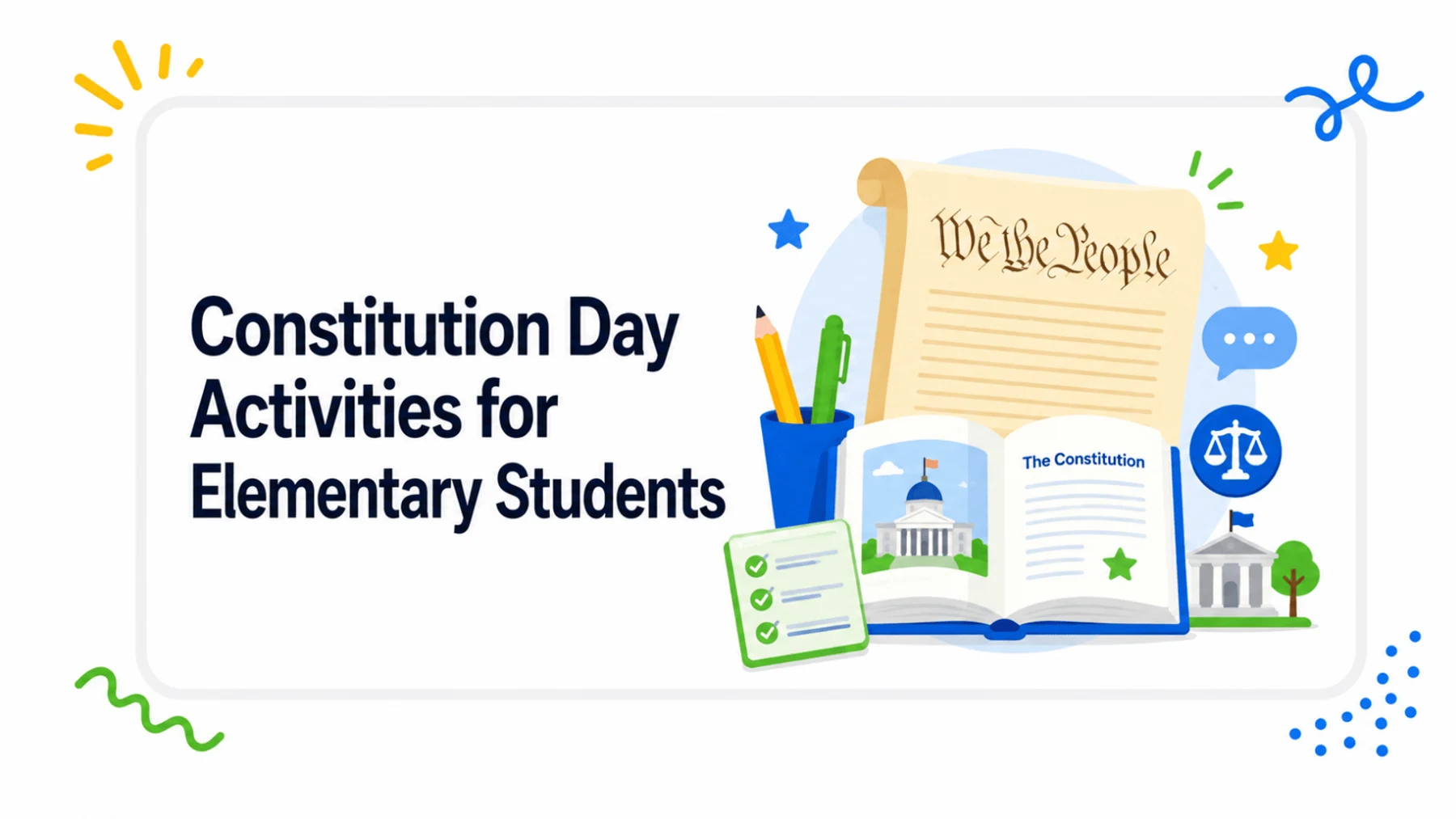
Constitution Day can sneak up on teachers. September routines are still settling, back-to-school work is barely behind you, and suddenly September 17 is on the calendar.
The good news: you do not need a separate civics mini-unit to make the day meaningful.
For many elementary classrooms, the simplest approach is also one of the strongest: start with one clear, age-appropriate reading passage, check comprehension, and add one short activity that helps students connect the ideas to real life.
That gives students enough background knowledge to understand what the Constitution is and why it matters, while keeping the lesson manageable inside a normal reading or ELA block.
What Is Constitution Day?
Constitution Day and Citizenship Day is observed on September 17. The date marks the signing of the U.S. Constitution in 1787.
The U.S. Department of Education explains that educational institutions receiving federal funds are required to hold an educational program about the Constitution for students on September 17. If the date falls on a weekend or holiday, the program can take place during the preceding or following week.
The law does not prescribe one specific type of lesson. That gives schools considerable flexibility in how they teach the topic.
For elementary students, that flexibility is useful. A Constitution Day lesson does not need to cover every article, amendment, court case, or historical debate. A short reading lesson can focus on a few foundational ideas students can actually understand.
Start With One Kid-Friendly Reading Passage
Before students sort branches of government, write a class constitution, or study the Preamble, they need enough background knowledge to make those activities meaningful.
A short informational passage can introduce ideas such as:
- what a constitution is;
- why a country needs a framework for government;
- how the Constitution divides responsibilities among branches of government;
- why limits on government power matter;
- what amendments are;
- how the Constitution has changed over time.
For grades 3–5, concrete language matters. Terms such as Constitution, government, branch, amendment, rights, and Preamble are useful, but they need examples and context.
You can browse PicoBuddy reading passages by grade and topic, or create a custom reading passage when you need a Constitution text at a specific level.
A Simple Constitution Day Reading Lesson for Grades 3–5
A reading-first lesson does not need many moving parts. This four-step structure is enough for a focused Constitution Day activity.
1. Read for the big idea
Ask students to read with one main question in mind:
Why does a country need a constitution?
That question keeps students focused on purpose instead of memorizing isolated facts.
A strong elementary passage might explain that the Constitution creates a structure for the federal government, gives different responsibilities to different branches, and sets rules for how government power works.
2. Check comprehension
After reading, use a few targeted questions rather than a long worksheet.
Useful question types include:
- What is the main idea of the passage?
- Why was the Constitution created?
- What does the word amendment mean in this passage?
- Which detail explains how government power is divided?
- What evidence from the text shows that the Constitution can change?
These questions keep Constitution Day connected to normal reading goals such as main idea, vocabulary in context, key details, and text evidence.
3. Make the idea concrete
Elementary students often understand abstract civics concepts better when they can compare them with something familiar.
You might ask:
How is a constitution different from a list of classroom rules?
A classroom-rules comparison can help students think about purpose, responsibilities, and limits. Just make the distinction clear: the U.S. Constitution is a foundational legal document for a national government, not simply a larger version of classroom rules.
4. Add one short extension
Choose one activity that builds directly on the reading.
For example:
- paraphrase one part of the Preamble in student-friendly language;
- sort simple examples into legislative, executive, and judicial responsibilities;
- write a short class constitution for one classroom routine;
- examine an image of an original Constitution page and make observations;
- compare the Constitution with another founding document students have studied.
One purposeful extension is usually more useful than six disconnected themed activities.
Constitution Day Activities by Grade Band
The same topic can look different depending on students' reading level and background knowledge.
Grade 3: Keep the ideas concrete
Third graders may be ready to understand that governments need written rules and structures, but they do not need a detailed constitutional law lesson.
Focus on:
- what a constitution does;
- why rules for government matter;
- simple vocabulary;
- identifying main idea and details;
- connecting the idea of responsibilities to familiar communities.
A short passage with a glossary and four or five comprehension questions can be enough.
Grade 4: Add structure and text evidence
Fourth graders can go a step further by exploring how the Constitution organizes government.
You might introduce:
- the three branches at a basic level;
- the purpose of the Preamble;
- the idea that government power has limits;
- how amendments allow the Constitution to change.
Reading questions can ask students to explain ideas using evidence from the passage rather than simply recall vocabulary.
Grade 5: Compare ideas and documents
Fifth graders may be ready for more comparison and historical context.
They can explore:
- why the Constitution followed the Articles of Confederation;
- checks and balances at an introductory level;
- how amendments changed the Constitution;
- how the Constitution differs from the Declaration of Independence.
If your students have already studied independence, PicoBuddy's The Big Ideas of the Declaration of Independence can provide useful background for a comparison between the two documents.
5 Low-Prep Constitution Day Activities
If you want to extend the reading lesson, keep the activities tied to the ideas students just encountered.
1. Passage + evidence hunt
Give students a short Constitution passage and ask them to highlight or underline evidence for one question, such as:
How does the Constitution organize government?
This turns the holiday topic into useful nonfiction reading practice.
2. Rewrite the Preamble in kid-friendly language
Use the Preamble as a short close-reading text. Students can identify unfamiliar words, discuss the overall purpose, and rewrite the meaning in plain language.
For a primary-source connection, the Library of Congress Constitution Day resources include Constitution-related documents and teaching materials.
3. Create a mini class constitution
Choose one real classroom situation, such as group work or classroom materials.
Ask students to agree on:
- a shared goal;
- two or three responsibilities;
- one way decisions will be made;
- what should happen if the agreement needs to change.
Then connect the activity back to the reading: written frameworks can describe responsibilities and processes, but a classroom agreement is not the same thing as a national constitution.
4. Sort the three branches
Give students simple actions or responsibilities to sort under legislative, executive, or judicial.
Keep the examples basic and check them carefully. The goal is to understand that government responsibilities are divided, not to memorize every power held by each branch.
5. Observe a primary source
Show students an image or excerpt from an original Constitution document and ask observation questions before giving background information.
Try prompts such as:
- What do you notice first?
- What clues show that this is an old document?
- What questions does the document make you ask?
- Why might the physical document matter in addition to the words it contains?
The National Archives Constitution Day resources can help you add a primary-source element without building a full lesson from scratch.
Keep Constitution Day Factual and Nonpartisan
Constitution Day is a civics and history topic, so precise language matters.
For elementary students, focus first on what the Constitution does, how the federal government is structured, and how amendments have changed the document over time.
Avoid presenting complicated historical or current political questions as if they have one simple classroom answer.
It is also worth avoiding the idea that the Constitution instantly created equal rights and political participation for everyone in 1787. The original system excluded many people from full participation, and constitutional amendments, laws, court decisions, and social movements changed how rights and citizenship were understood and protected over time.
That history does not need to dominate a short elementary lesson, but one accurate sentence is better than an oversimplified claim.
Turn Constitution Day Into Reading Practice
A strong Constitution Day lesson can do double duty.
Students can practice:
- main idea and supporting details;
- vocabulary in context;
- summarizing;
- comparing texts or documents;
- using text evidence;
- speaking and writing about informational text.
That means Constitution Day does not have to compete with your reading block. It can become the reading block for the day.
If you need something more specific, create a passage at the grade level and topic you need, then use the comprehension questions, online quiz, or printable PDF as part of the lesson.
Ready to Build the Lesson?
Start with the reading level your students actually need.
Browse PicoBuddy reading passages, explore history passages, or create a custom Constitution Day passage for your grade level.
One focused passage, a few strong questions, and one meaningful extension can be enough to make Constitution Day useful without turning September 17 into another giant prep project.
Frequently Asked Questions
Related Articles
Helping kids read better, together.
Like this article? Join 500+ educators using PicoBuddy to generate high-quality reading materials in seconds.