
How Do I Know If We’re Doing Enough in Homeschool?
“Enough” is easier to judge by progress, consistency, appropriate challenge, breadth, and sustainability than by copying another family's timetable.
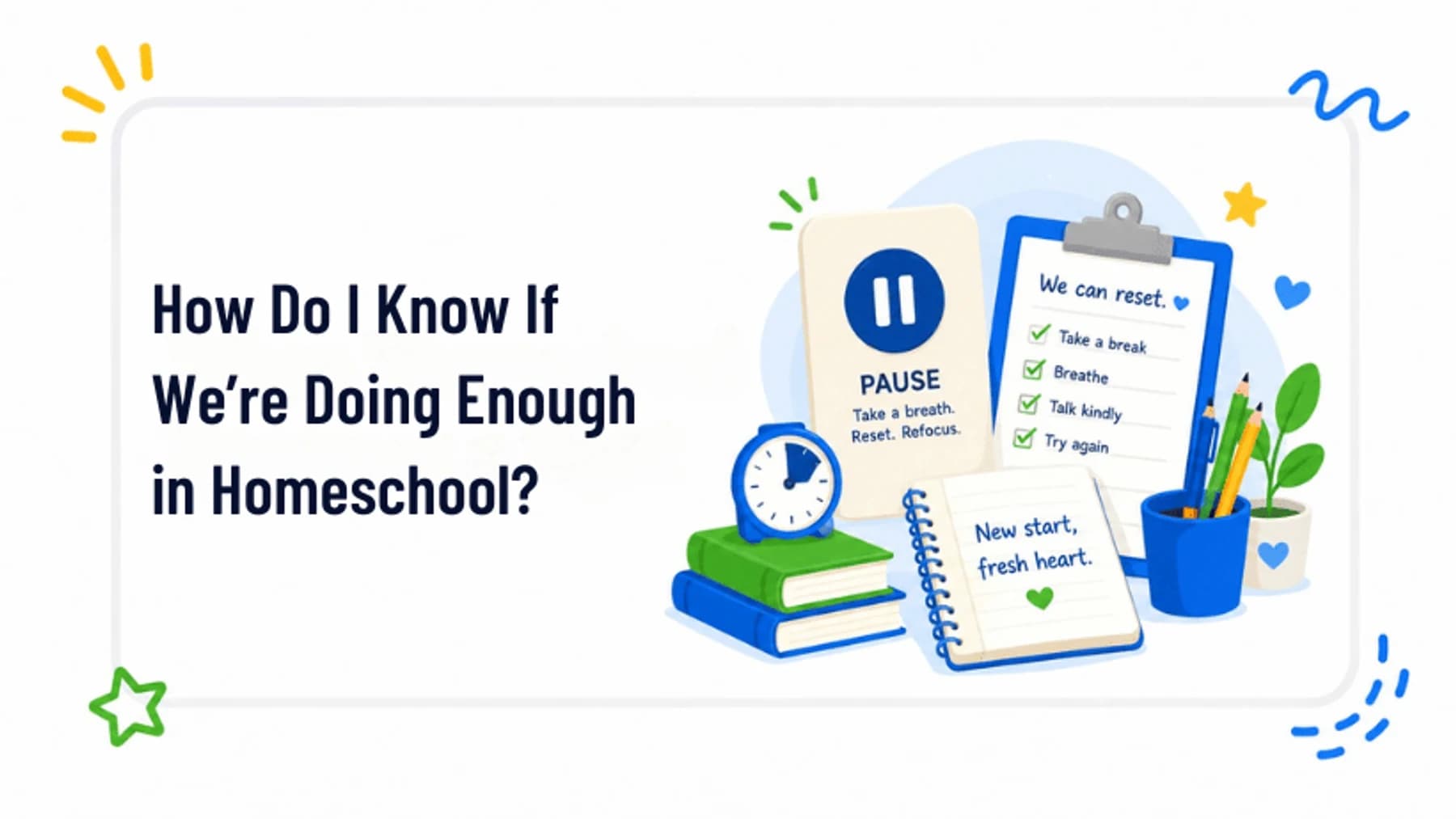
The fear that you are not doing enough is common because homeschool has no bell at the end of the period telling you that the day was officially complete.
A better measure than hours, pages, or someone else's schedule is a combination of progress, consistency, appropriate challenge, breadth, and sustainability.
You are looking for evidence that learning is moving forward, not proof that your home looks like a school building.
For the broader system around schedules, workload, independence, and flexible learning, start with Homeschool Without the Overwhelm.
1. Is There Progress Over Time?
Look back over several weeks or a month.
Can your child do something now that was harder before?
Progress may look like:
- reading with more independence
- explaining ideas more clearly
- solving a type of problem with less help
- writing more comfortably
- remembering and using vocabulary
- managing a routine more independently
- making stronger connections across subjects
Not every week produces a dramatic jump. The question is whether you can see movement when you zoom out.
2. Are Important Skills Showing Up Consistently?
A flexible schedule can still have anchors.
Ask:
- Are core skills practiced often enough to build continuity?
- Are we regularly reading, writing, thinking, discussing, and solving problems at an appropriate level?
- Do important subjects repeatedly disappear because the week gets too crowded?
If your priorities consistently happen, the exact shape of each day can vary.
3. Is the Work Challenging Without Being Constantly Overwhelming?
“Enough” does not mean easy all the time.
Children need opportunities to:
- make mistakes
- work through confusion
- practice something that is not automatic yet
- complete tasks without immediate parent rescue
But productive challenge is different from a day built around constant frustration.
If nearly all work requires intensive prompting or ends in shutdown, adding more may not be the right answer. The level, support, or schedule may need adjusting.
4. Is the Learning Broad Enough Across the Month?
Not every subject needs equal time every day. Look across a longer window. Has your child had chances to work with:
- core academic skills
- longer ideas and projects
- books and information
- creative work
- practical skills
- interests and curiosity
- independent responsibilities
A week can be uneven and still contribute to a balanced month.
5. Can Your Family Sustain the System?
A plan that looks impressive but repeatedly collapses is not automatically “more educational” than a simpler plan that happens consistently.
Ask:
- Can we repeat this next week?
- Is there enough space for illness, appointments, difficult days, and ordinary family life?
- Are we constantly carrying unfinished work forward?
- Does the parent have enough energy left to teach well?
Sustainability is not the opposite of rigor. A workable system creates more chances for good teaching and learning over time.
Make a Monthly Evidence Check
Once a month, write brief answers to these questions:
- What has become easier?
- What still needs direct teaching or practice?
- What is my child doing more independently?
- Which subjects or experiences have been missing?
- What is making the week harder than it needs to be?
That gives you a much stronger basis for adjustment than comparing your 10-year-old's Tuesday with a stranger's color-coded schedule online.
Separate Legal Requirements From Self-Doubt
Homeschool laws, required subjects, assessments, attendance, or instructional-time rules vary by state and location. Check those requirements separately.
Meeting legal requirements is one question. Deciding whether your child is learning and your routine is working is another.
“Enough” Should Produce Evidence, Not Exhaustion
You do not need to prove homeschool is serious by filling every available hour.
Look for progress. Keep important work consistent. Provide appropriate challenge. Make room for a broad education. Build enough flexibility that the system can survive real life.
If those pieces are present, you have useful evidence to work from. If one is missing, adjust that specific part before assuming the answer is simply more work.
Frequently Asked Questions
Related Articles


Helping kids read better, together.
Like this article? Join 500+ educators using PicoBuddy to generate high-quality reading materials in seconds.