
Is a 4-Day Homeschool Week Enough?
A 4-day homeschool week can work when the weekly goals fit, the fifth day has a clear role, and the routine is sustainable.
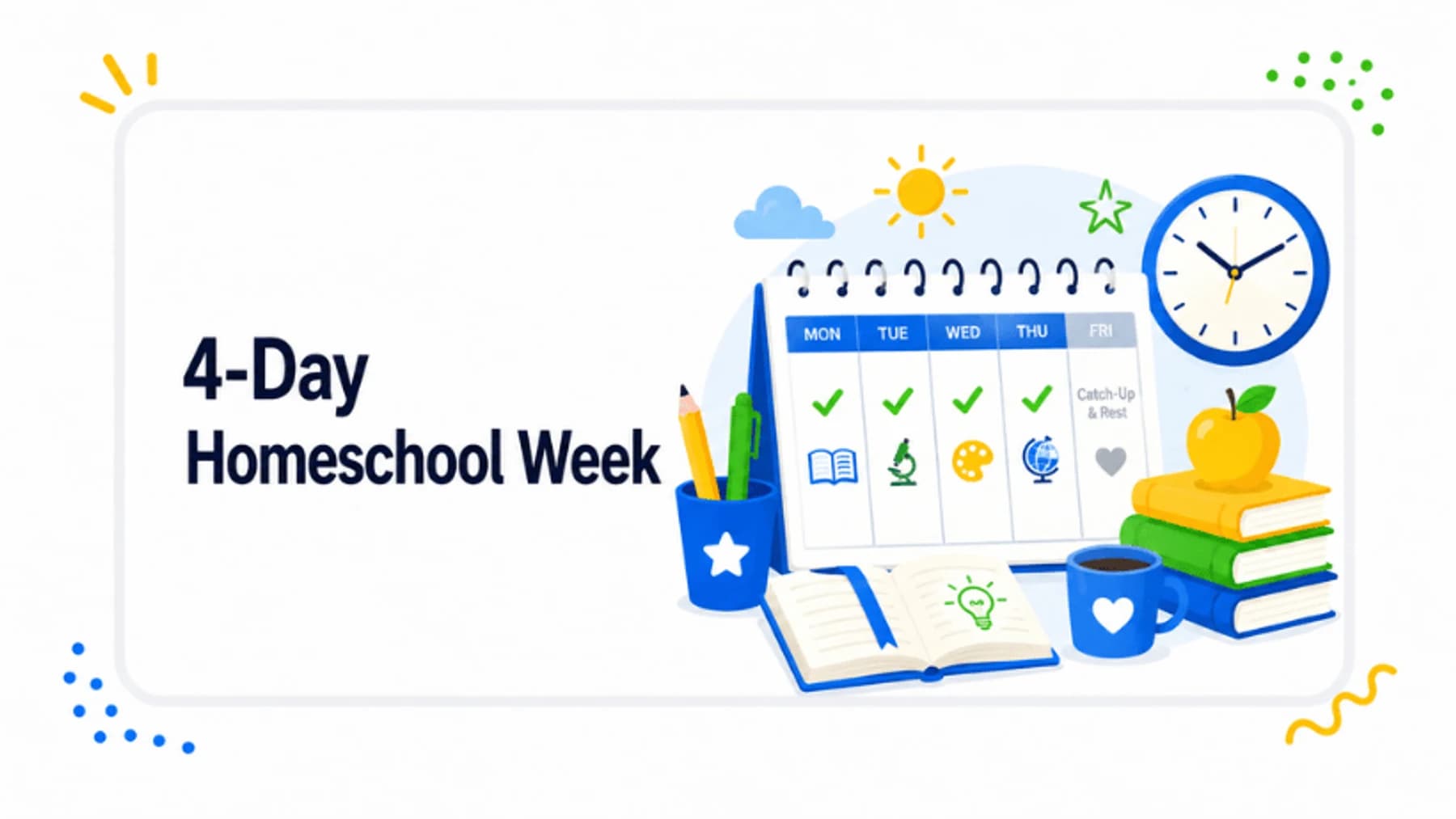
A 4-day homeschool week can be enough for some families.
The important question is not whether you copied a five-day school calendar. It is whether your weekly learning goals, required instruction, and family responsibilities fit into the four structured days without making those days overloaded.
A four-day week works best when the fifth day has a purpose rather than becoming the place where an unrealistic schedule spills over every week.
For the broader system around schedules, workload, independence, and flexible learning, start with Homeschool Without the Overwhelm.
What a 4-Day Week Can Look Like
A four-day homeschool week does not have to mean four identical long days.
For example:
- Monday through Thursday may hold most core lessons
- Friday may be used for library time, field trips, projects, appointments, catch-up, or family learning
- independent reading may continue every day even when formal lessons do not
- one subject may still happen on Friday when it naturally fits there
The structure can be flexible without being vague.
The Main Test: Does the Week Still Fit?
Before switching, list what actually needs to happen across the week.
Separate it into:
Core priorities
These are the skills or subjects that need consistent attention.
Rotating work
These may happen once or twice a week rather than every day.
Flexible learning
Projects, art, documentaries, library visits, outdoor learning, practical skills, and topic exploration may fit differently from week to week.
If four days can carry those priorities without turning every morning into a rush, the structure may work well.
What Can Go Wrong
A 4-day week is less helpful when it simply compresses five overloaded days into four.
Watch for:
- lessons becoming much longer just to “fit everything in”
- children losing useful breaks
- Friday becoming mandatory catch-up every single week
- important skills disappearing because there is no room left
- the family feeling more rushed rather than less
If that happens, the problem may not be the number of days. It may be the number of subjects, resources, or transitions you are trying to manage.
Give the Fifth Day a Job
The fifth day can become one of the most useful parts of the structure.
It might be a:
- buffer day for unfinished work
- project day for science, art, building, cooking, or research
- out-of-the-house day for library visits, field trips, sports, or appointments
- shared-topic day for a family unit study
- quiet independent day with reading or self-directed work
If you use a topic day, ready-made resources can reduce prep. For example, PicoBuddy's curated reading lists collect several passages around one topic, so a child can explore a subject without you searching for each text separately.
That is an option, not a requirement. The fifth day should solve a family problem, not create a new checklist.
Try It as an Experiment
You do not have to redesign the whole year at once.
Try a four-day structure for two normal weeks and track:
- What consistently gets finished?
- What keeps getting pushed to the fifth day?
- Are the four structured days still calm enough to learn well?
- Does the extra flexibility improve family life?
- Are important skills still getting enough practice?
If Friday becomes a useful buffer, project, or life-learning day, the schedule may be a good fit.
If Friday becomes emergency recovery from four exhausting days, the week probably needs a different adjustment.
Four Days Can Be Enough Without Becoming a Rule
A 4-day homeschool week is a scheduling tool, not a badge of better homeschooling.
Use it when it helps your family protect focused learning and leave room for the rest of life. Keep five structured days if that rhythm works better.
The best schedule is the one that covers what matters and is still realistic enough to repeat.
Check state and local homeschool requirements separately, because required days or instructional time vary by location.
Frequently Asked Questions
Related Articles


Helping kids read better, together.
Like this article? Join 500+ educators using PicoBuddy to generate high-quality reading materials in seconds.