
What to Do When Homeschool Turns Into a Daily Fight
Repeated battles over homeschool work are information. Use the pattern to separate task difficulty, fatigue, transitions, expectations, and relationship strain before deciding what to change.
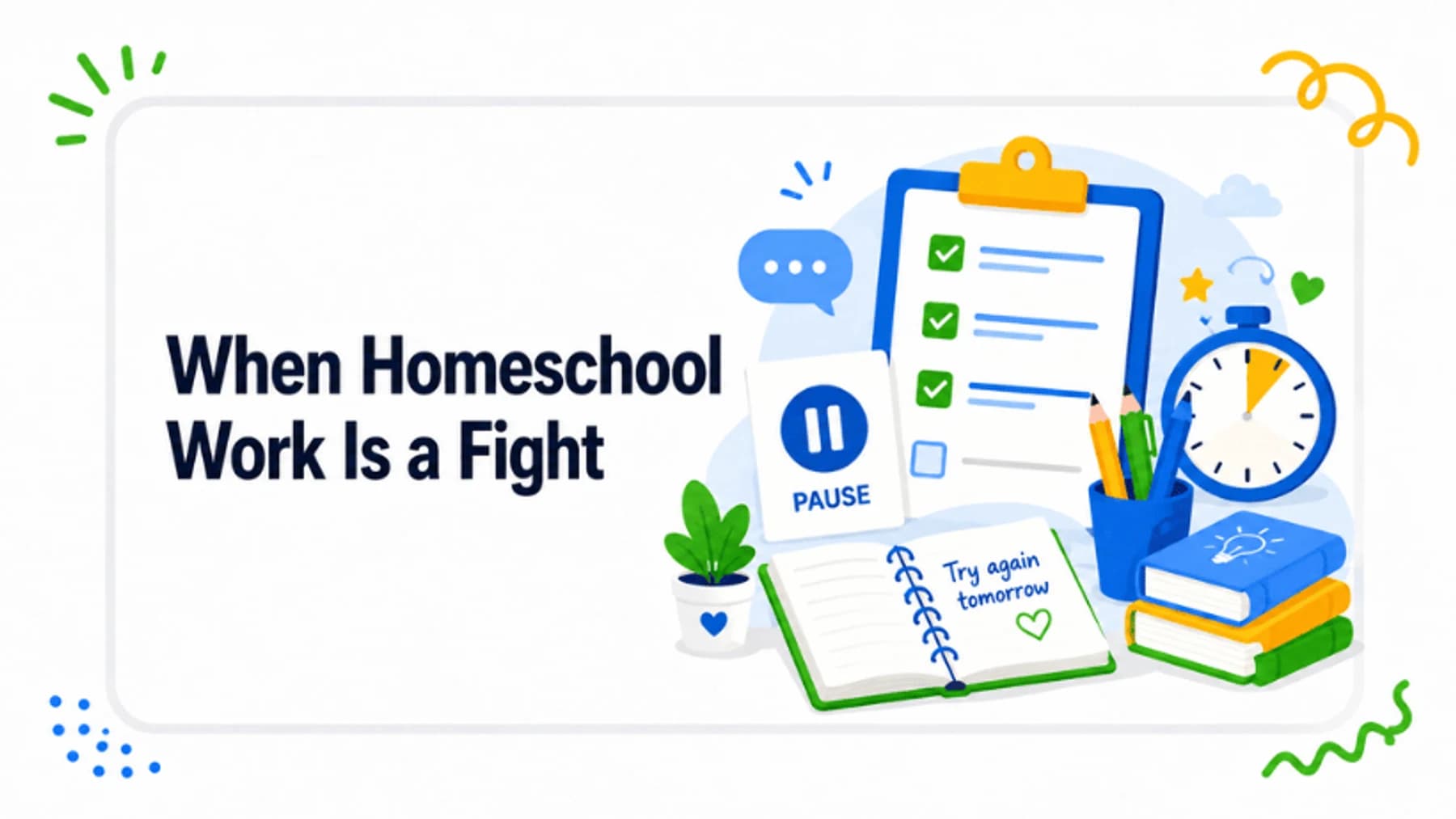
One difficult lesson is normal. A pattern of daily arguments is different.
When the same conflict keeps happening, the useful question is no longer only “How do I make my child do this?” It is also “What keeps happening right before this fight, and what is the system teaching both of us to expect?”
Repeated homeschool conflict can grow around difficulty, fatigue, transitions, unclear expectations, parent stress, child stress, or the way both people now enter the task expecting a battle.
A practical way to interrupt that pattern is:
Pause → Diagnose → Adjust → Re-enter
For the broader homeschool system around schedules, workload, independence, and flexible learning, start with Homeschool Without the Overwhelm.
1. Pause the Pattern Before Solving the Lesson
When everyone is already escalated, it is usually a poor moment to redesign curriculum, argue about motivation, or deliver a long explanation about responsibility.
Pause long enough to stop repeating the same exchange.
That may mean:
- take a short break
- finish only the smallest reasonable stopping point
- move the discussion about expectations until later
- write down what happened while it is still fresh
Pausing does not mean the child controls whether learning ever happens. It means you are separating immediate regulation from the later teaching decision.
2. Diagnose the Repeating Pattern
Look for where the conflict reliably begins.
Task difficulty
Does the child resist one specific type of work?
Maybe writing requires much more effort than oral explanation. Maybe reading is fine until questions require evidence. Maybe math falls apart when multi-step problems begin.
Task length
Does the first part go well and the fight start near the end?
The child may need a shorter initial block, a visible midpoint, or a different amount of independent work.
Transition
Does the conflict happen when stopping a preferred activity or switching subjects?
Then the transition itself may need more structure.
Expectations
Does the child know exactly what must be completed, what quality looks like, and when the task ends?
Parent load
Are you entering the lesson already rushed, distracted, or frustrated because three other things are waiting?
That does not make the conflict “the parent's fault.” It means the adult side of the system also deserves attention.
3. Adjust the Smallest Part That Could Matter
Do not redesign the entire homeschool week because Wednesday's writing lesson exploded.
Choose one change that matches your best hypothesis.
If the problem looks like difficulty:
- model the first step
- reduce complexity temporarily
- provide more direct teaching
If it looks like length:
- split the task
- use a clear finish point
- move one part to another day
If it looks like transitions:
- give a countdown
- use the same transition routine each day
- reduce unnecessary subject switches
If it looks like clarity:
- put the steps on paper
- define what “done” means
- separate required work from optional extension
If it looks like a larger workload issue:
- review the week instead of squeezing harder on one lesson
4. Re-enter With a Different Script
The next attempt matters.
If both parent and child expect the same argument, even a better task can trigger the old pattern.
Keep the restart simple:
“Yesterday this got really hard. Today we're trying it differently. We are doing these two steps first, and then we'll check in.”
That signals that the expectation remains, but the process is not locked.
Separate Teaching From Limit-Setting
Homeschool is unusual because the same adult may be teacher, parent, scheduler, helper, and rule-setter within five minutes.
Try to separate two questions:
What does this child need in order to learn this?
and
What family expectation or boundary needs to stay in place?
Sometimes the learning task needs adaptation while the expectation to participate stays firm.
Other times the boundary is not the main issue because the task itself is poorly matched.
Keeping those questions separate makes it easier to respond without turning every learning problem into a behavior battle.
Build One Calm Win
After a rough stretch, do not try to prove the homeschool system works by having the biggest possible comeback day.
Choose one meaningful task that is likely to succeed with the new support.
A calm win can rebuild useful expectations:
- the child experiences starting without a fight
- the parent practices a different response
- both people see that the pattern can change
Then build from there.
When the Problem Is Bigger Than the Routine
Repeated severe distress, persistent learning difficulties, significant anxiety, or problems that appear across settings may need support beyond schedule adjustments.
A homeschool routine can help you notice patterns. It cannot diagnose their cause.
If you are concerned about a learning, developmental, behavioral, or mental-health issue, consider seeking appropriate professional guidance rather than assuming the answer is stricter scheduling or a new curriculum.
Map One Fight Instead of Fighting the Whole Week
Pick one conflict that happens often and write four lines:
Pause: What helps us stop escalation?
Diagnose: Where does the pattern start?
Adjust: What one variable will we change?
Re-enter: How will we start differently next time?
That turns “homeschool is a daily fight” into a problem you can actually observe and test.
Frequently Asked Questions
Related Articles


Helping kids read better, together.
Like this article? Join 500+ educators using PicoBuddy to generate high-quality reading materials in seconds.