
How to Build a Homeschool Schedule You Can Actually Keep
Build a homeschool schedule around priorities, energy, transitions, and flexibility instead of trying to fit every subject into every day.
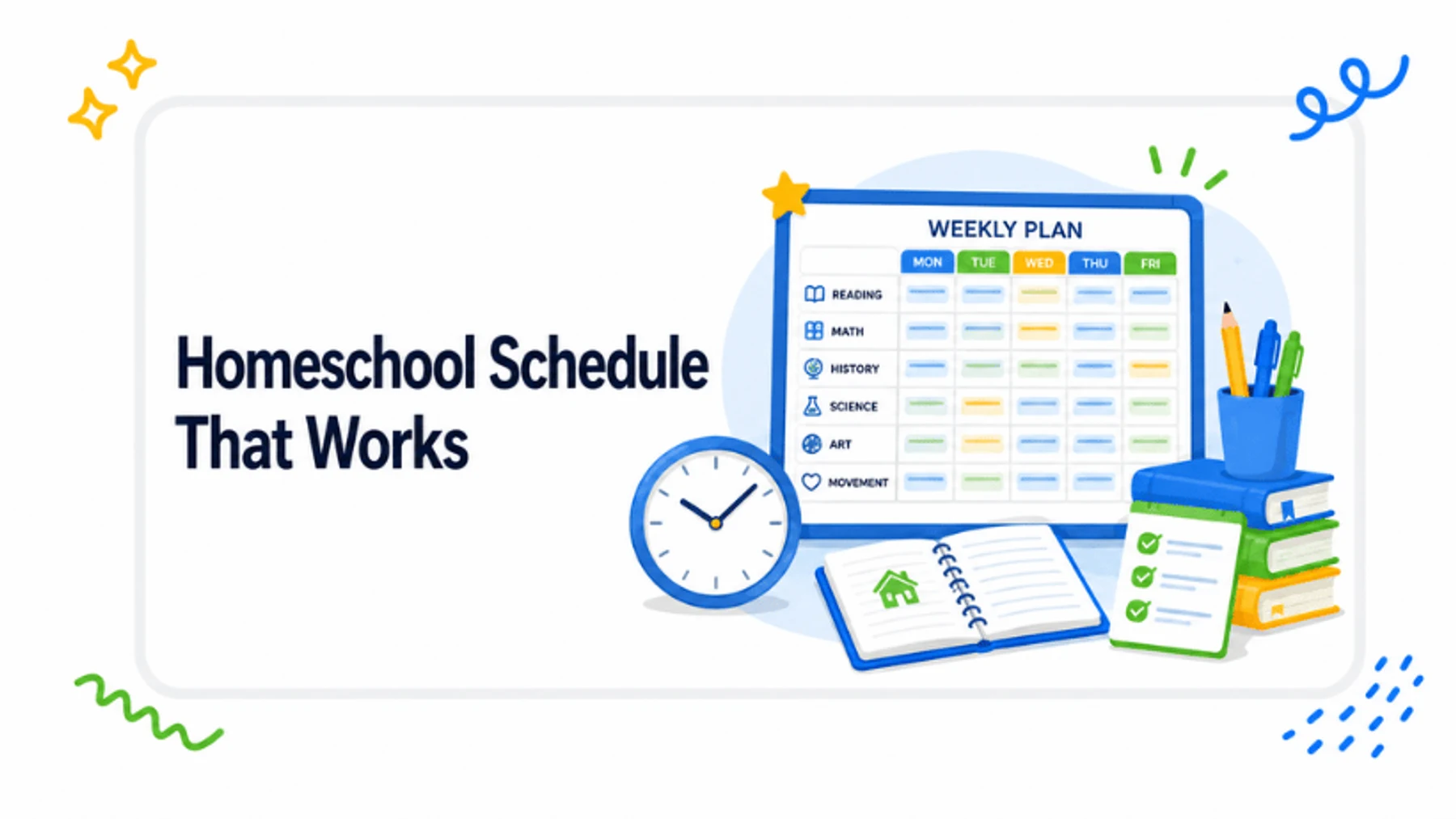
A homeschool schedule works when it survives normal life.
It should still make sense when someone sleeps badly, an appointment lands in the middle of the morning, a math lesson takes longer than expected, or a child becomes deeply interested in something you did not plan.
The goal is not to design the most complete timetable. It is to build enough structure to make important learning happen, with enough flexibility that the schedule does not collapse the first time the day changes.
For the broader homeschool system around workload, independence, multiple ages, curriculum choices, and family rhythm, start with Homeschool Without the Overwhelm.
Start With the Week, Not the Clock
Before assigning times, list what needs to happen across the whole week.
Use three buckets:
1. Non-negotiables
These are the skills or responsibilities that need consistent attention.
Examples might include:
- math
- reading or language arts
- a developing skill that needs frequent practice
- any required coursework for your state or program
2. Rotating subjects
These can often happen on selected days:
- science
- history
- geography
- art
- longer writing
- projects
- specific grammar or vocabulary practice
3. Flexible learning
This includes work that may move around the week:
- library visits
- field trips
- experiments
- documentaries
- cooking
- practical life skills
- independent interest projects
When you start with the week, you stop asking every Tuesday to carry the entire curriculum.
Choose the Lightest Schedule Structure That Works
Different families need different levels of predictability.
Fixed schedule
A fixed schedule gives subjects a regular time.
Example:
- 9:00 math
- 9:45 language arts
- 10:30 break
- 11:00 science
This can work well for children who like strong predictability or families working around firm outside commitments.
It can also become fragile when every delay pushes the rest of the day off track.
Block schedule
A block schedule protects broader chunks of time instead of exact minutes.
Example:
- Morning core: math + language arts
- Late morning: science/history/project
- Afternoon: independent reading, activities, outside commitments
This keeps order without requiring every lesson to start at 9:17.
Loop schedule
A loop schedule works through a list in order.
For example:
science → history → geography → art → science...
If Tuesday becomes chaotic, you do not “miss geography.” You simply continue with the next item when the rotating block happens again.
Checklist schedule
Older or more independent learners may work well from a daily or weekly checklist.
The parent protects deadlines and priorities while the child has more control over order.
The right schedule style is the one that solves your actual problem. Do not add complexity because a beautiful planner can hold it.
Reduce Transitions Before You Add More Time
A common schedule problem is not the amount of work. It is the number of times everyone has to stop, reorganize, and restart.
You can reduce transitions by:
- putting related language arts tasks together
- using one science topic across reading, discussion, and a project
- combining siblings for shared subjects
- grouping independent work into one block
- rotating lower-priority subjects instead of touching each one every day
For interest-led or shared-topic blocks, PicoBuddy Themes can be useful because one topic can include reading passages, word games, coloring, and related resources. If you want a ready-made set of texts rather than a full theme world, Curated Lists group passages around a topic or teaching moment.
Those are examples of reducing resource switching, not a requirement for how to homeschool.
Decide What Needs You and What Does Not
Your schedule should not assume the parent is teaching every child every minute.
Mark each task as:
- Teach with me
- Start with me
- Independent
- Shared family work
Then stagger those categories.
While one child gets direct math help, another might read independently, complete a short skill practice, or work on a project.
If independent English practice fits your plan, short grammar or vocabulary quizzes can function as one self-starting block. A child who needs a ready-made text can browse reading passages by topic and level.
The important schedule principle is broader: save your direct attention for the work that truly needs it.
Build Buffer Time on Purpose
Do not schedule 100 percent of the available week.
A buffer can absorb:
- unfinished work
- appointments
- difficult days
- a project that deserves more time
- extra support for one child
- spontaneous outings or opportunities
Some families protect Friday. Others leave part of every afternoon open. Some build one intentionally light day into the middle of the week.
A buffer is not wasted time. It prevents every disruption from becoming a scheduling emergency.
Three Sample Schedule Shapes
A. Younger learner
Morning anchor
- short math block
- reading/language work
- movement/snack
Later morning
- shared science/history/topic work
- hands-on activity
Afternoon
- read-aloud, outdoor time, art, free play, outing, or no formal work
B. Mixed-age family
Shared opening
- read-aloud, calendar, discussion, or topic introduction
Direct-teaching rotation
- Child A: math with parent
- Child B: independent task
- Child C: reading/project
Then rotate.
Shared content block
- science, history, geography, art, or project
C. More independent student
Weekly checklist
- core lessons with deadlines
- independent reading/writing
- rotating science/history
- selected parent check-ins
The student chooses much of the order while the parent checks quality and progress.
These are shapes, not prescriptions.
Troubleshoot the Schedule by the Problem
Everything takes too long
Check task length, difficulty, transitions, and how much work you are assigning before extending the day.
We never get to science or history
Move them out of the “after everything else” slot. Give rotating subjects protected places in the weekly plan.
I am teaching every minute
Identify one block each child can learn to start without you. Independence is built gradually, not granted all at once.
One bad morning ruins the week
Add buffer capacity. A schedule with zero recovery space is too brittle.
We keep changing systems
Stay with one simple structure long enough to discover whether the structure is wrong or the expectations inside it are wrong.
Build the Skeleton First
For next week, create one page with:
- your true non-negotiables
- your rotating subjects
- the schedule style you are using
- which tasks need direct parent attention
- one protected buffer
Leave the exact minutes until last.
A homeschool schedule should make decisions easier, not create another system you have to serve.
Frequently Asked Questions
Related Articles


Helping kids read better, together.
Like this article? Join 500+ educators using PicoBuddy to generate high-quality reading materials in seconds.