
How to Help Kids Work More Independently in Homeschool
Independence is not doing everything alone. Build it in stages: do with me, start with me, check in, then show me when done.
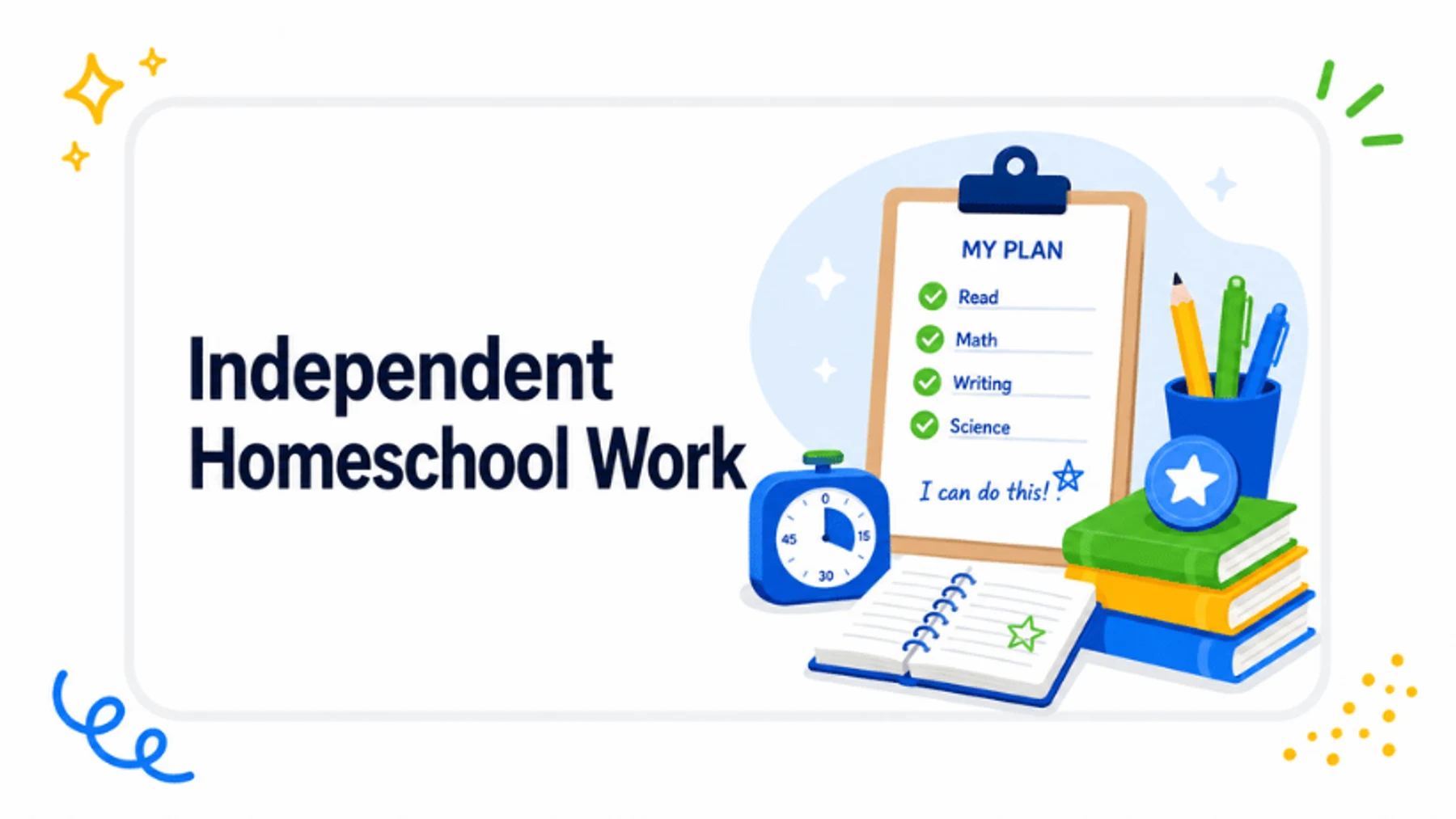
Independent homeschool work does not mean a child should learn everything alone.
A better definition is: the child can start, continue, and finish an appropriate task with the amount of support that task actually requires.
Independence grows through gradual release, not through suddenly saying, “You should be able to do this yourself now.”
Use this ladder:
Do With Me → Start With Me → Check In → Show Me When Done
For the broader homeschool system around schedules, workload, multiple ages, curriculum choices, and flexible learning, start with Homeschool Without the Overwhelm.
Step 1: Do With Me
Use this stage when the skill or routine is still new.
The parent may:
- explain the task
- model the first example
- stay nearby
- think aloud
- help the child notice mistakes
At this stage, the goal is not independence yet. The goal is learning what successful work looks like.
Step 2: Start With Me
Once the task is familiar, shift responsibility for the middle.
You might:
- read the directions together
- do the first item
- agree on the finish point
- let the child continue independently
This is often the easiest place to begin reducing parent involvement because the child is not facing a blank start alone.
Step 3: Check In
Now the child starts independently but knows when help will be available.
For example:
“Start the first three problems. I’ll come back in ten minutes.”
or
“Read the passage and answer the first questions. Put a sticky note beside anything you want to ask me about.”
A predictable check-in can reduce constant calling for help because the child knows support is coming.
Step 4: Show Me When Done
At this stage, the child can complete a familiar task and bring the result back for feedback.
The parent still checks quality, discusses errors, and teaches when a gap appears.
Independence is not the absence of feedback.
Choose the Right Tasks for Independent Practice
Good self-starting work is usually:
- already taught
- clearly explained
- at an appropriate difficulty
- limited enough to have a visible finish
- easy to check afterward
Poor independent work often asks the child to discover a new concept alone and then treats confusion as a motivation problem.
Make the Start Obvious
A child cannot be independent if every task begins with:
“Mom, what am I supposed to do?”
Make the first action visible.
Instead of:
Do language arts
try:
- read today's passage
- answer four questions
- put it in the finished tray
Or:
- complete one grammar skill
- check your feedback
- mark it done on the checklist
For English-language skill practice, self-starting options can include PicoBuddy's Grammar or Vocabulary practice when the child already knows how to use the format. For reading, the reading-passage library can provide a defined text-and-response task instead of requiring a parent to find new material each time.
Those tools do not replace instruction. Their value here is that the task structure can become familiar enough for a child to begin without a fresh explanation every day.
Use Help Windows
If you homeschool several children, constant interruption makes everyone's independent block less independent.
Try a help rule such as:
- mark the problem and continue if possible
- collect non-urgent questions
- parent checks in at a known time
- urgent confusion can still be brought immediately
Older children may use a written question list. Younger children may use a help card or sticky note.
The goal is not to make help difficult to access. It is to replace twenty random interruptions with predictable support.
Let Independence Include Choice
Once the routine is secure, give some control over order.
A child may choose:
- reading before math or math before reading
- which of two approved topics to explore
- whether to practice vocabulary first or later
- which optional extension to complete
For a lighter independent review block, PicoBuddy's Word Games can be used when playful vocabulary practice fits the goal.
Choice works best inside clear boundaries. “Do whatever you want today” is not the same as independent learning.
Do Not Push Every Task Up the Ladder at Once
A child may be fully independent with reading and still need direct math teaching.
Or they may start online practice easily but need substantial support planning a writing assignment.
Independence is task-specific.
Pick one recurring task that consumes parent attention and ask:
Which rung is this on now?
Then move it one step, not four.
Signs You Moved Too Fast
Step back when:
- errors multiply because the concept was not secure
- the child spends most of the block waiting for help
- directions are repeatedly misunderstood
- work quality drops sharply
- independent time becomes avoidance time
More independence should eventually reduce friction and increase ownership. It should not hide confusion.
Build One Self-Starting Block This Week
Choose one task your child already knows how to do.
Give it:
- a clear start
- a clear finish
- a visible instruction
- a known help point
- feedback afterward
Run that routine for several days before adding another independent block.
The goal is not a child who never needs you. It is a child who increasingly knows what they can do next without waiting for you to direct every step.
Frequently Asked Questions
Related Articles
Helping kids read better, together.
Like this article? Join 500+ educators using PicoBuddy to generate high-quality reading materials in seconds.