
How to Homeschool Multiple Ages Without Teaching Separate School Days
Homeschooling several ages does not require running several separate school days. Share content where it helps, keep sequential skills individual, and rotate your direct attention.
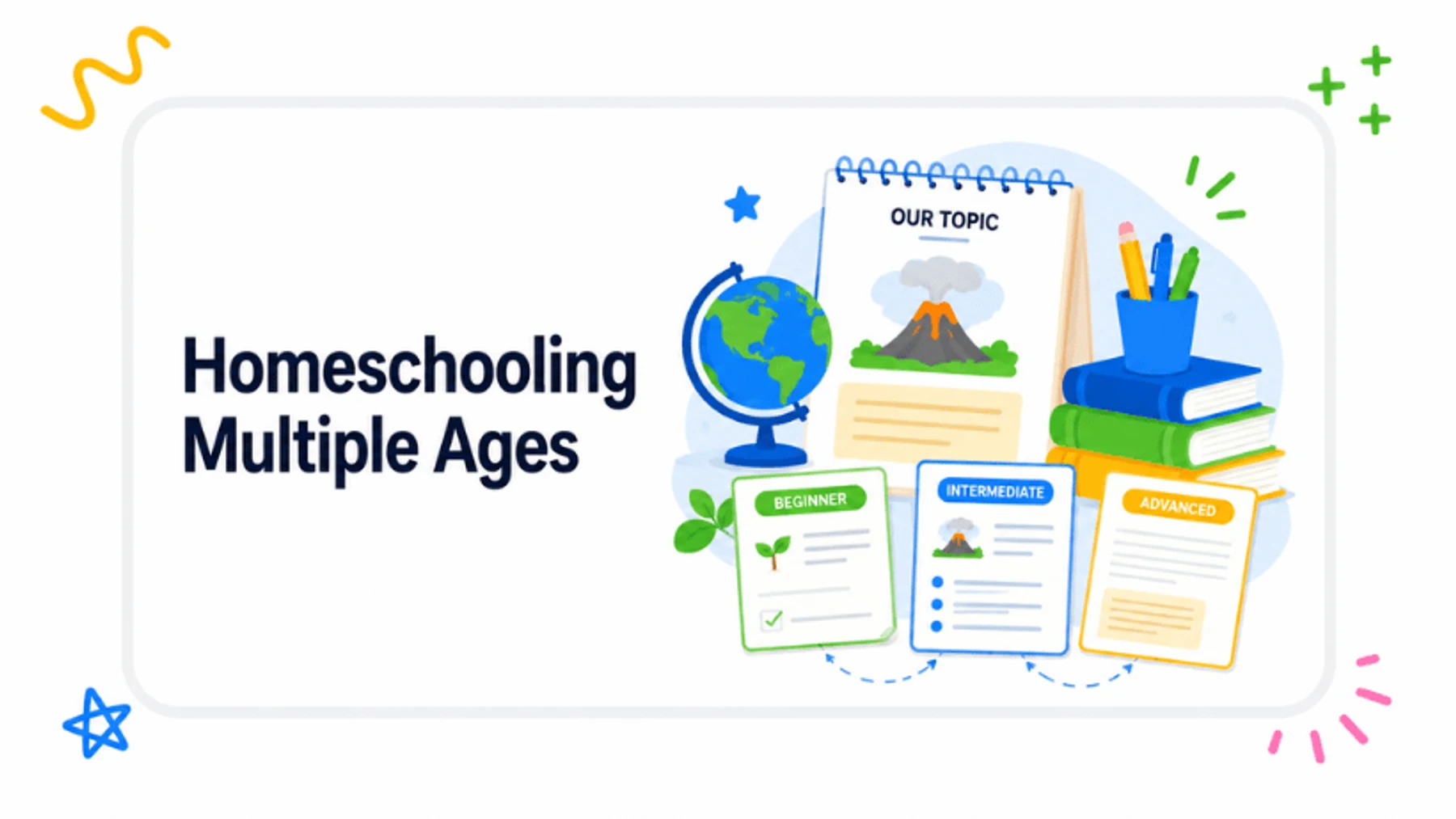
Homeschooling more than one child does not have to mean running a separate school day for every grade level.
The most workable approach is usually a mix:
share what benefits from being shared, separate what truly depends on level, and rotate your direct attention instead of trying to teach everyone at once.
A useful planning formula is:
Shared Content → Different Access → Different Output → Individual Skill Work
For the broader homeschool system around schedules, workload, independence, curriculum choices, and flexible learning, start with Homeschool Without the Overwhelm.
Start by Separating Content From Skills
Some subjects are naturally easier to share across ages because everyone can explore the same big idea.
These often include:
- science topics
- history
- geography
- biographies
- art and music
- family read-alouds
- nature study
- projects
- discussions
Other areas usually depend more heavily on a child's current sequence or skill level:
- phonics and decoding
- math
- spelling
- handwriting
- composition instruction
- targeted intervention
- some grammar skills
You do not need to choose between “everyone together” and “everyone separate.” Use both on purpose.
Keep the Topic Shared When It Saves Real Work
Suppose everyone is studying weather.
You can share:
- the opening discussion
- a documentary clip
- an experiment
- a map or diagram
- a family project
- the final conversation
Then change the reading or task for each child.
A younger child might learn about clouds. A middle reader might study how thunderstorms form. An older child might explore air pressure, supercells, or tornado formation.
If you want one topic with several ways in, PicoBuddy Themes can provide a shared topic world with reading and related activities. Curated Lists are useful when you mainly want several ready-made texts around one subject.
The point is not to put every child on the same worksheet. It is to reduce the number of completely unrelated lessons you have to prepare.
Change the Access Level
Children can learn about the same subject through different text difficulty, length, vocabulary, or support.
For reading, you might:
- give one child a shorter text
- read part of a passage aloud
- let another child read independently
- use different question depth
- provide vocabulary support for one learner
- ask an older learner to compare two sources
PicoBuddy's reading passage library lets you start from topic and grade. If you already have the right topic but need another level, Remix can adapt the same passage topic to another level or language.
That is one example of a broader multi-age principle: keep the content connection while changing the access point.
Change the Output Too
Shared learning does not require identical assignments.
After the same family science topic:
Younger learner
- tell three facts
- draw and label
- sort pictures
- answer orally
Middle learner
- write a short summary
- answer focused questions
- explain a sequence
- compare two ideas
Older learner
- analyze evidence
- compare sources
- write an explanation
- research a follow-up question
The shared topic creates family connection. The output keeps the learning appropriate.
Rotate Your Direct Attention
The hardest part of multi-age homeschool is often not curriculum. It is parent attention.
Try planning blocks by who needs you most.
For example:
Block 1
- Child A: direct math lesson with parent
- Child B: independent reading or known practice
- Child C: self-starting task or project
Block 2
- Parent rotates to Child B
- Child A practices independently
- Child C continues or changes task
Do not expect every child to begin the year fully independent. Build self-starting tasks gradually so your attention can rotate without the whole room stopping.
One Sample Family Day
Imagine three children at different levels.
Shared start
Breakfast read-aloud or family discussion.
Core rotation
Each child gets the direct help they need for math, reading, writing, or another sequential skill.
Shared content block
Everyone studies one science or history topic, but with different texts or output.
Independent finish
Older children complete checklist work. Younger children finish a short familiar task, read, play, or work on a hands-on extension.
Shared close
Come back together for one question:
“What did you learn that the others might not know yet?”
The different levels become useful rather than something you must hide.
Know When Sharing Is Creating More Work
A shared topic is not always the right choice.
Separate work may be better when:
- one child needs a very specific intervention
- the topic has become too easy or repetitive for an older learner
- simplification makes the material unnatural
- interests are so different that the shared topic creates resistance
- an older child needs sustained independent study
- the parent spends more time adapting the shared lesson than separate materials would take
Family-style learning is a tool, not an ideology.
Use a Shared / Separate / Independent Grid
For next week, make three columns.
Shared
Which topics, read-alouds, projects, or discussions can everyone join?
Separate
Which sequential skills truly need individual teaching?
Independent
What can each child start or continue while you work with someone else?
Then build your day around those categories rather than around three completely separate grade-level timetables.
Multi-age homeschool becomes more manageable when you stop trying to synchronize everything. Share the world. Separate the skill work. Rotate the support.
Frequently Asked Questions
Related Articles
Helping kids read better, together.
Like this article? Join 500+ educators using PicoBuddy to generate high-quality reading materials in seconds.