
Fiction vs Nonfiction Reading Comprehension: What’s the Difference?
Fiction and nonfiction reading passages build different comprehension skills. Learn when to use each, what questions to ask, and how to balance both in elementary reading practice.
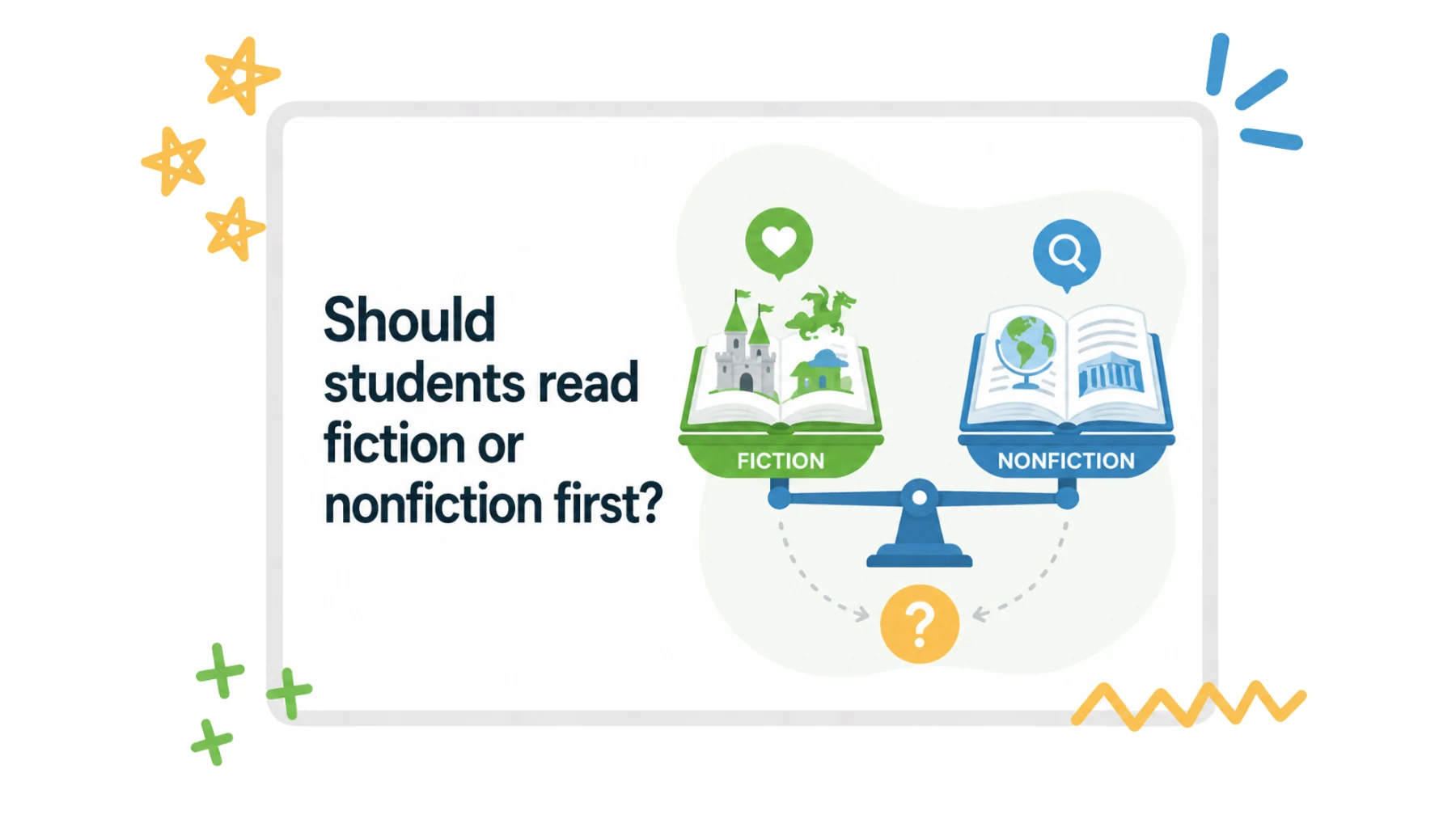
Fiction and nonfiction both help students build reading comprehension, but they do it in different ways.
A fiction passage asks students to understand a story. Students think about characters, setting, plot, feelings, conflict, theme, and what the author might be showing through the story.
A nonfiction passage asks students to understand information. Students think about facts, main idea, details, vocabulary, text structure, author’s purpose, and what the text is explaining or teaching.
Students need both. Fiction helps students understand stories, emotions, and meaning. Nonfiction helps students build knowledge, vocabulary, and academic reading skills.
Once you have chosen a text type, our elementary reading comprehension guide can help you connect it to a lesson goal, useful questions, and a reading routine.
What is fiction reading comprehension?
Fiction reading comprehension means understanding made-up stories.
In fiction, students usually read about characters, settings, events, problems, and solutions. The passage may be realistic, funny, emotional, adventurous, mysterious, or completely imaginative.
When students read fiction, they often need to understand:
- Who the characters are
- Where and when the story happens
- What problem the character faces
- What happens first, next, and last
- How a character feels
- Why a character makes certain choices
- How the character changes
- What lesson or theme the story may show
For example, a fiction passage about a nervous student joining a new soccer team may help students think about friendship, courage, character feelings, and problem solving.
Common fiction comprehension questions include:
- Who is the main character?
- Where does the story take place?
- What problem does the character have?
- How does the character feel at the beginning?
- How does the character change by the end?
- What lesson can you learn from the story?
- What can you infer from the character’s actions?
Fiction is especially useful when the reading goal is story understanding, inference, discussion, emotional connection, or theme.

What is nonfiction reading comprehension?
Nonfiction reading comprehension means understanding factual or informational texts.
In nonfiction, students read to learn about real people, places, animals, events, processes, ideas, or topics. A nonfiction passage might explain how volcanoes erupt, why bees are important, what life was like in ancient Egypt, or how teamwork helps athletes.
When students read nonfiction, they often need to understand:
- The main idea
- Important details
- Facts and explanations
- Vocabulary in context
- Cause and effect
- Compare and contrast
- Sequence or steps in a process
- Text features
- Author’s purpose
- Evidence from the text
For example, a nonfiction passage about sea turtles may help students learn about habitats, life cycles, predators, conservation, and scientific vocabulary.
Common nonfiction comprehension questions include:
- What is the passage mostly about?
- Which detail supports the main idea?
- What does this word mean in the passage?
- Why did this event happen?
- How are these two ideas alike and different?
- What is the author trying to explain?
- Which sentence gives evidence for the answer?
Nonfiction is especially useful when the reading goal is knowledge building, vocabulary, main idea, details, science, social studies, or academic reading practice.

Fiction vs nonfiction: the main difference
The main difference is that fiction tells a story, while nonfiction explains real information.
Both can be used for reading comprehension practice, but they usually require different kinds of thinking.
| Area | Fiction | Nonfiction |
|---|---|---|
| Purpose | Tell a story | Explain, inform, or teach |
| Content | Made-up characters and events | Real facts, topics, people, or ideas |
| Common skills | Plot, character, theme, inference | Main idea, details, vocabulary, text structure |
| Questions often ask | What happened? Why did the character act that way? | What does the text explain? What evidence supports it? |
| Best for | Story understanding, empathy, discussion | Knowledge building, academic vocabulary, informational reading |
Fiction often asks students to follow a story and understand meaning. Nonfiction often asks students to organize information and learn from facts.
For example:
A fiction passage about a child finding an injured bird may ask students to understand the character’s feelings and the lesson of the story.
A nonfiction passage about birds may ask students to understand facts about feathers, nests, migration, or habitats.
Both passages can be valuable. They simply teach different reading skills.

Why fiction is important for reading comprehension
Fiction is important because it helps students understand stories, people, emotions, and meaning.
Many young readers naturally connect with fiction because stories feel familiar. A story has a beginning, middle, and end. It has characters who want something, feel something, or face a problem.
Fiction helps students practice:
- Following a sequence of events
- Understanding character motivation
- Making inferences
- Identifying theme
- Discussing feelings and choices
- Noticing point of view
- Understanding story structure
- Building empathy and imagination
For example, a story about a child moving to a new school can help students discuss fear, friendship, change, bravery, and kindness.
Fiction passages are especially useful for:
- Early readers
- Reluctant readers
- Discussion-based lessons
- Character and theme work
- Social-emotional topics
- Creative writing follow-up
- Inference practice
Fiction also gives students a safe way to talk about real feelings and situations through made-up characters.
Why nonfiction is important for reading comprehension
Nonfiction is important because it helps students read to learn.
As students move through elementary school, they are expected to understand more science, history, geography, biographies, health topics, and real-world information. Nonfiction helps them build the vocabulary and background knowledge they need for school.
Nonfiction helps students practice:
- Identifying the main idea
- Finding supporting details
- Learning academic vocabulary
- Understanding facts
- Using text evidence
- Building background knowledge
- Reading science and social studies content
- Understanding cause and effect
- Comparing information
- Understanding text structure
For example, a passage about animals can teach students facts about habitats, life cycles, predators, and conservation. It can also introduce words like hatchling, migrate, protect, and endangered.
Nonfiction passages are especially useful for:
- Science topics
- Social studies topics
- Vocabulary building
- Test preparation
- Knowledge-building lessons
- Older elementary students
- ESL and ELL students when the topic is familiar
Nonfiction helps students become stronger academic readers because it teaches them how to learn from text.

How comprehension questions differ for fiction and nonfiction
A good reading comprehension question should match the text type.
Fiction questions often focus on story elements, character actions, feelings, and theme. Nonfiction questions often focus on main idea, facts, vocabulary, evidence, and explanation.
| Skill | Fiction question example | Nonfiction question example |
|---|---|---|
| Main idea | What is the story mostly about? | What is the passage mostly explaining? |
| Details | What did the character find? | Which detail explains how turtles lay eggs? |
| Inference | Why did the character stay quiet? | Why might this animal be hard to find? |
| Vocabulary | What does “whispered” show about the character? | What does “habitat” mean in the passage? |
| Evidence | Which sentence shows the character was nervous? | Which sentence supports the main idea? |
| Author’s purpose | Why did the author include this event? | Why did the author write this passage? |
For fiction, students may need to think about what a character feels or why an event matters.
For nonfiction, students may need to think about what the author is explaining and which facts support the idea.
This is why fiction and nonfiction should not always use the exact same question types. The questions should fit the purpose of the text.
To learn more about writing strong questions, see What makes a good reading comprehension question?
Which is easier: fiction or nonfiction?
Fiction is often easier for young readers because stories have characters, feelings, and events. Many children understand stories naturally because they hear and tell stories in everyday life.
But nonfiction can be easier when the topic is familiar or highly interesting.
For example:
- A child who loves animals may find a nonfiction animal passage easier than a fantasy story.
- A child who loves adventure may find fiction more motivating than a fact-based text.
- An ELL student may understand nonfiction about school or food more easily than fiction with idioms or figurative language.
- A child with strong background knowledge about dinosaurs may understand a nonfiction dinosaur passage very well.
Difficulty depends on several things:
- Topic familiarity
- Vocabulary
- Sentence length
- Background knowledge
- Text structure
- Student interest
- Question difficulty
- Passage length
So instead of asking, “Is fiction or nonfiction easier?” it is better to ask:
Which passage is clearer, more interesting, and better matched to this student’s level?
For more guidance on where to start, see Should students read fiction or nonfiction first?
Fiction and nonfiction by grade level
Students should read both fiction and nonfiction in every grade. But the balance and difficulty often change as students grow.
| Grade | Fiction focus | Nonfiction focus |
|---|---|---|
| Grade 1 | Characters, setting, simple events | Simple facts and familiar topics |
| Grade 2 | Sequence, problem and solution | Details and basic vocabulary |
| Grade 3 | Main idea, inference, story elements | Main idea, facts, vocabulary |
| Grade 4 | Theme, character change, inference | Text evidence, cause and effect |
| Grade 5 | Theme, point of view, deeper analysis | Author’s purpose, structure, evidence |
In Grade 1, fiction can be a gentle starting point because stories are often simple and familiar. But students can still read simple nonfiction about animals, weather, food, families, or school.
In Grade 2, students can begin comparing simple stories and informational passages. They can answer questions about sequence, details, and basic vocabulary.
In Grade 3, nonfiction becomes more important. Students begin working with main idea, supporting details, and vocabulary in context.
In Grade 4, students are usually ready for more evidence-based questions. They can explain how details support an answer.
In Grade 5, students should practice deeper analysis in both fiction and nonfiction. They may compare ideas, identify theme, explain author’s purpose, and use evidence from the passage.
To see how these skills build step by step across each grade, read How Reading Comprehension Develops from Grade 1 to Grade 5.
Should teachers and parents pair fiction and nonfiction?
Yes. Pairing fiction and nonfiction on the same topic is often one of the best ways to build reading comprehension.
When students read both text types on the same topic, they connect story, facts, vocabulary, and background knowledge.
For example, if the topic is volcanoes, students could read:
- A fiction passage about a child visiting a volcano museum
- A nonfiction passage about how volcanoes erupt
The fiction passage gives students a story and emotional connection. The nonfiction passage gives them facts, vocabulary, and real-world knowledge.

Here are more examples:
| Topic | Fiction passage | Nonfiction passage |
|---|---|---|
| Space | A story about a moon adventure | Facts about the Moon |
| Friendship | A story about solving a conflict | What makes a good friend? |
| Animals | A story about a rescued turtle | Facts about sea turtles |
| Texas | A story set in Texas | Facts about Texas geography or history |
| Sports | A story about a nervous soccer player | How teamwork helps athletes |
Pairing fiction and nonfiction can help students:
- Build vocabulary
- Compare text types
- Discuss a topic more deeply
- Connect facts and stories
- Use one topic across multiple lessons
- Strengthen background knowledge
- Stay more engaged
- Practice both story and informational reading
This approach can also work well for mixed-level classrooms. Students can explore the same topic through different texts, levels, and question types.
With PicoBuddy Remix, you can adapt a passage to a different reading level or language while keeping the same topic. Learn more about Remix.
Fiction vs nonfiction for ESL and ELL students
For ESL and ELL students, the best text type depends on clarity, topic familiarity, vocabulary, and support.
Fiction can help English learners because stories have characters and events. A familiar story about school, family, pets, or friendship can be easier to discuss.
Fiction can support ELL students with:
- Character names and actions
- Clear events
- Familiar feelings
- Simple dialogue
- Everyday situations
- Story retelling
Nonfiction can also be very helpful because it builds useful vocabulary and real-world understanding. A nonfiction passage about food, weather, animals, sports, or school may be easier than a fiction passage with figurative language or unfamiliar cultural references.
Nonfiction can support ELL students with:
- Real-world vocabulary
- Clear topics
- Facts and examples
- Headings and structure
- Visual support
- Background knowledge
For ESL and ELL students, it often helps to:
- Use short passages
- Choose familiar topics
- Pre-teach key vocabulary
- Ask clear questions
- Pair fiction and nonfiction on the same topic
- Use visuals when possible
- Adjust the reading level when needed
For example, students could read a fiction passage about a child playing soccer, then a nonfiction passage about teamwork in soccer. The shared topic makes vocabulary easier to remember and gives students more chances to understand the content.
How to choose between fiction and nonfiction
The best choice depends on your reading goal.
Choose fiction when the goal is:
- Story structure
- Character understanding
- Theme
- Point of view
- Emotional engagement
- Motivation
- Discussion
- Inference from character actions
- Creative writing
Choose nonfiction when the goal is:
- Main idea
- Facts and details
- Academic vocabulary
- Background knowledge
- Science or social studies content
- Author’s purpose
- Text evidence
- Cause and effect
- Compare and contrast
Choose both when the goal is:
- Deeper topic understanding
- Comparison
- Vocabulary reinforcement
- Balanced reading practice
- A multi-day lesson
- Mixed-level classroom practice
- Connecting knowledge and story
- Student engagement
A simple rule is this:
Use fiction to help students understand stories and people. Use nonfiction to help students understand information and the world. Use both to build strong, flexible readers.
Can PicoBuddy help with fiction and nonfiction reading passages?
Yes. PicoBuddy helps teachers, parents, and homeschool families find and create fiction and nonfiction reading passages by grade, topic, and text type.
You can browse ready-made passages or create a custom passage for a specific reading goal.
For example, you might create:
- A Grade 3 fiction passage about friendship
- A Grade 3 nonfiction passage about friendship
- A Grade 4 fiction passage set in Texas
- A Grade 4 informational passage about Texas
- A Grade 5 fiction passage about sports
- A Grade 5 informational passage about teamwork
This is useful when you want students to practice both story comprehension and informational reading on the same topic.
Need fiction and nonfiction passages on the same topic? Browse PicoBuddy’s free reading passages or create your own custom passage by grade, topic, and text type.
Final thoughts
Fiction and nonfiction both build reading comprehension, but they build different parts of it.
Fiction helps students understand stories, characters, emotions, plot, theme, point of view, and inference.
Nonfiction helps students understand facts, vocabulary, main idea, details, evidence, author’s purpose, and real-world topics.
The best reading plan uses both.
Students should read stories that help them connect emotionally and informational texts that help them learn about the world. When teachers and parents use fiction and nonfiction together, students get a richer, more balanced reading experience.
Browse fiction and nonfiction reading passages on PicoBuddy, or create a custom passage for the exact grade, topic, and reading goal you need.

Frequently Asked Questions
Related Articles
Helping kids read better, together.
Like this article? Join 500+ educators using PicoBuddy to generate high-quality reading materials in seconds.